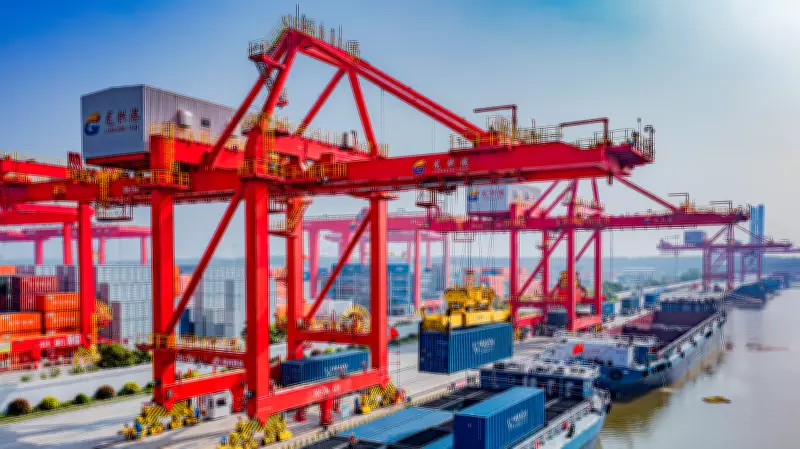
China's zero tariff policy on exports from Africa, which took effect two weeks ago, has been praised as a strategic initiative that will encourage local production and help reposition Africa in the global market.
Speaking at the Lagos Forum themed 'The Successful Practice of Principles of Sincerity, Real Results, Amity, and Good Faith in Africa,' organized by the Consulate-General of the People's Republic of China in Lagos, Research Director for Africa at Zhejiang Normal University, Ikenna Emewu, noted that Africa accounts for only four percent of global exports.
Emewu highlighted the trade imbalance between Nigeria and China, stating that in 2023, the disparity stood at 89.5 percent. 'While China exported about $21 billion worth of goods to Nigeria, our response was $2.37 billion,' he said. He added that for Africa as a whole, the imbalance was 64.5 percent in favor of China, with China exporting $348 billion to Africa and the continent responding with $123.02 billion.

The research director emphasized that a nation cannot achieve prosperity without being a major trader, which depends on its available commodities for exchange. 'The zero tariff gives Africa leverage to grow its economy as it is a policy targeted at bridging the trade balance gap between China and Africa. China, on the other hand, can benefit by gaining more access and outsourcing some production to Africa at reduced costs,' he explained.
Emewu, also Editor-in-Chief of Africa China Economy Magazine, noted that this development could elevate the currency value of nations, as an existing agreement between the People's Bank of China and Ecobank allows transactions using local currencies.
He said China has remained a strong ally of Africa through initiatives such as the African Continental Free Trade Area and its shareholding in the African Development Bank. Africa's trade with China continued to grow, recording a 5.4 percent increase in 2025, while China-Africa trade growth stood at 25.8 percent. Emewu said the new zero-tariff policy is expected to further accelerate Africa's exports to China, stressing that African countries must strengthen local production to fully benefit from the opportunity.
Chinese manufacturing investments in Africa have expanded steadily over the past 15 years, contributing about 12 percent of the continent's manufacturing GDP and 9.5 percent of Nigeria's. Emewu explained that Chinese firms are attracted to Africa due to overcapacity at home and the need to build competitive production bases abroad, create jobs, and increase local consumption. The policy covers both raw materials and finished products, including textiles, processed leather, canned seafood, fruit juice, and construction materials, giving African countries the chance to add value locally before exporting to China.
Emewu said the new trade regime would create jobs across Africa as demand for production and export activities rises. He also pointed to recent financial agreements aimed at strengthening Nigeria-China trade, including Stanbic IBTC Bank's loan deal with the China Development Bank and Ecobank's currency swap agreement with the People's Bank of China.
Consul General's Remarks
Consul General of China in Lagos, Yan Yuqing, said the principles of China's African policy showcase the sincerity surrounding China's relations with Africa. She stated that the zero tariff policy is a major step in how China upholds the principles of sincerity, real results, amity, and good faith, as well as the principle of pursuing greater good and shared interests with Africa.
According to her, over the past seven decades, China-Africa friendship has transcended time and space, with its spirit passed down from generation to generation. 'Since the dawn of the new era, under the joint vision and leadership of President Xi Jinping and African leaders, China-Africa relations have achieved leapfrog development,' she noted.
She said President Xi Jinping's Global Development Initiative places development and people at the center of China's cooperation with Africa, while promoting South-South cooperation and high-quality Belt and Road projects. The Global Security Initiative encourages countries to resolve disputes through dialogue and peaceful means, adding that China remains committed to supporting Africa's peace and security efforts and strengthening the China-Africa security partnership.

Yuqing said China-Africa cooperation has continued to produce visible results in Nigeria, citing the newly completed ECOWAS headquarters in Abuja, the Lekki Deep Sea Port, and the Lagos Blue Line Rail project. She added that China had also supported humanitarian programs in Nigeria, including cataract surgeries for nearly 500 patients and food support for more than 1,000 low-income households through joint charity initiatives.
Academic Perspective
Lecturer at the Faculty of Arts, University of Lagos, Dr. Adetoro Banwo, said China's sincerity towards Africa can be seen in its support for governance, healthcare, and sustainable development across the continent. According to him, the Forum on China-Africa Cooperation Action Plan for 2025-2027 focused on programs covering medical support, trade, poverty reduction, digital innovation, green development, and capacity building.
Banwo said China's 'real results' were visible in infrastructure projects across Africa under the Belt and Road Initiative. He cited the TAZARA railway linking Zambia and Tanzania as one of the continent's most significant projects, while noting that railway projects in Nigeria, including the Abuja-Kaduna line, had improved transportation and opened up communities for economic growth.
On the principle of good faith, Banwo said China had supported Africa in peacekeeping, conflict resolution, and economic development. He noted that China had contributed to United Nations peacekeeping operations in South Sudan and supported mediation efforts in the Horn of Africa.