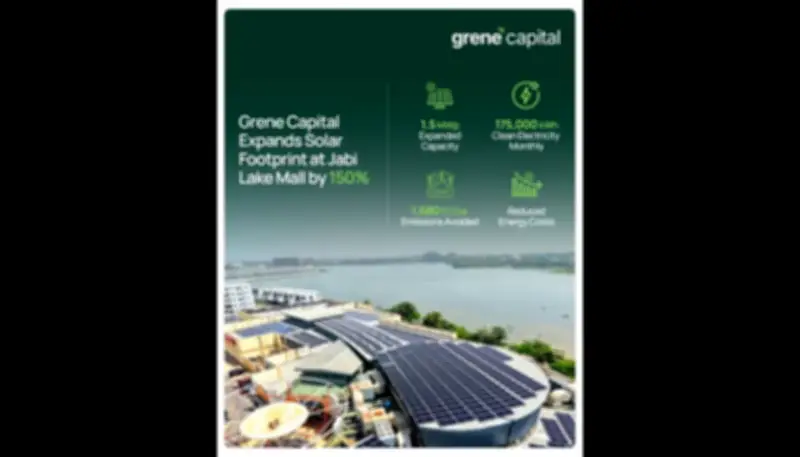
Grene Capital, a renewable energy investment firm, has expanded the solar installation at Jabi Lake Mall in Abuja by 150%, increasing the total installed capacity to 1.5 megawatts peak (MWp). The expansion adds 900 kilowatts peak (kWp) to the existing 600kWp system, making it one of the largest commercial rooftop solar projects in Nigeria.
Project Details and Energy Impact
The upgraded solar plant now covers approximately 60% of the mall's rooftop area, with over 4,000 solar panels installed. According to Grene Capital, the system is expected to generate about 2.1 million kilowatt-hours (kWh) of electricity annually, offsetting roughly 1,500 tonnes of carbon dioxide emissions each year. The solar installation now meets up to 50% of the mall's total energy demand, significantly reducing reliance on the national grid and diesel generators.
Grene Capital CEO, Ifeanyi Orajaka, stated: 'This expansion underscores our commitment to providing clean, reliable, and affordable energy solutions to commercial properties in Nigeria. By scaling up the solar capacity at Jabi Lake Mall, we are not only reducing operational costs for the mall but also contributing to the country's renewable energy targets.'

Financial and Operational Benefits
The project was financed through a combination of equity and debt, with Grene Capital partnering with local banks and development finance institutions. The expanded system is expected to save the mall approximately ₦80 million annually in electricity costs, based on current diesel and grid tariffs. Jabi Lake Mall management reported that the solar installation has already reduced their diesel consumption by 70% since the initial phase was completed in 2024.
The expansion aligns with Nigeria's National Renewable Energy and Energy Efficiency Policy (NREEEP), which aims to increase renewable energy's share in the national energy mix to 30% by 2030. Commercial and industrial solar projects like this are seen as crucial to bridging the country's energy deficit, which stands at an estimated 4,000 megawatts.
Technical Specifications and Grid Integration
The solar plant uses bifacial panels and string inverters, with a monitoring system that tracks real-time performance. The system is grid-tied with battery storage backup, allowing the mall to operate independently during grid outages. The battery storage capacity was also expanded as part of the project, now totaling 500 kilowatt-hours (kWh).
Grene Capital has deployed similar projects at other commercial sites across Nigeria, including shopping malls, office complexes, and industrial parks. The company's total installed solar capacity now exceeds 10MWp across various locations.
Market Context and Future Outlook
Nigeria's solar energy market has grown rapidly, driven by rising electricity costs and unreliable grid supply. According to the Nigerian Electricity Regulatory Commission (NERC), commercial and industrial customers pay an average of ₦50 per kWh for grid electricity, while diesel generators cost over ₦200 per kWh. Solar power offers a levelized cost of energy (LCOE) of around ₦30-40 per kWh, making it increasingly attractive for businesses.
Industry analysts project that Nigeria's commercial and industrial solar market could reach 1.5GW by 2030, with investments exceeding $2 billion. Grene Capital's expansion at Jabi Lake Mall is a testament to this growing trend, as more businesses seek to hedge against volatile energy costs and improve their environmental footprint.