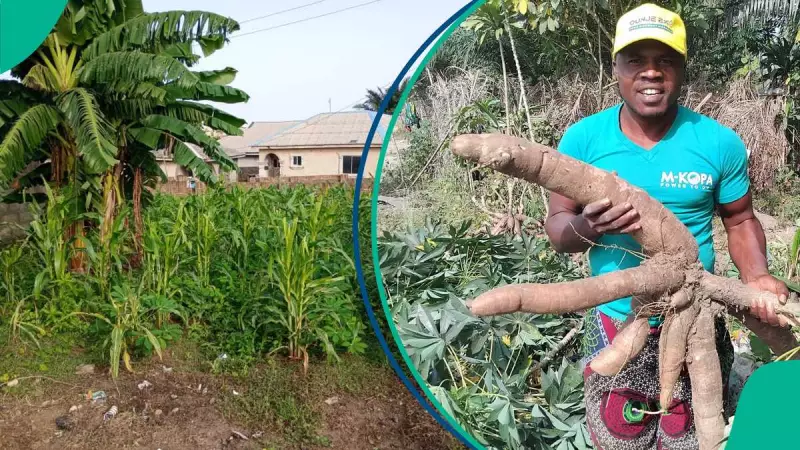
In the face of a severe economic crisis marked by soaring food prices, a resourceful community in Ogun State, Nigeria, has found a lifeline by converting idle lands into productive survival farms. This grassroots movement is helping families to eat healthier and save money, directly tackling the cost-of-living crisis.
From Empty Plots to Family Food Baskets
The initiative is flourishing in the Iwoye-Aiyedokun Area Central Development Council (CDC) within the Ado-Odo/Ota Local Government Area. Here, residents are leveraging favourable soil conditions and unused land to practice small-scale, subsistence agriculture. Since 2023, this practice has gained significant momentum as a direct response to national economic pressures.
Rukayat Ogunjimi, a secondary school teacher, started her 30x40-foot compound farm in Iwoye spontaneously in 2023. Her plot now yields maize, cassava, plantain, spinach, jute leaves, scent leaf, and pineapple. "The soil structure, nutrient cycling, root health…we are blessed, my brother," she said, highlighting the agricultural potential of the area.

Similarly, Ademola Adedokun, a trader and father of four, drew on secondary school agriculture lessons to begin farming in 2022. He started with cocoyam and later expanded to cassava, pawpaw, and vegetables on a borrowed plot near his home. "The current situation in Nigeria has taught me to ‘wise up’," Adedokun stated. He received permission from the Lagos-based landowner to use the idle portion of the property.
A Pragmatic Response to National Challenges
This community-led action unfolds against a backdrop of significant national hardship. President Bola Tinubu's economic reforms, including the removal of the petrol subsidy and naira devaluation since May 2023, have intensified a cost-of-living crisis. Further disruptions to agriculture come from insecurity, including kidnappings in the north and farmer-herder conflicts in the country's central belt.
The residents' approach offers multiple benefits. By growing food locally, they minimize "food miles," reducing the carbon emissions associated with long-distance transportation. They produce staples like cassava flour, pap, and soups for family consumption, with surplus sometimes sold within the community. Aloko Aiyegun, a resident originally from Benin Republic, exemplifies this, stating his cultural inclination towards agriculture. The model requires minimal capital, no paid labour, and eliminates transport costs.
Leadership Endorsement and Local Hurdles
The push for subsistence farming has been echoed by prominent figures. In April 2024, Nonye Soludo, wife of the Anambra State governor, urged Nigerians to adopt backyard gardening to cope with economic realities. Similarly, Nigeria's First Lady, Remi Tinubu, used her X (formerly Twitter) account in July 2024 to promote the #EveryHomeAGarden initiative, sharing pictures of her own garden.
However, the practice in Iwoye-Aiyedokun faces local challenges, primarily from free-ranging livestock like sheep and goats that browse on crops. This has led to conflicts among residents. In response, Baale Dada Adio, the traditional ruler, enacted a regulation banning straying animals to mitigate these issues and protect the farms.
The story of Iwoye-Aiyedokun demonstrates a powerful, community-driven strategy for enhancing food security. By transforming unused spaces into sources of nourishment, these residents are not just waiting for economic relief but are actively cultivating their own resilience and sustainability.