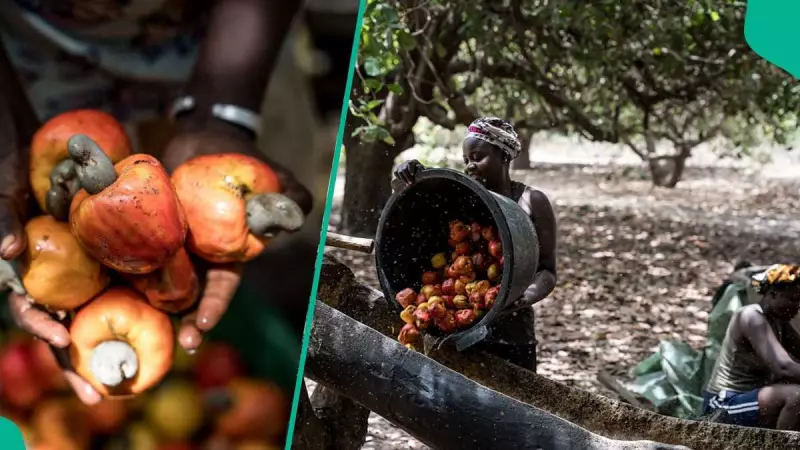
The National Cashew Association of Nigeria (NCAN) has projected that Nigeria possesses the capacity to generate a staggering $10 billion in annual revenue from its cashew industry. This immense financial potential, however, remains locked due to persistent challenges including weak local processing capacity and inadequate data management.
Untapped Potential and Policy Hurdles
Dr. Ojo Joseph Ajanaku, the National President of NCAN, made this revelation during a press briefing in Abuja ahead of the forthcoming Nigeria Cashew Day 2026. He emphasized that Nigeria's vast land, growing population, and access to international markets provide a natural foundation for global leadership in cashew production and processing.
"Nigeria has the land, the people and the market access to dominate the global cashew industry. What we lack is the right policy environment and sufficient local processing," Ajanaku stated. He identified weak policy frameworks and limited processing infrastructure as the primary brakes on the sector's progress.

Nigeria Cashew Day Aims for National Policy and Ownership
The Nigeria Cashew Day initiative, which began in Benin in 2023 and has been held in Enugu (2024) and Lagos (2025), is designed to unite stakeholders across the value chain. The 2026 edition is scheduled for Abuja to facilitate direct engagement with the Federal Government.
"Our aim is to have a national cashew policy that is owned by Nigerians, not imposed by external interests," Ajanaku explained. He stressed the desire for a policy that protects the industry, promotes organic cashew cultivation, and ensures Nigerians retain full ownership of their produce.
Exporting Raw Nuts Costs Jobs and Revenue
Ajanaku highlighted the significant economic loss Nigeria suffers by exporting raw, unprocessed cashew nuts. This practice deprives the nation of job creation, added revenue, and foreign exchange earnings that would come from local value addition.
He pointed to Kogi State, a leading cashew producer, as a stark example. "Kogi is one of the leading cashew-producing states in Nigeria, yet it has no single cashew factory. If factories are located in producing areas, our children will be employed and rural economies will grow," he said. He called on state governments to provide incentives to attract investors into local processing.
Data Deficits and Illegal Exports Undermine Growth
A major concern raised by the NCAN president is the lack of reliable production data. Nigeria currently relies heavily on export figures to estimate total output, a flawed method compounded by significant illegal exports.
"We don't have the correct statistical structure to determine how many cashews we produce. Worse still, a large volume leaves the country without records, as exporters bypass official procedures," Ajanaku noted. Officially, documented exports from the last season exceeded 400,000 metric tonnes, valued at about $700 million, though actual figures are believed to be much higher.
By-Products Offer Additional Billion-Dollar Stream
Looking forward, Ajanaku expressed optimism about scaling production to over 2 million metric tonnes annually within five years, with a long-term potential exceeding 4 million tonnes. At a conservative price of $1,500 per tonne, 2 million tonnes would generate $3 billion, excluding revenue from by-products.
He specifically mentioned Cashew Nut Shell Liquid (CNSL) and residue cake, which are often wasted locally but can fetch about 95 cents per kilogram internationally. "If we process what we produce locally and fully exploit the value chain, Nigeria can earn a minimum of $10 billion annually from the cashew industry," Ajanaku concluded. He believes the upcoming Nigeria Cashew Day will be pivotal in positioning the country as a prime destination for global cashew investment, contingent on the right policy decisions.