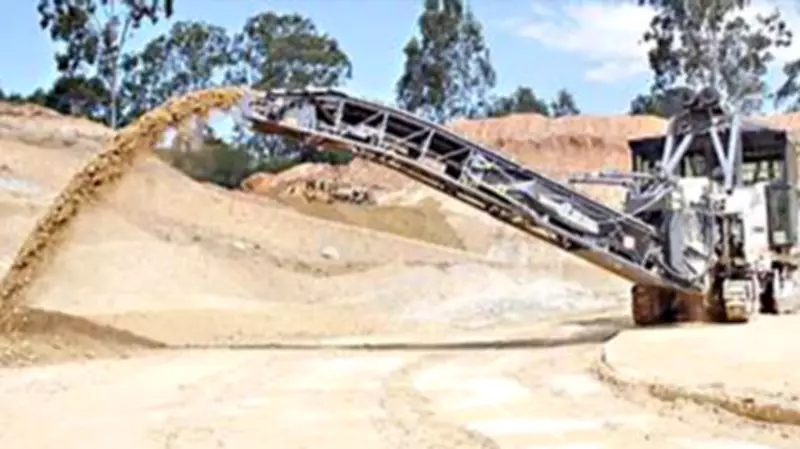
Rising demand for construction materials has triggered a surge in indiscriminate mining of sand, granite and laterite across Nigeria. Experts warn that without strict zoning, environmental safeguards and stronger enforcement, the country risks worsening coastal erosion, biodiversity loss and damage to critical national infrastructure, VICTOR GBONEGUN reports.
Unlicensed operations undermine sustainability
The operations of local and foreign investors involved in unlicensed sand dredging activities are increasingly undermining economic and environmental sustainability, as the costs of indiscriminate mining on communities and national revenue continue to expand across states. In many growing cities and urban centres, unregulated dredgers are extending operations into rivers and coastlines to meet rising demand for construction materials. The development has raised concerns about the inadequacy of regulatory oversight and institutional capacity to halt illegal operations.
Uncontrolled sand, granite and laterite mining pose significant challenges to communities and infrastructure, while also disrupting and degrading ecosystems. The sand mining industry has seen an exponential rise in investment, accompanied by the proliferation of operators with little or no technical expertise, leading to unsustainable operations that harm host communities.

Scope of sand mining activities
Sand mining involves the removal of sand from open pits, beaches, inland dunes, rivers and ocean beds through dredging. The activity has spread to locations such as Mowe, Amo, Agboro, and Alagada in Ogun State, as well as parts of Lagos, Rivers, Oyo, Osun, Delta, Akwa Ibom, Benue, Imo, Abia, Edo, and Anambra states. However, several of these locations are becoming increasingly ecologically fragile.
For operators with stronger expertise, heavy equipment such as dredgers and excavators are deployed to scoop sand and stockpile it for sale to truckers. However, unchecked mining of sand, laterite and granite often leaves land unsuitable for housing or infrastructure projects, while also causing depreciation in land value and leaving deep pits across communities.
Construction boom drives demand
With rapid urban migration and population growth fuelling a construction boom, demand for housing continues to rise. Public and private developers are making efforts to bridge Nigeria’s estimated housing deficit between 16 to 28 million. Nigeria’s immediate past Minister of Housing and Urban Development, Ahmed Dangiwa, had stated that at least 550,000 new homes must be built yearly over the next decade to meet housing demand. The situation has further increased demand for sand, a critical construction material required from the foundation to completion stages of building projects.
Both foreign nationals and indigenous community members are involved in the activity, particularly in riverine and coastal areas with large sand deposits. However, foreign operators are believed to dominate the business alongside local dredgers. Sand extracted from lagoons and coastal areas is used for concrete production, road construction and land reclamation.
Weak enforcement persists
Despite existing laws, enforcement by relevant agencies remains weak, allowing illegal sand mining to persist due to high demand for materials used in roads, bridges and housing projects. The Guardian gathered that some operators pay royalties to local leaders in host communities and also allegedly settle security personnel to avoid disruptions during operations. These agreements sometimes last between five and 10 years.
Mining operations often involve dredgers working in rivers or blasting rocks in quarries on lands reportedly owned by some foreign nationals, particularly in Ogun State. Heavy-duty trucks are then used to transport extracted materials to end users. The prices and profits involved in the trade are substantial. A 30-tonne truckload of sharp sand is reportedly sold for between N285,000 and N300,000, depending on demand and location.

It was also gathered that landowners, popularly referred to as Omo-Onile, allegedly sell lands with huge deposits of sand and laterite to interested local and foreign investors for large sums. Sources told The Guardian that villagers often lease such lands for between N800,000 and over N1.5 million per acre yearly, depending on the estimated volume of deposits.
A source who requested anonymity said, “It happened in my area. None of those places belongs to the Chinese. Nigerians bought the land and handed it over to the Chinese to operate. One of the Baales even reclaimed part of the land through court action and is now running his own dredging site under foreign management.”
A construction professional identified on X as Arakunrin Iyelola recently raised concerns about the trend. “I bought sand from Chinese men and signed a receipt written in Chinese. I was running a construction project and needed sharp sand urgently. The sand was being pumped directly from the river in large quantities. Chinese men bought the land and our sand became their business,” he posted.
Community involvement and impacts
In the South-East, another source said local communities and their leaders allocate dredging sites to investors in exchange for royalties. “They pay the community and extract sand for years before moving to another location,” the source explained. Many affected areas are rendered unbuildable due to mining pits, reducing available land for housing and contributing to rising housing costs in rural communities. Mining pits also weaken road infrastructure, resulting in erosion, flooding and eventual road collapse.
“Those who are dredging the waterfront, it seems to be some kind of caucus now. You cannot just go into that business without experience. Most people using the sand and laterite supplied by operators do not understand what happens underground,” a source told The Guardian.
A builder, who pleaded anonymity, said community leaders and landowners often play central roles in sand mining activities. “You cannot go into those areas and start mining either government land or private land without the knowledge of community leaders,” the source said. He added, “You cannot just enter the business without experience. You must have passed through people already involved in dredging.”
Environmental consequences
Experts warn that unchecked mining erodes soil, destabilises riverbanks and alters drainage systems, thereby increasing flood risks. Sand mining also destroys aquatic habitats, affects microorganisms and pollutes groundwater, negatively impacting fishing, agriculture and other water-dependent livelihoods.
Stakeholders believe governments at all levels, particularly agencies such as state ministries of environment, ministries of energy and mineral resources, and the National Inland Waterways Authority, must strengthen enforcement and curb exploitation that threatens public well-being. Under the Environmental Impact Assessment (EIA) law, environmental studies must be conducted before permits are issued. Dredging equipment is also required to possess valid annual survey and operational permits from NIWA. The law further states that reclamation projects should not begin until all approvals are obtained and that sand transported from sites must be properly covered. However, dredging and transportation activities remain largely uncontrolled in many locations.
Sand mining was recently linked to the loss of livelihoods in Okun Alfa along the Elegushi coastline in Lagos. The Baale of Okun Alfa, Yusuf Olatunji Elegushi Atewolara, attributed recurring ocean surges in the community to dredging activities linked to nearby construction projects. He noted that since dredging activities stopped in the area, the ocean surges had reduced significantly.
Recently, the Lagos State Commissioner for Waterfront Infrastructure Development, Dayo Alebiosu, expressed concern over the dangers associated with indiscriminate dredging across the state. Alebiosu acknowledged that dredging remains necessary for development and land reclamation, but warned that the desperation for sand is exposing the dangers of over-exploiting waterways and coastal resources. He warned that increasing scarcity and rising costs of sand could trigger wider economic, environmental and food security challenges if urgent measures are not taken.
According to him, some developers carrying out reclamation projects in the Lekki-Ajah corridor now source sand from communities as far as Ikorodu, pumping sand across distances of up to 12 kilometres because of depletion in nearby areas. The commissioner said the development highlights mounting pressure on available sand deposits and underscores the need for stricter regulation and accurate data on extraction volumes and operators.
Environmental experts also warn that aggressive dredging disrupts marine ecosystems, destroys aquatic habitats and forces fishermen to travel farther in search of fish.
A former President of the Nigerian Association for Engineering Geology and the Environment, Kingdom Abam, said sand mining has become rampant across the country because of rising demand for reclamation and construction activities. Abam lamented that mining operations are often carried out in a haphazard manner with little regulation. “Where sand mining is rampant, operators obtain licences, but there is hardly any enforcement. The rivers where sand mining takes place are now experiencing serious erosion, threatening bridges and houses along riverbanks,” he said.
According to him, many operators mine indiscriminately without considering the long-term environmental impact. He called for regulations defining safe mining zones and minimum distances from critical infrastructure such as bridges. “Some rivers should not be mined at all because the environmental consequences outweigh the benefits,” he warned.
Abam explained that unregulated dredging alters riverbed topography and increases water flow velocity, thereby worsening erosion. “In some communities, you can already see the foundations of bridges exposed because of mining activities. Drivers crossing such bridges now fear possible collapse,” he said. He urged government agencies to establish scientific guidelines identifying rivers that can or cannot be mined, based on environmental impact assessments.
An environmentalist at the Centre for Environment and Sustainable Development, Prof. Michael Ahovi, linked the persistence of illegal sand mining to poverty and unemployment. “Poverty is deeply entrenched in many communities. In places around Badagry and Akesan in Lagos, people engage in sand mining for survival. Government must educate communities and provide alternative livelihoods,” he said.
Ahovi warned that many communities are gradually losing their lands to foreign interests because of economic hardship. “We are losing those lands to foreigners who eventually become owners of the properties and natural resources. The gap between the people and government is what these foreigners are exploiting,” he added.