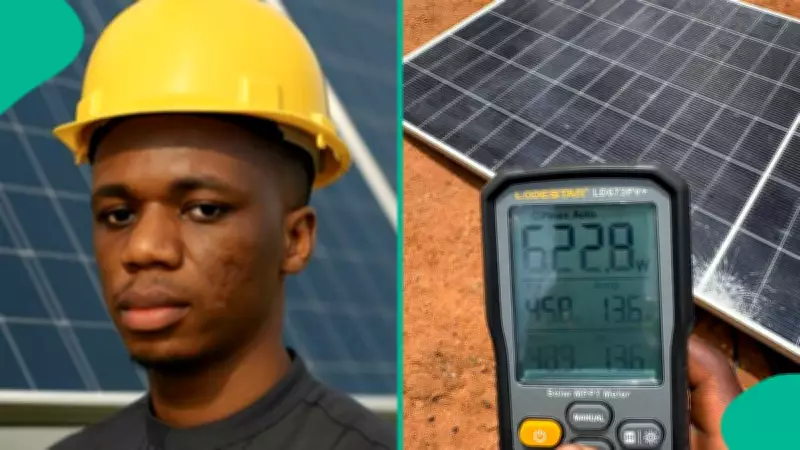
A solar engineer has captured widespread attention on social media after sharing a straightforward technique for distinguishing between high-quality and substandard solar panels. The post, which quickly went viral, provides a simple method that does not require specialized tools or expertise.
Engineer's Demonstration Goes Viral
The account @GbeleePaul on X posted photos of himself testing a solar panel. In the caption, he explained how to identify panels that perform well versus those that do not. The demonstration involved a panel rated at 555W, which during testing generated 622.8W, exceeding its rated capacity. The engineer described the result enthusiastically, calling the panel 'fire' for its impressive performance.
He wrote: 'Testing panels!!! Best way to recognize good and bad panels. 555W panel generating 622.8W. This panel nah fire!!!'

Reactions from Social Media Users
The post quickly attracted comments from Nigerians who shared their thoughts and experiences. Some users expressed surprise at the simplicity of the assessment, while others asked for more details. Notable reactions include:
- Parody asked: 'This panel nah fire!!! Is that a good thing?'
- Ovie advised: 'Put load then take again.'
- Good punter requested: 'Mind sharing your plug?'
- Chukwunedum noted: 'VOC without load right.'
- Livëon Luxe commented: 'Show me the jobs you do to get the fundings to put all this in place? Introduce me sir, so I can replicate.'
- @Mikk remarked: 'Y'all post about solar so much now the government are charging before u use solar in Lagos, make una reduce the way u post about stuff.'
- Pastor Tunde asked: 'What is your advice best number of panels and Accessories to fit a duplex building with 8 rooms, for 8 fan, light bulbs, 2 AC, TVs and 2 refrigerator???'
Broader Context
In related news, a Nigerian landlady recently explained her decision to ban tenants from installing solar panels in her property, citing several grievances. The ongoing discussions highlight the growing interest in solar energy solutions across Nigeria, as well as the challenges and considerations involved in adoption.