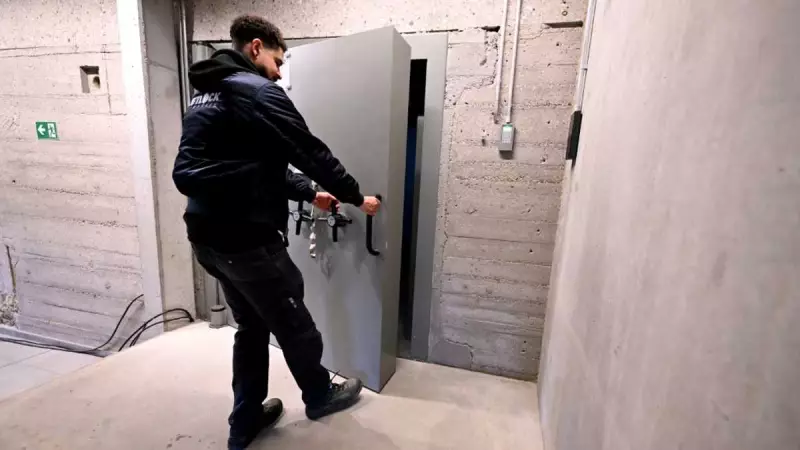
Deep in a confidential location east of Frankfurt, behind a colossal four-tonne steel door, lies Germany's most significant strategic reserve. This isn't a gold vault, but a modern-day treasure chest filled with rare earths—materials at the heart of global technology and rising geopolitical friction.
The Fortified Vault of Modern Technology
Housed within a repurposed World War II bunker under intense video surveillance, the company Tradium operates this secure facility. Specializing in trading these critical materials, Tradium stores thousands of barrels containing elements like dysprosium, terbium, and neodymium. These are not just obscure names; they are the lifeblood of smartphones, electric vehicles, and wind turbines that define our modern world.
In a stark revelation of supply chain dependency, almost all of these materials originate from China, the undisputed global leader in rare earths. According to the International Energy Agency, China controls over 60% of global mining and a staggering 92% of refined production.

Economic Stakes and Geopolitical Realities
The strategic importance of this stockpile is magnified by recent trade tensions. In April, amidst the US-China trade war, Beijing imposed stringent export restrictions, making rare earths subject to licenses that demand the disclosure of industrial secrets. Matthias Rueth, President and founder of Tradium, confirms that these restrictions remain in place, creating significant uncertainty.
The impact is acutely felt in Germany's flagship automotive sector, which relies heavily on rare earth magnets. Rueth reports that nervousness is rising among clients, with some fearing that further shortages could halt production entirely. Despite this, Tradium, a firm with fewer than 40 employees, anticipates a remarkable turnover of 300 million euros ($346 million) this year.
Europe's Dilemma and a Gloomy Forecast
Europe finds itself in a precarious position. Martin Erdmann from the Federal Institute for Geosciences and Natural Resources (BGR) explains that the continent never developed a comparable mining industry, preferring to import materials at lower cost from nations with laxer environmental rules. The United States, once the sector leader, also abandoned production decades ago, cementing China's dominance.
In response, the European Union has adopted the Critical Raw Materials Act, setting ambitious 2030 targets for local extraction, processing, and recycling. However, experts like Erdmann warn that artificially low prices maintained by Beijing make profitable exploitation outside China nearly impossible.
Looking at the immense challenge of catching up, Tradium's founder, Matthias Rueth, offers a sobering conclusion: "It's already too late." He emphasizes that modern life is entirely dependent on these materials, and finding alternatives when they become scarce is exceptionally difficult, leaving European industry highly exposed in a volatile geopolitical landscape.