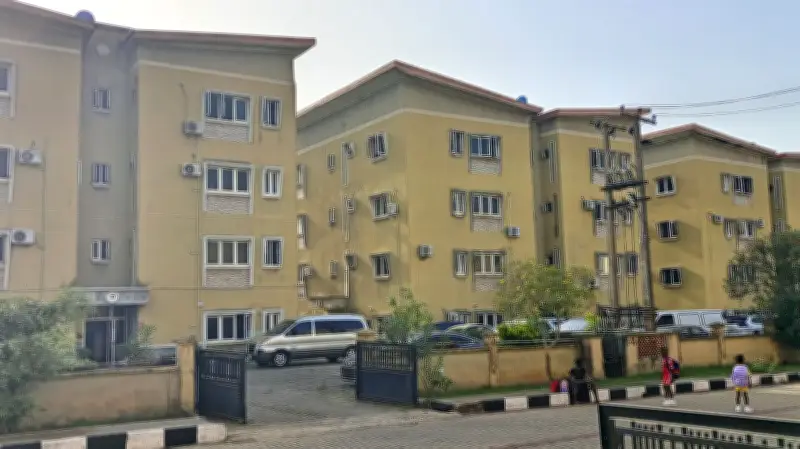
When Lagos introduced mass housing under former Governor Lateef Jakande in the 1980s, civil servants, factory workers and low-income earners could buy homes through instalment payments stretching over 30 years. Four decades later, findings by DevReporting show that many of Lagos' low-cost homes now cost between ₦5 million and ₦25 million, with repayment conditions that exclude 70 per cent of the city's working population, who earn below ₦100,000. Only 7 per cent (1,400,000) of Lagos residents earn above ₦200,000.
Income Mismatch in Housing Schemes
An analysis of government procurement records from 2020 to 2025, housing prices, mortgage requirements, labour income data and interviews with allocatees reveals that a three-bedroom flat under the Lagos Home Ownership Mortgage Scheme requires monthly earnings above ₦343,000 to qualify. Between 2024 and 2025 alone, Lagos awarded at least ₦2.69 billion in housing-related contracts covering estates in Igando, Egan and Badagry. Yet the schemes met only a fraction of the city's annual housing needs while targeting income groups far above those of the urban poor.
For residents like Tajudeen Fajobi, the shift is not just statistical but personal. He received allocation for a three-bedroom flat at Abesan Estate under Jakande's programme in the 1980s, when a 15-year instalment plan totalled ₦9,700. At the time, he was a SCOA Motors worker earning less than ₦250 monthly, yet the scheme made ownership possible over time. Today, those who benefited from the homeownership scheme sell the same flat for between ₦17 million and ₦30 million. What was designed as low-cost housing for low-income earners has become middle-class real estate in Abesan, one of Lagos' oldest public housing estates.

Affordability Calculations
At Lateef Kayode Jakande (LKJ) Gardens in Igando, a 492-unit estate commissioned in recent years, three-bedroom flats sell for ₦10 million through the LagosHOMS rent-to-own arrangement. It requires a 5 per cent down payment (₦500,000 plus ₦250,000 in fees) and monthly deductions of ₦103,000 for 10 years at 6 per cent simple interest. Standard mortgage lending recommends allocating no more than 30 per cent of income to housing, meaning that ₦103,000 in monthly payments requires a minimum income of ₦343,000.
Lagos Bureau of Statistics and labour market studies indicate approximately 70 per cent of the city's workforce operates in the informal sector, with median monthly earnings between ₦50,000 and ₦120,000. For a trader earning ₦100,000 monthly, the ₦103,000 payment consumes 103 per cent of income, which is mathematically impossible. For the minimum-wage earner earning ₦70,000, it exceeds their entire salary by 47 per cent.
Documentation Barriers for Informal Workers
Beyond price, the application process itself excludes informal workers. Lagos HOMS requires six months of bank statements showing regular deposits, payslips proving formal employment, a LASSRA card (Lagos residency proof), a guarantor letter from the employer or government official, and a ₦20,000 application form fee. For informal workers who dominate Lagos' labour market, these documents are precisely what they lack. Market traders banking irregularly have no six-month statements, artisans paid in cash have no payslips, and day labourers have no employers to provide guarantor letters.
The Commissioner for Housing, Lagos State, Moruf Akinderu-Fatai, defended the verification process, stating that if 33.3 per cent of income does not cover the payment, the applicant is not eligible. This threshold prevents over-leveraged borrowers from defaulting but inadvertently ensures only middle-class applicants qualify. An informal trader earning ₦100,000 monthly can afford ₦33,000 in housing payments under this rule, supporting a maximum loan of ₦3 million, which is insufficient for even the ₦5 million one-bedroom unit.

Civil Servants Also Priced Out
Even civil servants find the schemes unaffordable. Adewale Kasumu (not real name), a Grade Level 12 officer at the State Auditor General's Office, said housing prices between ₦25 million and ₦35 million are far beyond what he can afford on his salary, even with the civil servant rebate. Although he has the required documents and knows colleagues who secured allocations, most of them are directors. He still hopes to one day own a home in Lagos, but the gap between policy and reality remains wide.
Affordability Decline Since Jakande Era
The gap between government housing and genuine affordability has widened dramatically since Jakande's era. In the 1980s, a ₦9,700 three-bedroom flat represented 77.6 months of the ₦125 minimum wage. Today's ₦10 million flat represents 142.8 months of the ₦70,000 minimum wage, an 84 per cent decline in affordability. The affordability collapse is compounded by currency devaluation, with the naira depreciating over 2,400 per cent since 1980, while housing prices have far outpaced both wage growth and currency devaluation.
An electrician who received an original allocation at Abesan Estate, Bayo Alowoeshin, recalled the difference: the government did not stress anybody; allocatees decided how much to pay monthly over 30 years. The quicker they paid, the cheaper it was. Allocatees paying upfront incurred no interest, while those stretching payments over 30 years paid ₦50,000 total due to accumulated interest. The flexibility made the difference.
Production Gap and High Costs
Government procurement records show Lagos State awarded ₦2.69 billion between 2024 and 2025 for housing schemes, theoretically delivering 269 homes at ₦10 million per three-bedroom unit. Against Lagos' estimated annual housing deficit growth of 200,000 units, this represents 0.13 per cent of need. Over 25 years, the Ministry of Housing delivered approximately 10,000 units across 52 schemes, averaging 400 units annually. At current enhanced production of 1,667 units yearly, closing Lagos' 3-5 million units deficit would require 1,800-7,500 years.
A retired civil servant familiar with Lagos lands and housing outlined five factors driving costs: recent houses are built for medium to high-income earners; construction costs are high due to political reasons and building material costs; mortgage loan costs are beyond low-income earners' reach; the government focuses on revenue generation rather than social benefits; and lands are inadequate, with high compensation costs. A registered estate surveyor estimated construction costs at ₦180,000-250,000 per square metre, with a 75-square-metre two-bedroom flat costing approximately ₦16.5 million to construct. Yet at Fashola Estate, two-bedroom flats sell for ₦35 million, requiring a minimum wage earner saving 10 per cent monthly 416 years to afford.
Women Doubly Excluded
Professor Taibat Lawanson highlights how women face compounded barriers. Female-headed households are unable to access housing due to patriarchal dynamics in the political sector. Women dominating informal markets as traders and food sellers lack the payslips and bank statements required for allocation. Single mothers cannot combine with a wife as the Commissioner suggests. The ACRC Lagos City foundation report found that Lagos needs two million new builds and three million units from urban upgrading, not evictions, but current housing policy addresses neither need at scale.
Unoccupied Units and Speculation
At government estates, some units sit empty while millions need homes. The Commissioner encourages diaspora Nigerians to buy, but some only come home twice or three times yearly. For rent-to-own beneficiaries, occupancy is mandatory, but for outright purchasers, enforcement proves hard. The ministry recently reviewed 94 units for non-compliance, including non-payment of facility fees and non-occupancy. The irony persists: taxpayer-subsidised housing sits empty as investment vehicles while millions live in slums.
What Genuine Affordability Requires
Housing experts recommend interventions beyond the current approach. Mr Alowoeshin advocates returning to shell-and-core delivery, where the government provides basic structure at two to three million, and allocatees finish interiors incrementally. The retired civil servant argues for tax incentives, reduced import duties on building materials, satellite town development, and research into alternative building materials. The ACRC research recommends combining new construction with intentional slum upgrading rather than evictions.
Housing economists suggest tiered pricing matched to income brackets: ultra-low-cost housing at ₦2-3 million with 30-year payment terms for the bottom 40 per cent of earners, standard low-cost at ₦5-7 million for the lower-middle class, and affordable middle-class housing at ₦10-15 million. Alternative documentation pathways could accept market association verification letters, community vouching systems, or tax records for informal businesses instead of requiring six months of bank statements.
Several experts advocate government-retained rental housing charging ₦50,000-80,000 annually rather than sale programs. Permanent government ownership prevents speculation, maintains perpetual affordability, and provides secure tenure without the documentation barriers of ownership programs.
The question is not whether Lagos can afford to build for the poor. The ₦2.69 billion already spent proves capacity. The question is whether Lagos will build what the poor can afford. At Abesan, where Jakande's mass housing became middle-class real estate, Fajobi reflects simply: these houses are no longer for the poor. Four decades later, at LKJ Gardens and Egan-Igando, the government is still building low-cost housing that the poor still cannot afford.