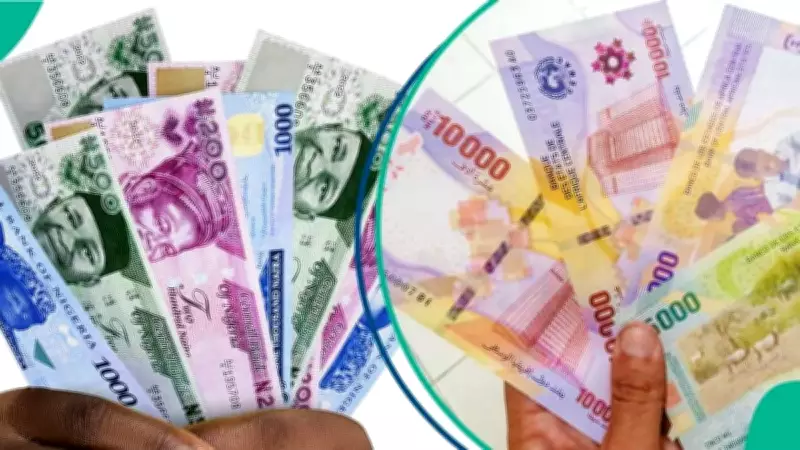
Naira Avoids Africa's 10 Weakest Currencies in February 2026 Ranking
Fresh economic data released in February 2026 has revealed that Nigeria's naira currency did not appear among Africa's ten weakest performing currencies, despite facing significant volatility and depreciation in recent years. The ranking, compiled using figures from the Forbes currency calculator, highlights nations whose currencies have experienced sharp depreciation against major global currencies like the US dollar and euro.
Understanding the Impact of Weak Currencies
A weak currency extends far beyond mere numbers on trading screens, carrying substantial real-world consequences for households, businesses, and governments across Africa. For countries heavily dependent on imports, currency depreciation rapidly translates into higher prices for essential goods including food, medicine, fuel, and machinery. This inflationary pressure erodes purchasing power and increases the cost of living for ordinary citizens.
The economic impact reaches deeper than consumer prices alone. Many African nations hold significant external debts denominated in foreign currencies, meaning that when their local currencies weaken, repaying those loans becomes substantially more expensive. Governments often find themselves forced to divert funds from crucial development projects or implement tax increases to meet debt obligations, ultimately slowing economic growth across the continent.

Investor Confidence and Economic Stability
Currency weakness sends concerning signals to both domestic and international investors. Exchange rate volatility fuels economic uncertainty, prompting investors to exercise caution with their capital. In severe cases, this can lead to capital flight, making it increasingly difficult for governments to attract the foreign direct investment necessary for infrastructure development, industrial expansion, and job creation.
Over time, persistent currency depreciation can deepen economic inequality within nations. Wages frequently struggle to keep pace with rising prices, particularly in urban centers where imported goods constitute a significant portion of household spending. Lower-income families typically bear the heaviest burden of these economic pressures.
Africa's Weakest Currencies in February 2026
According to the latest data, the following countries currently possess the weakest currencies across the African continent:
- São Tomé and Príncipe – São Tomé & Príncipe Dobra (22,282 per US dollar)
- Sierra Leone – Sierra Leonean Leone (20,970 per US dollar)
- Guinea – Guinean Franc (8,765 per US dollar)
- Madagascar – Malagasy Ariary (4,270 per US dollar)
- Uganda – Ugandan Shilling (3,598 per US dollar)
- Burundi – Burundian Franc (2,964 per US dollar)
- Tanzania – Tanzanian Shilling (2,559 per US dollar)
- Democratic Republic of the Congo – Congolese Franc (2,311 per US dollar)
What This Means for Nigeria's Economic Outlook
While the naira continues to experience volatility, particularly due to Central Bank of Nigeria interventions in foreign exchange markets, its absence from the bottom ten suggests relative improvement compared to some regional peers. Currency stability typically depends on a combination of sound monetary policy, fiscal discipline, and broader structural economic reforms.
Without these foundational elements, currency depreciation can become self-reinforcing, feeding inflation, weakening investor confidence, and straining public finances. For African economies navigating global economic uncertainty, maintaining currency stability remains central to safeguarding growth, protecting citizens' purchasing power, and attracting long-term investment.
The naira's position outside Africa's weakest currencies indicates that despite ongoing challenges, Nigeria's currency situation shows signs of relative stability compared to nations experiencing more severe depreciation. This development comes as African economies work to strengthen their financial systems and implement policies that promote sustainable economic growth across the continent.