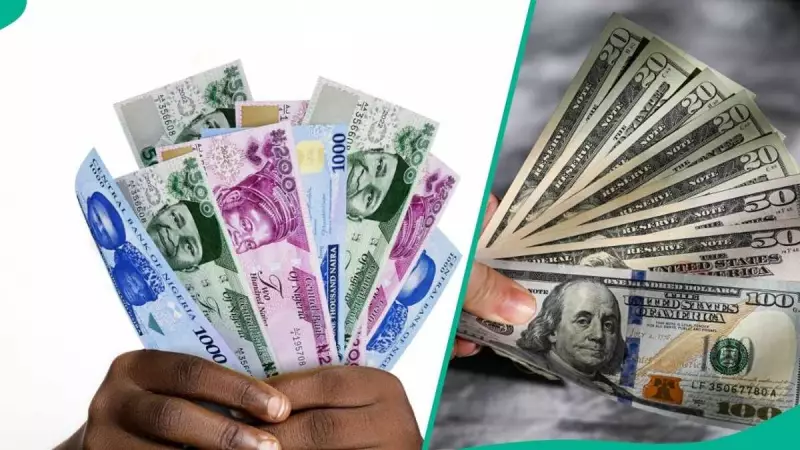
The Nigerian naira concluded the 2025 financial year on a disappointing note, recording further depreciation at the official market window. This occurred in spite of consistent foreign exchange interventions by the Central Bank of Nigeria designed to stabilise the currency.
Naira's Year-End Decline Amidst CBN Actions
Official data from the Central Bank of Nigeria revealed that the naira lost ground, closing at ₦1,445.68 to one US dollar. This represented a decline of ₦3.17 from its previous position. Throughout the final trading session, the currency's movement was confined to a narrow range between ₦1,443.00 and ₦1,447.00 per dollar, highlighting a market under significant pressure.
In a continued effort to provide liquidity and curb volatility, the apex bank sold $50 million to authorised dealer banks. This move was part of a broader strategy to increase the overall supply of dollars in the system and manage extreme fluctuations in the exchange rate.

Contrasting Reserve Growth Offers a Silver Lining
In a positive development separate from the naira's performance, Nigeria's external reserves saw a measurable increase. Reports indicated the reserves climbed to $45.45 billion, marking a daily gain of approximately $178 million. This improvement has contributed to a year-to-date growth of about 11.19 percent.
This bolstered reserve position provides the CBN with enhanced capacity to defend the naira in the short term. Financial experts suggest the larger buffer can aid market stability, though they question the long-term viability of a strategy overly reliant on direct interventions without corresponding growth in fundamental dollar inflows.
Global Market Context: Oil Steady, Gold Rebounds
The global economic landscape at year-end presented a mixed picture. Brent crude oil prices saw a modest increase, trading at $61.97 per barrel, while US West Texas Intermediate experienced a slight dip to $58.04. Analysts anticipate continued volatility in oil markets due to persistent geopolitical tensions.
Conversely, gold prices staged a recovery, with spot gold rising to $4,368.25 per ounce. This rebound helped secure the precious metal's strongest annual performance in decades, driven by investor demand for safe-haven assets amidst global uncertainty.
As Nigeria enters 2026, the juxtaposition of rising external reserves and a persistently weak naira underscores the complex challenge facing the country's monetary authorities. The effectiveness of intervention-based measures remains under scrutiny, with market watchers calling for structural reforms to boost confidence and sustainable foreign exchange earnings.