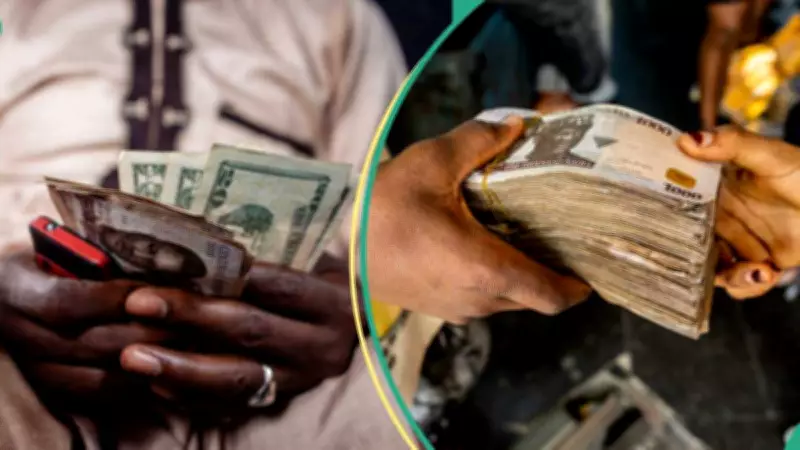
Naira Extends Decline Against Dollar, Reaches Five-Month Low
Nigeria's currency, the naira, continued its downward trajectory on Monday, depreciating to its weakest level in five months despite a notable increase in foreign exchange inflows into the market. Data released by the Central Bank of Nigeria (CBN) revealed that the naira fell by N12.36 during trading at the Nigerian Foreign Exchange Market (NFEM) window.
Official Market Performance
The local currency closed at N1,405.62 per dollar, compared to N1,393.26 recorded on the previous Friday. This represents a 0.9 percent decline at the official market, highlighting persistent pressure on Nigeria's currency even as authorities implement policy reforms to stabilize the foreign exchange market.
Parallel Market Stability
While the naira weakened at the official window, it remained relatively stable in the parallel market, commonly referred to as the black market. At the close of trading on Monday, the naira exchanged at N1,420 per dollar in the parallel segment.

The gap between the official rate and the black market rate narrowed further to N15, equivalent to about 1.07 percent. This is significantly lower than the N27 spread, or 1.94 percent, recorded at the end of trading on Friday.
Currency analysts view the narrowing gap as a sign that Nigeria's multiple exchange rate segments are gradually converging, following reforms introduced by the apex bank to improve transparency and efficiency in the FX market.
Foreign Exchange Inflows Strengthen
Despite the weakening of the naira, recent data indicate that foreign exchange inflows into Nigeria's market have strengthened significantly in recent weeks. A report by the research arm of Coronation Merchant Bank showed that total FX inflows rose to $1.26 billion last week, representing a 17.76 percent increase compared with $1.07 billion recorded the previous week.
Foreign portfolio investors emerged as the largest contributors to the inflows, supplying $518.7 million, which accounted for 41.3 percent of the total funds entering the market. The CBN followed with $314.2 million, representing 25 percent of total inflows during the period.
Exporters also contributed significantly, providing $159.1 million or 12.7 percent of the inflows. Non-bank corporates supplied $135.5 million (10.7 percent), while individual participants accounted for $110.9 million, representing 8.8 percent of total inflows.
Analysts say these inflows are helping to provide liquidity support for the foreign exchange market, even though strong demand for dollars continues to influence exchange rate movements.
External Reserves Edge Higher
Nigeria's foreign exchange reserves have also recorded modest growth in recent days. Figures published by the Central Bank of Nigeria show that the country's gross external reserves climbed to $49.93 billion as of March 5, 2026.
The latest figure represents a week-on-week increase of about 0.48 percent, equivalent to an addition of roughly $236.21 million, according to a report by BusinessDay. The steady improvement in reserves follows a broader recovery in Nigeria's net foreign exchange position in recent years.
According to the CBN, net FX reserves rose sharply to $34.8 billion at the end of 2025, compared with just $3.99 billion two years earlier. CBN Governor Olayemi Cardoso attributed the improvement to stronger external sector fundamentals and ongoing monetary and foreign exchange policy reforms aimed at rebuilding investor confidence in Nigeria's currency market.
Market Outlook and Analysis
Market analysts expect the naira to trade within a relatively stable range in the near term, supported by sustained foreign portfolio investment inflows and improved participation by exporters in the foreign exchange market.
In addition, rising crude oil prices linked to geopolitical tensions in global energy markets could boost Nigeria's foreign exchange earnings and further strengthen the country's reserves.
However, the naira recorded an overall weaker performance last week. At the official NFEM window, the currency depreciated 2.14 percent week-on-week, closing at N1,393.26 per dollar compared with N1,363.42 the previous week.

The parallel market followed a similar trend, with the naira weakening 2.10 percent week-on-week to close at N1,430 per dollar. Analysts say the gradual narrowing of the gap between the official and parallel markets signals progress toward a more unified and stable foreign exchange system as ongoing reforms continue to take effect.
Historical Context and Reforms
Nigeria's currency staged a remarkable turnaround in 2025, recording its first annual appreciation in more than a decade as sweeping reforms by the Central Bank of Nigeria reshaped the foreign exchange market. According to a 2026 economic outlook by investment house Comercio Partners titled "Policy Shock to Structural Reset: Charting a Sustainable Economic Path," the naira strengthened by about 6.87 percent against the US dollar during the year.
The gain marked the currency's first annual rise in 13 years, signalling a shift from prolonged depreciation to renewed stability. The current market dynamics reflect the ongoing challenges and opportunities in Nigeria's foreign exchange landscape as authorities work to balance market forces with policy interventions.