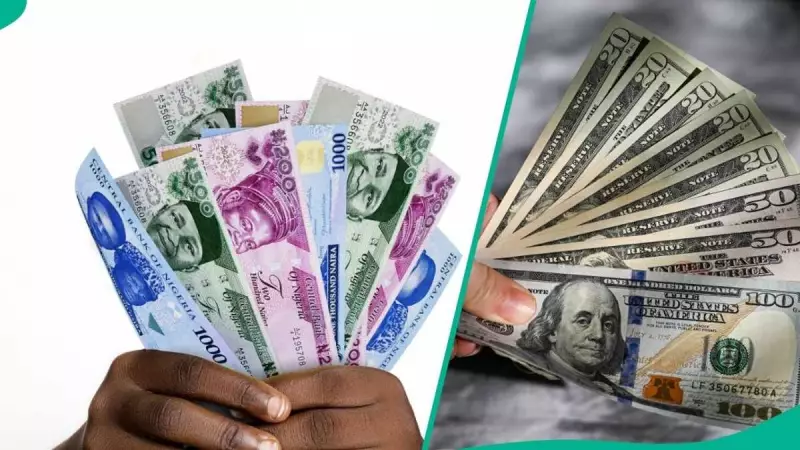
The Nigerian naira is currently facing a familiar seasonal test as surging demand for the US dollar coincides with the peak of festive spending, popularly known as 'Detty December'. Despite this pressure, the local currency has demonstrated notable resilience in the official foreign exchange market, backed by strategic interventions from the Central Bank of Nigeria and a steadily growing external reserve buffer.
Seasonal Demand Meets Central Bank Firepower
Financial experts confirm that the annual Christmas period consistently places the naira under scrutiny. Increased spending on international travel, holiday imports, and entertainment activities drives a significant spike in the need for foreign currency. Last week, the naira experienced a marginal week-on-week depreciation of 0.1 per cent, closing at N1,456 per US dollar at the official Nigerian Foreign Exchange Market window. This slight weakening occurred even after the CBN injected $250 million into the system and welcomed fresh inflows from offshore investors.
Market analysts, however, urge calm, interpreting this movement as a predictable seasonal pattern rather than a fundamental shift in the currency's dynamics. The underlying strength, they point out, is supported by concrete data. Nigeria's gross external reserves climbed for the 25th consecutive week, increasing by $396.84 million to reach $45.44 billion as of December 11, 2025. This consistent accumulation fortifies the country's external position and boosts investor confidence during a period of high demand.

Analysts Project Stability Despite Near-Term Pressures
Janet Ogochukwu, a senior banker and economist, emphasized the naira's expected durability. "Despite the high volume of demands, we expect the naira to maintain strong resilience in the markets," she stated in an interview. Ogochukwu credited the rising external reserves as a primary buffer ensuring stability and noted the proactive role of the CBN, which has stepped up its interventions to prevent the currency from trailing off significantly.
The forward market presents a mixed picture, reflecting the complex expectations of traders. Short to medium-term contracts showed depreciation, with the one-month, three-month, and six-month contracts weakening to N1,485.97, N1,536.28, and N1,599.70 per dollar respectively. Conversely, the one-year contract appreciated to N1,726.89 per dollar, signaling stronger confidence in the naira's long-term prospects. Analysts attribute the near-term softness directly to holiday-related imports, international travel bookings, and corporate year-end settlements.
Inflows and Policy Measures to Offset Demand
Relief is anticipated from increased financial inflows later in the month. Reports indicate that stronger diaspora remittances and spending from inbound tourists are expected to improve foreign exchange liquidity, partially offsetting the demand surge. These inflows typically peak towards the end of December, helping to balance the market.
On the policy front, domestic measures continue to provide a firm foundation. The Central Bank has held the Monetary Policy Rate steady at 27 per cent to anchor inflation expectations. Furthermore, the Nigerian National Petroleum Company Limited's continued naira-denominated crude oil sales to domestic refineries is a strategic move designed to reduce dollar demand within the local energy sector.
In the parallel market, the naira saw a slight weakening to N1,476 per dollar in late November, yet the gap with the official rate remains relatively narrow—a sign of continued market convergence. This stability over the past year has been supported by key reforms, including the transparent Electronic Foreign Exchange Management System.
While acknowledging risks from global oil price volatility, financial research firms like Cordros maintain a stable near to medium-term outlook for the naira. This optimism is underpinned by expectations of strong foreign exchange liquidity and the protective cushion of rising external reserves, proving that even a 'Detty December' has its limits against a well-managed currency framework.