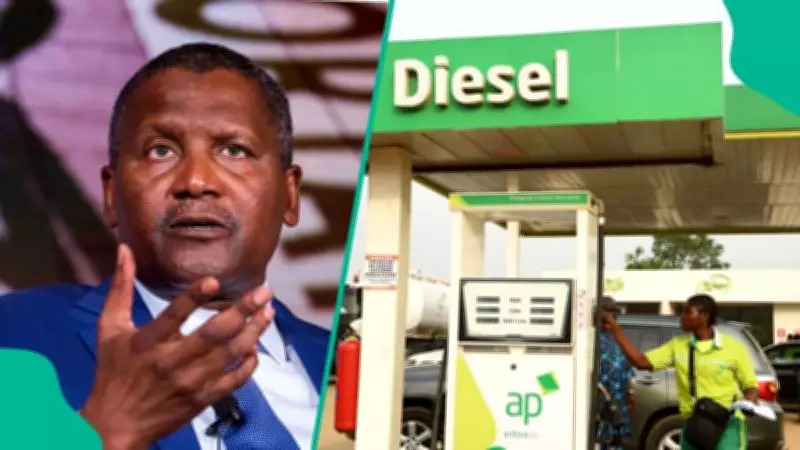
Dangote Refinery Suspends Diesel Loading Amid Price Surge in Lagos Depots
The Dangote Petroleum Refinery has announced a temporary halt to diesel loading and sales, a development that has coincided with a significant price increase by depot operators across Lagos. On March 5, 2026, diesel prices at major depots in Lagos rose to approximately N1,200 per litre, marking a sharp 12% increase from the previous day's average rates. This move has sparked widespread concern among fuel marketers and industry stakeholders, who are closely monitoring the situation for potential further adjustments.
Market Reactions and Speculation
Industry sources indicate that the suspension of diesel loading at the Dangote Refinery is often interpreted as a precursor to revised pricing structures. Traders note that such pauses typically occur when suppliers are reviewing prices before announcing new allocations. Market checks by Petroleumprice.ng reveal that several depot owners in Lagos have already implemented the price hike, with facilities like Menj Depot, Integrated Depot, and Ibeto Depot quoting N1,200 per litre. This represents a notable jump from the N1,070 to N1,078 per litre recorded on March 4, fueling speculation about additional price increases in the near future.
Price Increases Extend Beyond Lagos
The price adjustments are not confined to Lagos alone, as reports indicate similar trends in other key fuel distribution hubs across Nigeria. In Warri, depots such as Rain Oil and Zamson Depot are now selling diesel at N1,300 per litre, while in Port Harcourt, Bulk Strategic Depot has raised prices to N1,400 per litre. This suggests that the increase is spreading to other supply corridors, potentially affecting inland markets and raising concerns about uniform price movements across the country.

Analysts Link Trends to Market Dynamics
Industry analysts attribute these developments to evolving dynamics in the downstream sector, particularly following a reported reconciliation and alignment between the Dangote Refinery and major depot operators. This strengthened relationship may be facilitating quicker and more synchronized price adjustments across distribution centres. While some stakeholders believe this coordination could enhance supply stability and reduce disruptions, others express worry that it might drive prices higher for end consumers, exacerbating economic pressures.
Impact on Consumers and Businesses
With depot prices on the rise and the refinery suspending sales, marketers are increasingly concerned about the potential impact on consumers and businesses that rely heavily on diesel. A depot operator noted that pricing movements appear to be increasingly synchronized across the market, indicating a trend that could lead to further hikes. Traders in the downstream sector remain cautious, awaiting the next pricing signal from the Dangote Refinery, which has become a pivotal influence on fuel price movements in Nigeria. If the refinery resumes diesel loading with a higher price benchmark, experts warn that depot prices nationwide could escalate in the coming days.
Broader Context and Expert Warnings
This situation unfolds against a backdrop of global oil market volatility, with Brent crude currently priced at $84.10 per barrel. Energy experts had previously cautioned that petrol and diesel prices in Nigeria could rise if crude oil exceeded $90 per barrel, driven by rising tensions in the Middle East. Nigeria remains vulnerable to such volatility due to its reliance on imported crude for local refineries, highlighting the interconnectedness of domestic fuel prices with international market trends.