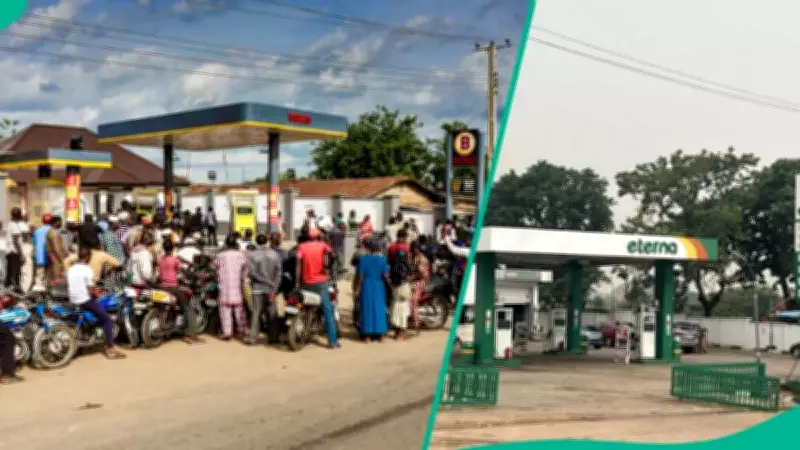
Nigeria's Fuel Market Under Strain as Depot Petrol Prices Rise Slightly
Nigeria's fuel market is experiencing renewed pressure as major depots and the Dangote Refinery implement modest upward adjustments in Premium Motor Spirit (PMS) prices. These incremental increases are raising concerns among motorists about potential future impacts on retail costs at filling stations nationwide.
Slight Upward Adjustments Across Key Depots
As of Thursday, April 16, 2026, depot prices for petrol have inched up marginally, according to data monitored by PetroleumPriceNG. The Dangote Refinery increased its ex-gantry price from ₦1,200 to ₦1,209 per litre. Other notable adjustments include Masters at ₦1,225 per litre, NIPCO Lagos at ₦1,206 per litre, and Sigmund at ₦1,230 per litre. Private depots such as AP and MRS have also reflected similar subtle shifts.
Experts anticipate that these ex-depot changes will gradually translate to higher retail prices at filling stations across the country, adding pressure on already stretched household budgets. The adjustments occur against a backdrop of persistent global crude oil volatility, exacerbated by the ongoing US-Iran standoff in the Strait of Hormuz.

Crude Oil Prices Remain Elevated
International benchmarks remained firm on Thursday, with Brent crude trading around $96.8 per barrel, West Texas Intermediate (WTI) at $92.41, and Murban at $100.4, according to oilprice.com data. This volatility stems from geopolitical risks, particularly the US blockade of Iranian ports in the Strait of Hormuz, a critical chokepoint for global oil flows.
Analysts suggest that failure to reach a quick US-Iran agreement could keep prices elevated or push them higher. Energy policy analyst Adeola Yusuf noted that a truce is expected soon, but the current blockade has heightened concerns among global energy players. OPEC+ members have ramped up output to offset potential shortages, yet Nigerians remain exposed due to the country's heavy reliance on imported and refined petroleum products.
Inflation Hits Two-Decade High as Energy Costs Bite
Nigeria's headline inflation climbed to 15.38% in March 2026, up from 15.06% the previous month, marking the first rise in nearly a year and the highest monthly reading in two decades. Food and transport costs, heavily influenced by fuel prices, were key drivers of this increase.
With over 70% of vehicles in Nigeria running on petrol, even small depot hikes quickly ripple through the economy, affecting everything from commuting to generator use for businesses and homes. This economic strain is prompting significant behavioral changes among consumers.
Consumers Cut Back: Petrol Demand Drops 17%
Data from the Nigerian Midstream and Downstream Petroleum Regulatory Authority (NMDPRA) reveals a sharp behavioral shift, with average daily PMS consumption falling to 47.3 million litres in March, down from 56.9 million litres in February—a 16.9% decline. This drop was not accidental, as depot prices were adjusted seven times in recent weeks (five increases, two reductions), creating uncertainty.
Pump prices hovering above ₦1,200 per litre in many areas forced quick adaptations, including transport operators cutting trips, small businesses limiting generator runtime, and households rationing fuel use. In a deregulated market, Nigerians have little choice but to adjust consumption when prices rise.
Supply Picture: Imports Step In to Fill the Gap
While demand eased, total petrol supply edged up modestly from 39.5 million litres per day in February to 40.1 million litres per day in March, a 1.5% increase. However, the composition shifted noticeably, with domestic supply declining from 36.5 million litres per day to 34.2 million litres per day.
In contrast, imports nearly doubled, jumping from 3.0 million litres per day to 5.9 million litres per day, a 97% surge. Dangote Refinery still supplies the bulk of local gasoline, over 72% of national consumption according to NMDPRA, but marketers increasingly turned to imports to maintain availability and prevent widespread shortages or queues.
The reduced consumption has eased some pressure on the supply chain, allowing products to circulate more freely in certain areas despite the marginal overall supply growth.

What This Means for Nigerians
These subtle depot price increases highlight the fragility of Nigeria's fuel market. Global tensions in the Strait of Hormuz, combined with domestic inflation and repeated price volatility, continue to squeeze consumers. While a US-Iran truce could bring relief, the immediate outlook suggests Nigerians will keep paying a premium for petrol.
Many are already changing habits, such as driving less, consolidating trips, or seeking alternatives where possible. In the longer term, greater domestic refining stability from facilities like Dangote could help buffer against external shocks, but for now, the market remains sensitive to every global ripple.
Earlier reports indicated that Nigerian motorists received a welcome breather on Monday, April 13, 2026, as depot owners largely kept Premium Motor Spirit (PMS) and Automotive Gas Oil (AGO) prices steady despite a sharp rally in global crude oil markets. While Brent crude climbed to $100.4 per barrel and West Texas Intermediate hit $101.6, downstream operators adopted a wait-and-see approach, heavily influenced by pricing signals from the Dangote Refinery.