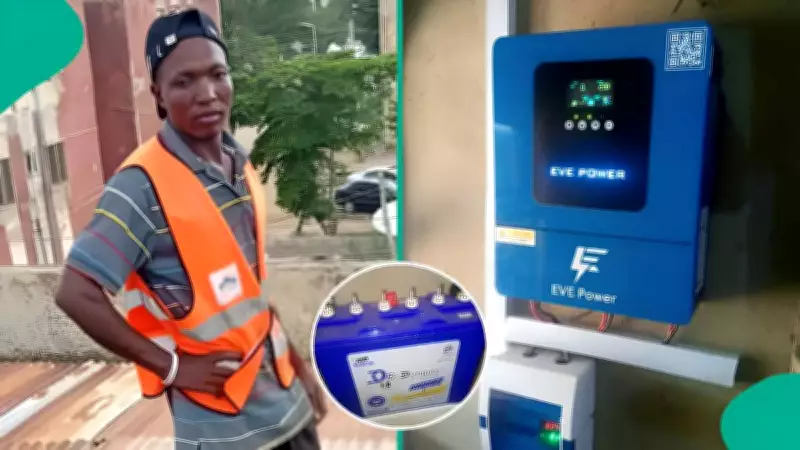
Solar System User Seeks Help Over Battery Performance Issues
A young Nigerian man has raised concerns online about the performance of his solar power system, specifically regarding how long his tubular battery lasts after charging. The individual, who uses a 2kVA hybrid solar inverter with one tubular battery and two 550W solar panels, revealed that despite his battery reaching full charge within just 30 minutes, it only provides power for approximately 1 hour and 20 minutes when supporting a 340-watt load.
Technical Details of the Solar Setup
The man shared detailed specifications of his solar configuration on social media, explaining he uses a 2kVA hybrid inverter with an inbuilt MPPT 80A charge controller along with a single 260Ah tubular battery. His post quickly went viral as he pleaded for assistance, stating: "Please I need help, my battery always gets full within 30 minutes of connecting but will not last for up to 1 hour 20 minutes with 340-watt load on it."
This unexpected performance issue has prompted the solar system owner to seek solutions from the online community, as the battery's rapid charging but short discharge time contradicts expectations for such equipment.

Community Responses and Technical Analysis
Several social media users offered technical advice and potential solutions to the man's solar system challenges:
- Mohammed Al-Uniquah suggested adding another solar panel of the same size after verifying the battery's condition, noting that a 260Ah tubular battery should theoretically provide 6.2kW of rated power with 3.2kW usable capacity at 50% depth of discharge.
- Ernest Okechukwu recommended connecting additional panels in series while considering the inverter's maximum photovoltaic requirements, sharing that he faced similar issues and resolved them through panel expansion.
- Nazifi Yau Na Baba questioned the battery's quality, stating that a properly functioning tubular battery should handle such loads for 3-5 hours if genuinely fully charged.
- Chinonso Celestine Great-Man proposed upgrading to a 24V system with either two carbon batteries or a lithium battery, suggesting the current 12V setup might be insufficient for the 340-watt load.
Broader Discussion About Battery Technology
The conversation expanded beyond immediate troubleshooting to include comparisons between different battery technologies:
- Daniel James Mamza advised against investing further in flooded tubular batteries and recommended switching to lithium-ion batteries instead.
- Henry Okoro expressed surprise at using a 340-watt load on a single tubular battery and suggested lithium batteries for better performance and peace of mind.
- Kemmy Okebie commented that expecting significant performance from a single battery might be unrealistic, using the phrase "You can't give what you don't have" to emphasize capacity limitations.
Related Solar Energy Incidents in Nigeria
This case follows other recent reports about solar system challenges in Nigeria. Another man previously shared how lightning damaged his 4kVA solar inverter during heavy rainfall, warning others to take precautions during storms. Additionally, multiple users have reported issues with tubular batteries losing power quickly after sunset, despite functioning adequately during daylight hours.
The growing discussion highlights increasing interest in renewable energy solutions across Nigeria, along with the technical challenges users face when implementing solar power systems in residential settings. As more Nigerians adopt solar technology for energy independence, understanding proper system configuration, battery maintenance, and load management becomes increasingly important for optimal performance and return on investment.