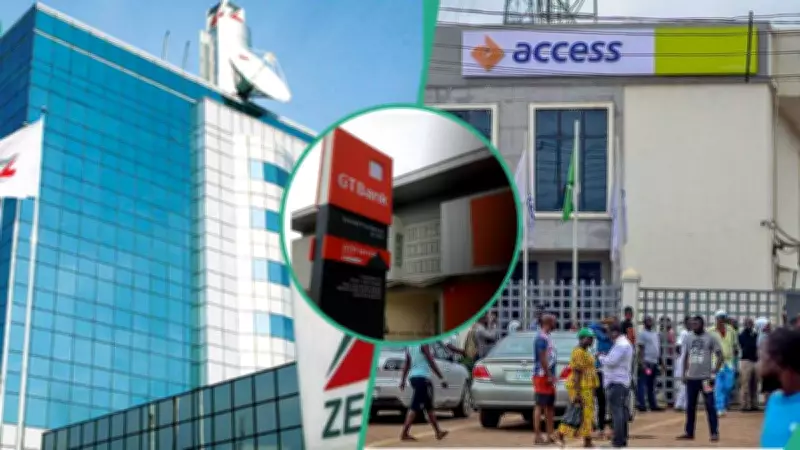
Access Holdings Plc has maintained its position as Nigeria's largest bank by total assets in the first quarter of 2026, reinforcing its leadership in the financial services sector following its expansion across Africa. Data from banks' financial statements and NGX filings show a sustained increase in total assets for the top ten listed banks, reflecting overall balance sheet growth.
Strong Asset Growth in Q1 2026
Nigeria's leading banks recorded strong asset growth in the first quarter of 2026. Total assets encompass all resources owned by a bank, including loans to customers, cash holdings, investments, and other financial assets. The ranking of Nigeria's top commercial banks based on total assets is as follows:
1. Access Holdings – N53.43 trillion
Access Holdings Plc, led by Group Managing Director and Chief Executive Officer Roosevelt Ogbonna, retained the top spot with total assets valued at N53.43 trillion. The bank's widespread retail network, strong corporate banking relationships, and expansive reach across Africa have enabled it to hold its leading position in Nigeria's banking sector.

2. United Bank for Africa – N33.13 trillion
United Bank for Africa Plc ranked second with N33.13 trillion in total assets, under the leadership of Group Managing Director and Chief Executive Officer Oliver Alawuba. Its pan-African operations remain a key driver of asset growth, with several subsidiaries across the continent contributing significantly to the group's overall balance sheet.
3. Zenith Bank – N32.01 trillion
Zenith Bank, led by Chief Executive Officer Adaora Umeoji, came third with assets valued at N32.01 trillion. The bank is recognized as one of the most efficient financial institutions in the country, owing to its strong corporate banking relationships and disciplined risk management approach. It has also built a reputation for profitability and robust shareholder returns.
4. FirstHoldCo – N26.87 trillion
FirstHoldCo Plc, led by Olusegun Alebiosu, secured the fourth position with total assets of N26.87 trillion.
5. GTCO – N18.75 trillion
Guaranty Trust Holding Company Plc (GTCO) ranked fifth with assets worth N18.75 trillion, under the leadership of Segun Agbaje. The bank has performed excellently over the past decade, driven by its digital platforms, retail market dominance, and efficient operational cost management. GTCO has established itself as a technology-driven financial services group.
6. Fidelity Bank – N11.35 trillion
Fidelity Bank, with Nneka Onyeali-Ikpe as Group Managing Director and Chief Executive Officer, recorded total assets of N11.35 trillion. Growth in its corporate, retail, and SME banking portfolios contributed to this figure. The bank has regained investor confidence in recent years, achieving improved profitability and stronger balance sheet fundamentals.
7. Stanbic IBTC Holdings – N9.70 trillion
Stanbic IBTC Holdings Plc, led by Group Chief Executive Officer Wole Adeniyi, posted assets worth N9.70 trillion. Its outstanding performance in wealth management and pension administration, combined with a strong presence in corporate banking, have been major contributors to its asset base. The bank's diverse financial service delivery system ensures stable profits.
8. FCMB Group – N7.54 trillion
FCMB Group, led by Ladi Balogun, reported total assets of N7.54 trillion as of December 2025. Growth in retail banking, SMEs, and digital financial services has helped increase its total assets. The group continues to expand across all its business segments, including banking and investment banking.
9. Wema Bank – N5.23 trillion
Wema Bank recorded N5.23 trillion in assets. Group Managing Director and Chief Executive Officer Moruf Oseni leads the bank, which has strengthened its position in retail banking through its ALAT digital platform, attracting younger customers.
10. Sterling Bank – N4.07 trillion
Sterling Bank, led by Abubakar Suleiman, ranks tenth with total assets of N4.07 trillion.

Banking Sector Stability
The Central Bank of Nigeria (CBN) maintains that the country's banking sector remains stable and well-capitalized despite ongoing macroeconomic pressures. The rise in total assets has been aided by gains from foreign exchange revaluation. Earlier, Legit.ng reported that a breakdown of Nigerian banks by license class obtained from the CBN shows that at least 28 banks in the country are currently not authorized to operate internationally. Under the CBN's regulatory framework, banks with international authorization are permitted to operate beyond Nigeria's borders and engage in cross-border banking activities.