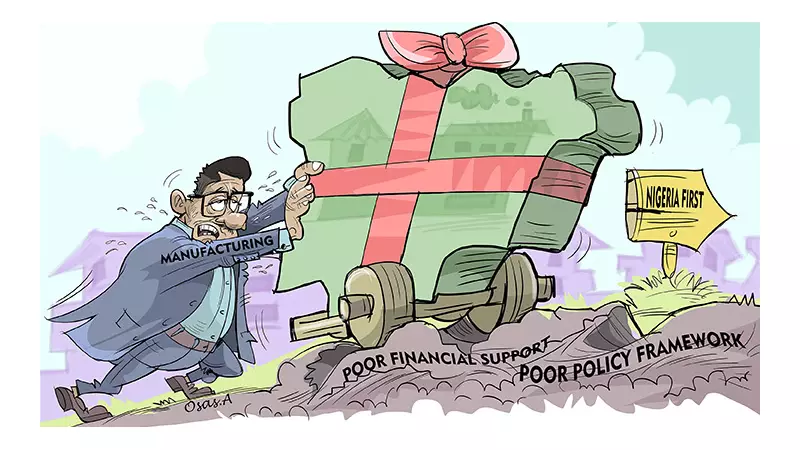
For years, Nigerian leaders have championed the vision of a robust, competitive industrial economy. Yet, the stark reality on the ground tells a story of persistent decline and unfulfilled potential. The manufacturing sector, widely acknowledged as the engine for job creation, economic diversification, and export growth, continues to languish, with stakeholders blaming a chronic lack of purposeful government action over mere rhetoric.
Policy Promises vs. Harsh Economic Realities
The administration of President Bola Tinubu introduced a 'Nigeria First' policy in May 2025, aiming to prioritise locally made goods in government procurement. This move followed two earlier Executive Orders—003 and 005—signed by the Buhari administration in 2017 and 2018, designed with similar objectives to boost domestic production.
Despite these high-level pronouncements, the impact on the economy has been negligible. Data paints a grim picture: the manufacturing sector operates at below 50% of its installed capacity, according to the Manufacturers Association of Nigeria (MAN). Its contribution to the Gross Domestic Product (GDP) has shrunk, falling from 9.2% in 2018 to 8.6% in 2024.

A KPMG report from the third quarter of 2025 reveals a sector in deep trouble. Growth has been weak and sluggish, averaging just 1.17% over the past five years. While export value saw a 194% year-on-year jump to N2.29 trillion in 2024, the sector's share of total exports remained a paltry 3%, overshadowed by stronger growth in other areas. Nigeria's five-year average manufacturing export of 4.2% lags far behind regional peers like Botswana (92.9%), Egypt (46.8%), and South Africa (39%).
The Enforcement Gap and Systemic Challenges
Industry leaders point to a yawning chasm between policy pronouncements and tangible implementation. Dr. Gamma Kwajaffa, Director General of the Textile Manufacturers Association of Nigeria, recalls a similar directive from 2017 for civil servants to wear Made-in-Nigeria attire on specific days, which saw no serious enforcement. "In practice, many procurement officers did not cooperate," he stated.
Kwajaffa highlighted the uneven playing field crippling local industries like textiles. While Nigeria produces cotton, cheap polyester fabrics from countries with large refinery capacities flood the market. "A high-quality cotton fabric may cost around N6,000, while imported polyester fabric can be sold for around N1,000," he explained. This price disparity, coupled with little tariff protection, has led to the closure of numerous mills, reducing their number from over 200 to about 15 operational today.
Mr. John Aluya, a member of MAN's executive council, confirmed that government Ministries, Departments, and Agencies (MDAs) are largely ignoring the Nigeria First policy, still preferring cheaper imported goods. He stressed that for the policy to work, there must be penalties for breaches. "If there are no penalties attached to it, there's no way the MDAs are going to stick to the rule," Aluya insisted.
Beyond Procurement: The Critical Need for Infrastructure
Manufacturers agree that procurement policies alone cannot revive the sector. The foundational issues of infrastructure deficit remain paramount. Aluya listed the critical needs: "We don't have good roads. We don't have power. We don't have rail... The typical one is the national grid going down regularly. How can you be producing when the national grid will be going down?"
Mr. Leye Kupoluyi, President of the Lagos Chamber of Commerce and Industry (LCCI), echoed this, stating that power, access to single-digit credit, and market protection are essential. "If we allow the market to continue to be flooded with foreign goods the way it is now, we will continue to weaken our local manufacturing sector," he warned.
The KPMG report aligns with these demands, recommending that the government must:

- Unlock access to long-term finance by strengthening development finance institutions.
- Accelerate reforms in the power sector and focus on rail and road transport.
- Digitalise and automate border clearing processes to reduce delays.
- Streamline the number of taxes and levies to reduce compliance burdens.
The situation is dire. Segun Ajayi-Kadir, Director General of MAN, disclosed that as of 2023, 335 manufacturing companies were ailing and 767 had shut down nationwide, crippled by high interest rates and heavy dependence on imported raw materials.
The consensus is clear: without deliberate enforcement of local content policies, protective measures for priority sectors, and a fundamental fix of the country's infrastructure, the 'Nigeria First' policy and its predecessors will remain rich in packaging but lean in meaningful impact, leaving the nation's industrialisation dreams perpetually deferred.