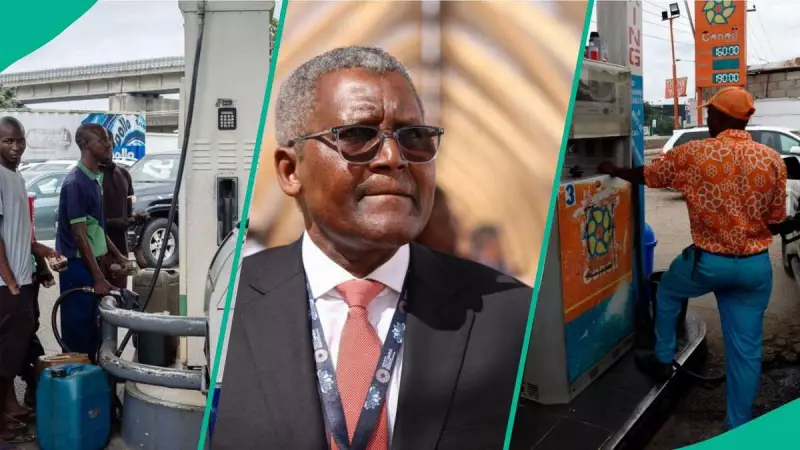
The Petroleum Products Retail Outlets Owners Association of Nigeria (PETROAN) has revealed that its members suffered losses amounting to billions of naira in 2025. This financial blow was a direct result of a protracted price war in the petrol market, primarily instigated by the Dangote Petroleum Refinery.
The Genesis of the Price War and Its Immediate Impact
According to PETROAN's Review of Nigeria’s Petroleum Sector (2025) and Prospects for 2026, the Dangote refinery implemented multiple reductions in the price of Premium Motor Spirit (PMS) throughout the year. This aggressive pricing strategy forced other key players, including the Nigerian National Petroleum Company Limited (NNPCL) and major depot owners, to respond with their own price cuts to remain competitive.
The association, in the document jointly signed by its National President, Billy Gillis-Harry, and National Public Relations Officer, Joseph Obele, stated that this prolonged competition severely eroded profit margins for retail outlet operators. The constant fluctuation created a climate of heightened uncertainty within the downstream petroleum market, making business planning and investment decisions exceptionally difficult.

Broader Market Consequences and Policy Gaps
PETROAN warned that the instability caused by the price war likely damaged investor confidence in the downstream sector. The association argued that such volatility could "rub the sector of the of competition" by discouraging long-term commitments.
The review highlighted that the tensions exposed significant policy gaps. "Tensions between petroleum importers and domestic refiners intensified in 2025, particularly over pricing dominance, crude access, and market share," PETROAN stated. It pointed out that the government struggled to balance the necessary incentives for local refining with the principles of fair competition and market neutrality.
Furthermore, PETROAN noted rising tensions between the Dangote refinery and other critical stakeholders. These included major labour unions like the Nigeria Union of Petroleum and Natural Gas Workers (NUPENG) and the Petroleum and Natural Gas Senior Staff Association of Nigeria (PENGASSAN), as well as the sector regulator, the Nigerian Midstream and Downstream Petroleum Regulatory Authority (NMDPRA).
Calls for Engagement and Context on Production & Imports
To address these challenges, PETROAN is advocating for transparent and effective stakeholder engagement. The association believes that sustained dialogue is essential for reducing operational conflicts, ensuring market stability, and achieving sustainable growth in the downstream sector.
In other sections of its annual review, PETROAN acknowledged a modest recovery in Nigeria's crude oil production in 2025. This was attributed to improved security measures, pipeline surveillance, and the partial reopening of some shut-in assets. However, the country continued to struggle to meet its OPEC production quota of 1.5 million barrels per day due to persistent issues like oil theft, vandalism, ageing infrastructure, and limited investment.
On the contentious issue of petrol importation, PETROAN called for a balanced approach. While recognising that imports play a short-term role in meeting demand, the association cautioned that over-reliance on them undermines the development of local refineries, fiscal sustainability, and long-term energy security. This commentary comes amidst repeated calls from Aliko Dangote for a ban on PMS imports, citing his refinery's capacity to satisfy domestic needs.
Industry experts have characterized the fierce price competition as a natural outcome of the fully deregulated downstream market, where only the most efficient and strategically agile players thrive.