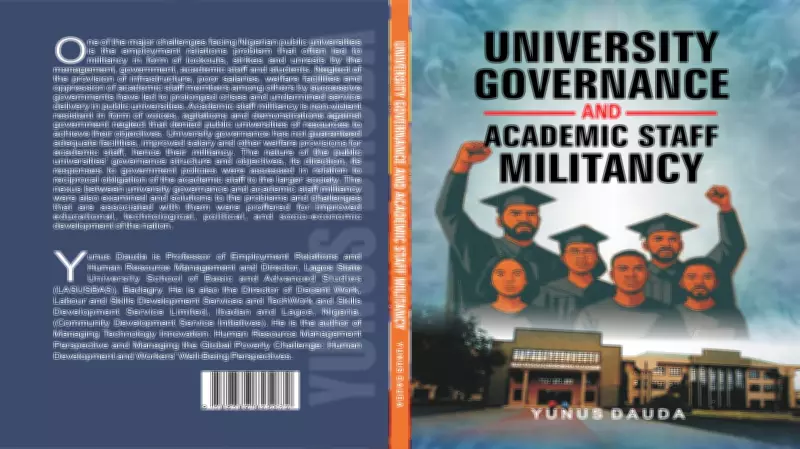
At a time when public debate often reduces university strikes to mere inconvenience and disruption, Yunus Dauda's ASUU, Militancy and the Politics of Negotiation arrives as a timely intellectual intervention. Rather than treating academic union militancy as simple confrontation, the author repositions it as a structured language of negotiation between labor and authority, grounded in struggles for dignity, institutional balance, and democratic participation. Drawing from employment relations theory, union documentation, and institutional experience, the text reframes recurring conflicts between the Academic Staff Union of Universities and successive Nigerian governments as manifestations of deeper structural tensions within the country's higher education system.
Context of National Fatigue
The book emerges within a national atmosphere fatigued by repeated university closures and prolonged industrial actions. Public commentary frequently portrays strikes as irrational disruptions driven by union obstinacy, while official narratives emphasize fiscal limitations and administrative complexity. Against this familiar polarity, the author complicates prevailing assumptions by situating militancy within the broader history of labor relations and democratic engagement. Conflict, in this account, becomes neither accidental nor episodic but historically embedded within governance arrangements that shape Nigerian universities.
Militancy as Communication
Central to the argument advanced by the text is the proposition that democracy depends upon sustained dialogue between authority and those subject to it. Militancy, within this framework, is not rebellion but communication. It represents an organized attempt by workers to assert voice where institutional channels fail to provide meaningful participation. The author advances the view that industrial action emerges when negotiation structures lose credibility, transforming strikes into cumulative responses to unresolved grievances rather than spontaneous acts of disruption.

Grounding in Employment Relations Scholarship
One of the intellectual strengths of ASUU, Militancy and the Politics of Negotiation lies in its grounding in employment relations scholarship. The author carefully explains militancy as a behavioral response shaped by organizational injustice, influence deprivation, and welfare dissatisfaction. By anchoring analysis within recognized theoretical traditions, the text moves discussion away from emotional reaction toward systematic explanation. Militancy is therefore analyzed not as temperament but as outcome, produced by identifiable institutional conditions.
Power Parity and Negotiation
Particularly persuasive is the discussion of power parity between employer and employee. The author argues that genuine negotiation becomes possible only where both parties recognize a relative balance of influence. Where authority becomes overwhelming, dialogue collapses into unilateral decision-making. Militancy thus functions as a corrective mechanism intended to restore equilibrium within labor relations. This interpretation reframes strikes as attempts to compel engagement rather than efforts to destabilize educational institutions.
Grievances and Organized Resistance
The book offers a detailed examination of how grievances evolve into organized resistance. Unresolved complaints, ineffective grievance mechanisms, and exclusion from decision-making processes are identified by the text as recurring triggers of union mobilization. Dissatisfaction rarely erupts suddenly; rather, it accumulates gradually within institutional environments lacking credible channels for expression. Collective pressure becomes, in such contexts, a rational organizational strategy.
Grievance Procedures as Stability Instruments
A notable contribution of the work is its treatment of grievance procedures as instruments of institutional stability. Complaints are not presented as administrative burdens but as essential mechanisms for sustaining organizational health. According to the author, structured grievance systems allow disagreement to be managed before escalation occurs. Nigerian public universities, he argues, often lack functional mechanisms capable of absorbing conflict constructively, thereby intensifying tensions between academic staff and governing authorities.

Broader Socio-Political Dynamics
Beyond procedural analysis, the text situates university conflicts within broader socio-political dynamics. Government dominance, delayed implementation of negotiated agreements, and perceived intimidation of union leadership are presented as factors deepening mistrust. When negotiation is replaced by coercive response, militancy becomes, in the author's assessment, an inevitable reaction. This argument expands the discussion beyond education policy into questions of democratic accountability and civic participation.
Internal Diversity of ASUU
Importantly, the book avoids portraying ASUU as a monolithic organization. The author acknowledges internal diversity within union structures, noting that militancy exists along a continuum shaped by member participation, demographic realities, and organizational cohesion. Internal disagreements, generational differences, and competing professional interests influence the intensity and direction of collective action. This nuance strengthens the analytical credibility of the work and prevents reductive interpretation.
Historical Reflection
Historical reflection forms another significant dimension of the book. The text positions ASUU within Nigeria's broader developmental trajectory, arguing that many gains within public universities emerged through sustained union advocacy. Improvements in academic welfare, institutional autonomy, and professional protections are interpreted as outcomes of organized struggle rather than administrative concession. This historical framing encourages readers to reconsider the long-term impact of union activism on national educational growth.
Dignity and Professional Identity
Equally compelling is the exploration of dignity and professional identity. Academic staff are depicted not merely as wage earners but as intellectual workers seeking recognition within a system that frequently undervalues scholarly labor. Militancy becomes intertwined with the defense of academic freedom and institutional integrity. Here, the author moves beyond labor economics into ethical reflection, suggesting that disputes over working conditions also reflect deeper concerns about respect for knowledge production.
Documentary Depth
The reliance on official union statements, newsletters, and institutional records adds documentary depth to the analysis. These materials allow readers to trace the evolution of disputes through primary sources, reinforcing the argument that industrial conflicts emerge through prolonged interaction rather than isolated confrontation. The evidentiary grounding enhances the scholarly seriousness of the book while maintaining relevance to contemporary debates.
Analytical Models
Throughout the work, analytical models are employed to map relationships between organizational oppression, welfare dissatisfaction, and union mobilization. Though occasionally technical, these frameworks provide conceptual clarity to discussions often dominated by public frustration. The author's methodological approach encourages readers to interpret recurring strikes not as anomalies but as predictable outcomes within specific institutional environments.