From Admission Denial to JAMB Success: Nigerian Student's Inspiring Journey
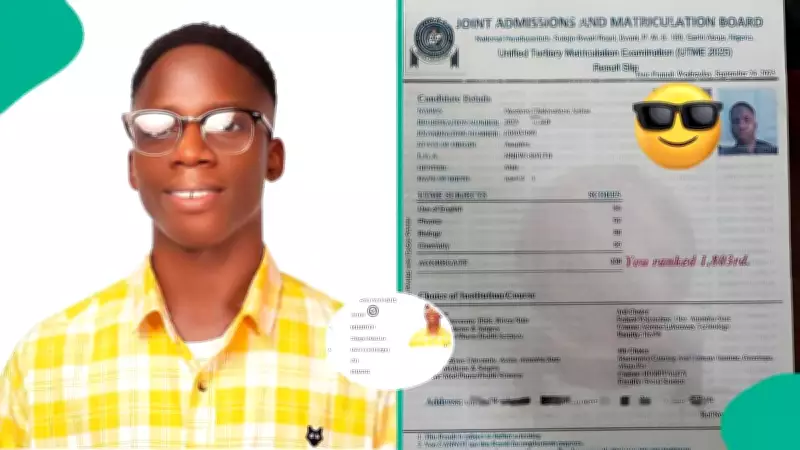
A determined Nigerian student has shared his remarkable academic journey, revealing how he transformed admission rejection into outstanding examination success. Okonkwo Chukwudozie Joshua, whose story initially gained attention in 2024 after being denied admission to study his dream course despite scoring 304 in the Joint Admissions and Matriculation Board (JAMB) examination, has now detailed how he achieved an impressive 338 score in the 2025 JAMB test.
Overcoming Multiple Admission Setbacks
The young scholar's path to university admission was marked by significant challenges. He first wrote the JAMB examination in 2022 but was denied admission to his preferred institution. In 2023, he chose not to register for the exam, hoping his previous score would eventually secure him a university placement. However, when 2024 arrived without admission, he attempted the examination again only to face another rejection from Nnamdi Azikwe University (UNIZIK), where he had hoped to study.
In a recent social media update shared on February 8, 2026, Joshua announced that he has moved beyond the admission-seeking phase and is now successfully enrolled in a Nigerian university, currently in his second year (200L) studying Medicine and Surgery. His post emphasized that while his initial admission struggles occurred in 2024, he has since progressed academically and now wishes to share his examination strategy with current JAMB candidates.

The Strategic Approach to JAMB Excellence
Joshua revealed that his breakthrough came through a meticulously planned study approach that differed significantly from his previous methods. While he had previously relied on past questions spanning ten years to achieve scores of 284 and 304, his 338-point achievement resulted from a more systematic strategy.
The core of his method involved:
- Downloading the complete JAMB syllabus and dividing it into specific topics
- Using artificial intelligence tools to process each syllabus section systematically
- Ensuring comprehensive coverage by preventing AI from providing overly brief explanations
- Combining AI-generated insights with traditional past question practice
He explained that this structured approach allowed him to complete the entire syllabus efficiently, even while preparing for the Joint Universities Preliminary Examinations Board (JUPEB) program simultaneously.
Practical Implementation and Results
Joshua detailed his implementation process, noting that he began with a JAMB mock examination score of 226 before progressively improving to his final 338 result. His strategy focused on breaking down the syllabus into manageable segments, using specific AI prompts to generate detailed explanations for each topic, and reinforcing this knowledge through targeted revision.
"This strategy helped me finish the syllabus in a short period of time, notwithstanding I was reading for JUPEB as well. Still pulled 338," he shared in his social media thread.
The medical student emphasized that his approach contains no magical shortcuts but rather represents a disciplined, systematic method that any dedicated candidate can replicate. He provided evidence of his achievement through examination score screenshots and confirmed his current academic status as a second-year medical student.
Broader Implications for Nigerian Education
This story highlights several important aspects of Nigeria's educational landscape:
- The competitive nature of university admissions, particularly for sought-after courses like Medicine and Surgery
- The resilience required from students facing multiple admission rejections
- The evolving study methods incorporating technology and artificial intelligence
- The importance of strategic preparation beyond mere past question repetition
Joshua's experience mirrors that of many Nigerian students who face admission challenges despite strong examination performances. His successful transition from admission denial to academic achievement serves as both inspiration and practical guidance for current JAMB candidates preparing for their examinations.

The student concluded his sharing by encouraging 2026 JAMB candidates to adopt structured approaches to their preparation, emphasizing that systematic syllabus coverage combined with traditional study methods can yield exceptional results even in highly competitive examination environments.