Contextualising After Shift: Diran Aderinto’s Lens on the City after Work
By Duniya Giles Gambo
“After Shift” is an exhibition that invites viewers into a realm of evocative photographic work created by Diran Aderinto, a multimedia artist whose academic journey spans a degree in Actuarial Science from the University of Lagos, Nigeria, and a Master’s in Filmmaking from Manchester Metropolitan University, UK. Set in Salford, these are not just pictures on display, but an intentional and contemplative interaction with the context that motivated these pieces. Aderinto’s works beautifully evoke the fleeting pleasures that exist in the transitional time between getting tired of work and entering into contemplative isolation. The artist underscores his dedication to this topic by travelling between Manchester and Salford many nights after dark, taking note of the quiet hours when regular people shift from the pressures of work to the joy of home. It is through his lens that Aderinto does not simply represent subjects; he exposes the dignity of ordinary life: it is the people who must walk through the quotidian, the deep journey home after long working hours.
The following takes a careful look at three essential works from the exhibition: “Waiting for Morning to Begin,” “The Body After Labour,” and “The Commute Home.” In this way, I explore how Aderinto’s photography transcends representation, inviting viewers to reflect on contemporary urban experience and social life. City life becomes an intricate tapestry of stories about the nightfall and the days that lie just beyond. I hope through this discussion the significance of Aderinto’s vision will be more clearly understood and the broader concerns of his work explored.

Waiting for Morning to Begin
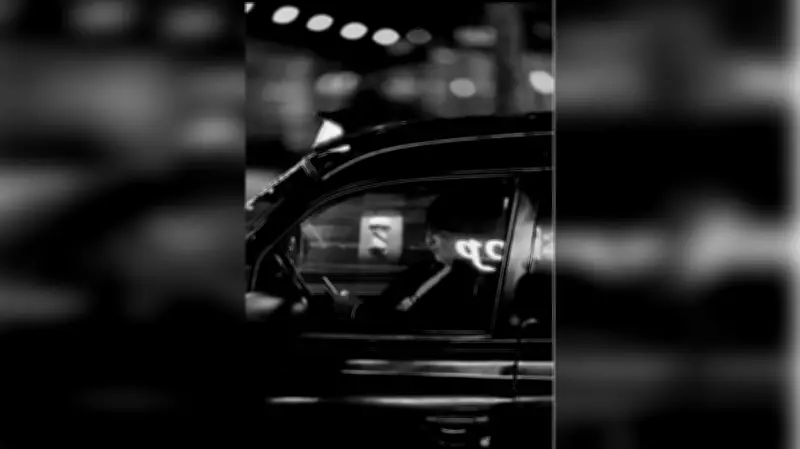
Aderinto’s works speak to everyday modern life in a developed city. “Waiting for Morning to Begin” is one such work. It captures a taxi driver engaged with his phone while waiting for perhaps a passenger, closing time, or indeed morning to break as alluded to by the artist. The intensity with which the taxi driver focused on his phone makes it obvious that he is engrossed with whatever it is that he is doing and therefore oblivious of his immediate environment. He has simply found another world within the one he operates. Thus, he creates an alternative experience as a coping strategy for his night routines. The quietness of the night and the absence of any immediate work or activity compel the taxi driver to find an alternative engagement for himself. This is reflective of most night workers, who sometimes experience slow or complete absence of patronage, particularly on night shifts. This creates a period of inactivity that needs to be put into use. Thus, for this driver, his phone becomes a handy alternative and therefore his temporal world.
The Body After Labour
Another interesting piece is “The Body After Labour.” The artwork is framed through the window of a night transport. Two people are captured in two different resting postures of a nightcap. The person in the background appears submissive to the weight of tiredness, as exemplified by his falling head, held back by his neck, while the one in the foreground appears to have taken a deliberate resting posture. The photographic art explores the varied dimensions of rest, particularly after a hard night shift at work. It captures two distinct individuals manifesting rest in two unique ways. Though both appear to be sleeping, it is apparent that sleep stole one of them, while the other courted sleep. The alternative point is that both are tired from work and needed sleep, which could not wait until they commute home.

The Commute Home
Incidentally, the last photographic piece to be reviewed here is titled “The Commute Home.” The work exemplifies yet another dimension of tired workers who are returning to their various abodes. These tired working strangers are brought together by the shared utility of public night transport. They are seated close to each other, yet each one is in his or her tired reflection, thoughts, and contemplation. They have therefore innocently created huge distances among and within themselves, despite their closeness in space. Such distances are further increased by the apparent silence that engulfs the environment they are commuting in. Their self-indulgence is also supported by the quiet social structure of urban British life, within which they live and work. Thus, you need a good justification to intrude into such private moments, despite the commonality of the transport means.
Aderinto has done a range of unconventional photographs inspired by the same message, but at different places. Among these are “The Last Stop Before Home” and “Resting Between Stops.” Between each of these works, the camera is the tool for Aderinto’s artistry. As Duniya (2025) aptly asserts, “the camera is an instrument for (de)constructing visual narratives, representation, and agency.” Aderinto has skillfully captured real, intuitive, moment-to-moment, realistic events as lived by night shift workers. In the process, it also reflects the emotional rhythm of the workaday lives, the subtle bonds that they establish with themselves and their cities via the cadences of their daily commutes. These visual stories may owe much to Aderinto’s own experiences as the intensity of daily commuting in Lagos offers a jarring contrast to the quieter, deeper, and darker rhythms of Manchester. Thus, these photographs create a form of psychological refuge for night shift workers, providing comfort when faced with anxious waits for dawn or fatigue during their on-the-job day. They echo the still, reflective thoughts of their travels home, which include symptoms of tiredness and hunger. Additionally, these pieces serve as positive affirmations even for those who do not value night shift work, re-evaluating existing ideas about post-night shift activities. Ultimately, Aderinto’s work encourages reflection on fatigue, labour, waiting, and the quiet emotional negotiations of urban life after dark.