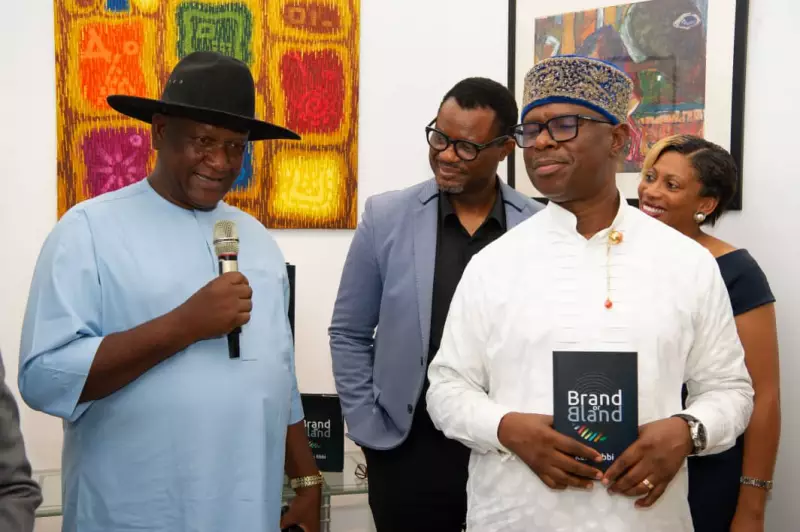
The recent presentation of a new book by renowned brand strategist Kenn Ebbi has ignited a crucial national conversation that extends far beyond its pages. The launch of 'Brand or Bland' on Tuesday, December 16, 2025, at The Art Hotel in Victoria Island, Lagos, transformed from a standard literary event into a profound dialogue on Nigeria's history, identity, and its struggle to project a cohesive national image to the world.
A Gathering of Minds on Branding and Perception
The event attracted a diverse and influential audience, including brand professionals, policymakers, business leaders, and creatives. Alongside the book unveiling was a destination branding exhibition featuring cultural monuments, underscoring the central theme of how societies remember and define themselves. The occasion was chaired by Pastor Onyekwere Ogba, who set a candid tone by admitting the book's intellectual demand, humorously comparing it to studying advanced engineering without the prerequisites. His personal takeaway was immediate: the book changed his perception, prompting him to wear a suit for the first time in two years as a personal act of rebranding.
Dr. James Raphael, founder of the Centre for Research, Information Management and Media Development (CRIMMD), took the discourse deeper into the realm of history and memory. He challenged the audience on the dangers of accepting narratives without verification, using the pervasive story of Mungo Park 'discovering' the River Niger as a prime example. 'He never claimed to have discovered the River Niger,' Raphael stated, pointing out that historical records show Park only sought to find its source. This, he argued, is symptomatic of a broader failure to interrogate our stories before passing them on.

Institutional Failures and Global Lessons
Dr. Raphael further highlighted a stunning institutional oversight: for six decades after independence, there was no publicly known record of who designed Nigeria's coat of arms, a primary national symbol of authority. His research eventually traced the records to the College of Arms in London. 'Why did the Nigerian government never make an effort to find out?' he questioned, stressing that such symbols are foundational to state legitimacy, not mere decoration.
Former Rivers State Commissioner, Mr. Austin Tam-George, placed Nigeria's branding challenges in a global context. He argued that strong national brands are built through deliberate, long-term strategy, not natural endowments. Citing Taiwan's rise as a microchip powerhouse despite lacking natural resources, and Barcelona's meticulous urban planning for future generations, he emphasized continuity and foresight. For Nigeria, he cautioned against confusing branding with propaganda, insisting it must be rooted in integrity and an honest acknowledgment of problems. He singled out Nollywood as a potent, under-leveraged cultural asset, urging intellectuals to engage with it seriously as a treasure trove of national imagination.
Authenticity as the Unshakeable Foundation
In his address, author Kenn Ebbi returned to his book's core thesis: authenticity is non-negotiable for any meaningful brand, be it personal, corporate, or national. He dismissed natural resources like oil as a branding foundation, asserting that 'a Nigerian will remain a Nigerian. That is authentic.' He critiqued fabricated narratives around business tourism in a climate where ease of doing business remains low, and instead pointed to Nigeria's vibrant cultural realities as untapped strengths. He provocatively suggested that an 'Owambe City' celebrating Nigeria's famed party culture could be a more powerful brand than projects like Eko Atlantic City.

Dr. Dakuku Peterside, former Director-General of NIMASA, provided a critical distinction between reputation and branding. He explained that reputation is about perception, while a true brand is built on consistent value delivery. 'If you speak the best grammar and you are not adding value, you have no brand,' he stated bluntly. He contrasted global brands like Ford and Mercedes, which evoke clear national competencies, with Nigeria's reliance on crude oil exports, which reflects little innovation. For him, sustainable branding requires introspection and addressing underlying weaknesses, as negative narratives do not emerge from a vacuum. 'Negative stories are not built on a foundation of nothing,' he concluded, linking credibility to long-term value creation and innovation.
The event, attended by figures like real estate mogul Afolabi Adams Akindele and The Etiquette Place's Yvonne Ebbi, concluded with a powerful consensus: Nigeria's path to a respected global brand lies not in propaganda or borrowed models, but in embracing its authentic identity, confronting its historical inaccuracies, and consistently delivering value rooted in its unique people and culture.