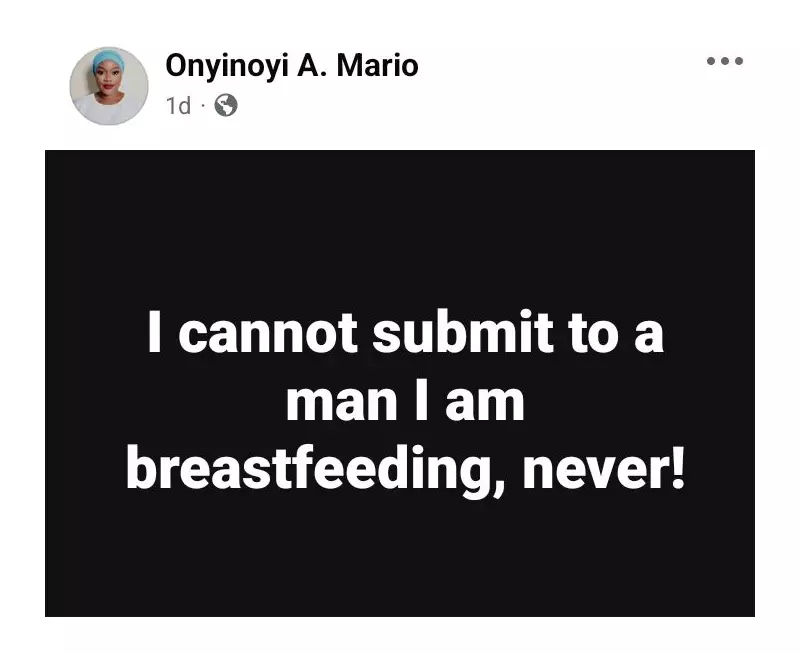
A statement made by a Nigerian woman regarding marital dynamics has ignited a fiery conversation across social media platforms and within communities. The core of the debate centers on the concept of a wife's submission to her husband, particularly during the physically and emotionally demanding period of breastfeeding a child.
The Viral Statement That Sparked Debate
The controversy began when a Nigerian woman, whose identity has not been publicly disclosed, made a bold declaration. She firmly stated that she cannot submit to a man she is currently breastfeeding. This remark, shared widely online, quickly transcended personal opinion to become a national talking point. It touched a raw nerve, prompting thousands of reactions from men and women across Nigeria and the diaspora.
The woman's perspective challenges traditional interpretations of marital roles head-on. In many Nigerian cultures, and indeed within various religious teachings, the wife's submission to her husband is often presented as a cornerstone of a successful marriage. Her statement introduces a new layer to this expectation, questioning its applicability during the intimate and taxing phase of motherhood where a woman is solely responsible for nourishing an infant.

Divided Public Reactions and Cultural Clash
Public reaction to the woman's stance has been sharply divided, reflecting the ongoing tension between traditional values and evolving modern perspectives on gender equality.
A significant segment of social media users, particularly many women, have rallied in support of her position. They argue that the statement highlights a profound truth about the physical and emotional labour of motherhood. Supporters contend that the act of breastfeeding itself is an ultimate form of giving and sacrifice, which temporarily redefines the power dynamics in a relationship. They see her comment as a call for mutual respect and understanding from husbands during this vulnerable time, rather than a blanket rejection of submission.
Conversely, a strong opposing view has emerged, primarily from individuals upholding more conventional beliefs. Critics have labeled the woman's statement as disrespectful and a deviation from established cultural and religious norms. They maintain that a wife's submission is a non-negotiable, continuous duty, unaffected by circumstances like childbirth or breastfeeding. From this viewpoint, the roles of mother and wife are separate, and one does not exempt her from the responsibilities of the other.
Broader Implications for Modern Nigerian Marriages
This viral episode is not an isolated incident but a symptom of a larger, ongoing dialogue in Nigerian society. It forces a re-examination of long-held beliefs about marriage, partnership, and gender expectations. The conversation delves into practical questions: What does submission mean in a 21st-century Nigerian home? How do couples navigate the shift in dynamics when a new baby arrives?
The debate underscores a growing demand, especially among younger Nigerians, for marriages built on partnership and flexibility rather than rigid hierarchy. It calls for a model where roles are adaptable based on circumstance, such as the postpartum period, and where a husband's support is seen as integral to the family's well-being.
Ultimately, the Nigerian woman's candid remark has opened a necessary, if uncomfortable, conversation. It has moved the discussion beyond abstract principles into the lived reality of millions of couples. While no consensus has been reached, the intense engagement with the topic proves that the definition of a successful Nigerian marriage is actively being negotiated, one viral statement at a time.