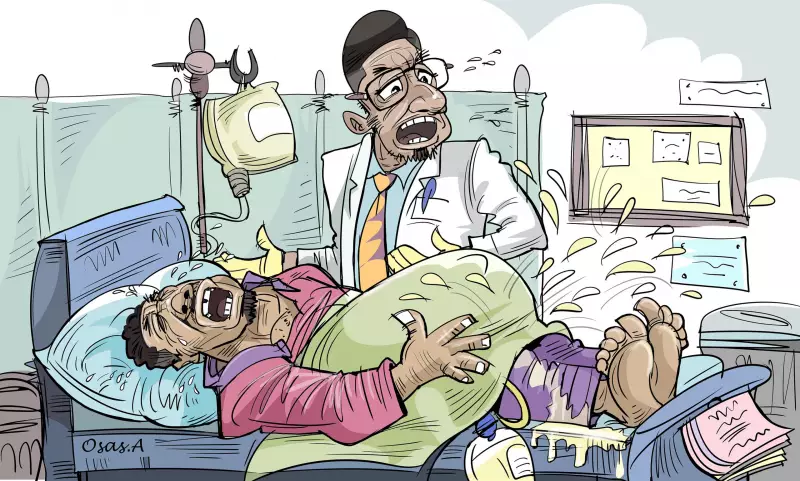
What was meant to be life-saving medical intervention for a stroke patient has instead resulted in a debilitating, life-altering injury. Alfred Ogene, a cleric and consultant architect, is now living with severe pain and a permanent catheter after what he describes as a mishandled procedure at a private Lagos hospital.
A Night of Emergency Turns Into a Prolonged Ordeal
On November 15, 2025, Alfred Ogene went to bed feeling unwell. He soon realised he could not move his right arm or leg. With public hospitals reportedly on strike, his family rushed him to the emergency unit of R-Jolad Hospital in Gbagada, Lagos. Scans confirmed he had suffered a stroke.
Due to his immobility, a urinary catheter was inserted. Ogene told The Guardian that he soon noticed a problem: while some urine flowed into the bag, a significant amount was leaking onto his body. After he reported it, a nurse replaced the catheter. It was after this replacement, performed by a nurse he identified as Nurse Elizabeth, that his nightmare began.

"I began experiencing persistent and worsening pain in my groin area," Ogene recounted. "I called the nurse four times. She kept telling me it was normal. By the fourth time, I had to shout because my stomach and groin had swollen badly. I felt my life was slipping away."
Systemic Failures and a Costly Complication
Only when his cries drew attention did two doctors—neither of them urologists—attend to him. Upon removing the catheter, blood spilled out. The doctors resorted to an emergency procedure, piercing his lower abdomen with syringes to drain urine directly from his bladder for temporary relief.
It took about three days before a urologist was available. By then, the damage was severe. Ogene was informed his urethra had been ruptured and required a suprapubic catheter—a tube inserted directly into the bladder through the abdomen. "The damage they caused was worse than the stroke I came in with," he stated.
The financial cost was staggering. Ogene's family had paid an advance of about N1.4 million for ICU admission. By the time he was discharged on November 27, 2025, total bills had exceeded N4.4 million, including an additional N750,000 for the urological procedure to address the hospital-induced injury.
Medical Evidence and Expert Analysis
Independent medical evidence corroborates Ogene's account. A scan conducted at Broad Places Radiology in Surulere, Lagos, on December 1, 2025, and reviewed by consultant radiologist Dr. Ezekiel Akande, confirmed a "rupture of the bulbar urethra." This serious injury is often linked to traumatic or poorly executed catheterisation.
Medical practitioners explained how such injuries occur. Dr. Martins, a medical practitioner, outlined risks: poor lubrication, premature inflation of the catheter balloon in the urethra instead of the bladder, or failure to fully deflate the balloon before removal. "Inflating the balloon before it enters the bladder could rupture the surrounding cells," he explained.
Jama Medan, Chairman of the National Association of Nurses, clarified protocols. While catheterisation is often a sterile nursing procedure, patient consent and understanding are paramount. He acknowledged that bleeding can be a known complication, not always indicative of error, but stressed that "when there is difficulty or bleeding, the doctor must be notified."
Nurse Elizabeth Adeosun of Isolo General Hospital outlined the duty to escalate: if a patient complains persistently, the nurse must assess, intervene for comfort, and formally notify the prescribing physician if issues continue. "Nurses are not expected to overlook patient complaints," she emphasised.

Life After Discharge: Pain, Silence, and Unanswered Questions
The injury has left Ogene dependent on a permanent catheter, hindering his stroke rehabilitation, his work as an architect, and his pastoral duties. Following discharge, he says the hospital management provided no explanation or follow-up, beyond an automated reminder for a neurology consultation days later—a message his wife found "confused and hurt."
Efforts by The Guardian to get an official response from R-Jolad Hospital were unanswered. The hospital had requested enquiries via email but provided no detailed response by the time of reporting.
Ogene's wife described the ordeal as "humiliating, exhausting and spiritually distressing," compounded by the immense financial strain. The family's quest for accountability and a normal life continues, overshadowed by a severe pain that began not with the stroke, but in the hospital room meant to provide healing.