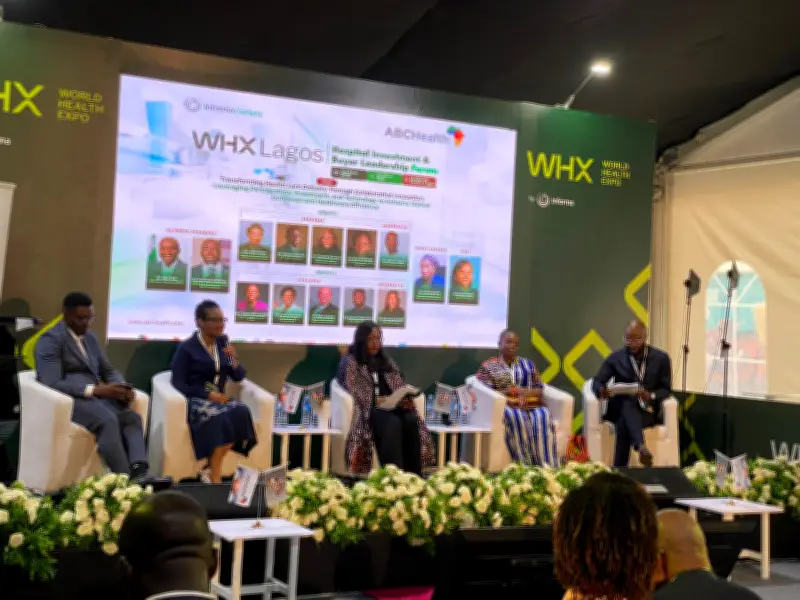
The conversations started even before the microphones were switched on. At Landmark Centre in Lagos, clusters of healthcare executives, policymakers, investors, and innovators moved between exhibition stands and panel halls at WHX World Health Expo, Day 2 of the Hospital Investment & Buyer Leadership Forum. Screens displayed digital health solutions, telemedicine systems were being demonstrated in real time, and conversations about transformation filled the air. But beneath the energy of innovation, a quieter truth kept surfacing throughout the day: Nigeria’s healthcare system is not short of ideas, it is short of execution.
Held in partnership with the African Business Coalition for Health (ABCHealth), the forum, themed “Advancing Hospital Growth and Innovation: Investment, Strategic Partnerships, and Technology Adoption in West Africa,” became less of a conference and more of a mirror held up to the system itself. The opening remarks from Dr. Mories Atoki, Chief Executive Officer of ABCHealth, and Zouera Youssoufou of the Aliko Dangote Foundation set a familiar tone—collaboration, investment, and cross-sector alignment. But as the day unfolded, a more urgent pattern emerged across keynote speeches, interviews, and panel exchanges: most stakeholders were no longer debating what the problems are. They were confronting why solutions are not scaling.
The real story behind WHX Lagos
Across panels, exhibitions, and hallway conversations that stretched between sessions, a consistent reality quietly shaped Day 2 of WHX Lagos: healthcare transformation in West Africa is no longer constrained by a lack of ideas or even a shortage of innovation. What became increasingly clear in the packed rooms of Landmark Centre was something more complex—and more uncomfortable. The challenge now is not invention, but alignment. Not possibility, but coordination. From digital health demonstrations on the exhibition floor to high-level discussions on hospital financing and policy frameworks, the same fault lines kept resurfacing: systems that do not talk to each other, innovations that struggle to scale beyond pilot phases, and well-funded initiatives that often remain disconnected from one another. In one corner of the venue, telemedicine platforms were being demonstrated as fully functional solutions for rural care. In another, conversations on regulatory frameworks were stressing the importance of standards and governance. Meanwhile, in panel rooms upstairs, hospital leaders spoke about investment pipelines that exist—but are often difficult to access or translate into sustainable impact on the ground. Innovation, in other words, was not missing. It was visible everywhere.

Investment was not absent either. It was present in conversations, partnerships, and active interest across public and private actors. And expertise was not in short supply—Nigeria’s healthcare ecosystem, as the discussions showed, is rich with technical knowledge, operational experience, and global partnerships. Yet despite all of this, a central question lingered beneath every session: how does a fragmented system become one functioning whole?

“It doesn’t work when people come in, build something, and then leave again” — Dr. Jide Idris
Speaking on collaboration, infrastructure, and financing, Dr. Jide Idris, Director-General of the Nigeria Centre for Disease Control and Prevention (NCDC), returned repeatedly to one idea: sustainability depends on ownership. When asked about the importance of collaboration, technology, and investment in improving healthcare delivery in Nigeria, he responded: “The point is that we know this: it doesn’t work when people come in, build something, and then leave again. You can’t build infrastructure without involving the people who will use and maintain that infrastructure. People come with different expertise and contribute to what is being built. We may not fully understand everything they are building, and they may not fully understand our context either. So whatever infrastructure we want to build has to be relevant to us and something we can relate to. Those who are supporting these efforts need to understand the situation here and what our actual needs are, rather than simply building infrastructure and leaving after a while. The same applies to technology. We know the role technology plays in improving our lives, making things faster and making work easier. But if technology is not properly regulated and coordinated, different people will adopt different technologies and, in the end, the systems become disconnected. Rather than working together, they end up competing with one another. The same is true for financing. There are people who need money, and there are people who have money. The challenge is creating a way for those who have resources to connect with those who need them. However, there are important issues involved. People need to be educated about what type of funding is available, what conditions are attached to it, and what is required to access it. Those providing funding are not giving it away for free, and those receiving it need the resources to achieve specific goals. The funding must be used to build and strengthen systems. That is why collaboration is so important. Collaboration is the only way we can truly transform our system. Transformation is not about ignoring what we already have; it is about understanding our environment and asking how we can improve it effectively to achieve positive outcomes. Ultimately, our goal is to do the right thing for our patients.”
On the question of Nigeria’s technological readiness for a digital revolution, Dr. Idris stated: “We already have technology. We have technology for ambulances, hospitals, and healthcare systems. What is required is integration. We have many systems, but these systems need to communicate with one another. For example, the platforms used by agencies such as the CDC and the systems used by government programs for diseases like tuberculosis often operate separately. Technology on its own is not enough. The challenge is that the data collected through these systems must be analyzed and used to improve patient care. If the systems are not integrated and cannot work together, much of the effort becomes wasted. That is why I keep emphasizing collaboration and integration. Integration cannot happen without policies and regulations. There must be standards and oversight. The people operating these systems must be competent and properly trained. Ultimately, it all comes down to governance.”
“We already have solutions. The problem is execution.” — Dr. Funmi Adewara
If Dr. Idris framed the system problem at policy level, Dr. Funmi Adewara, Founder and Chief Executive Officer of MobiHealth International, brought it sharply into implementation reality. “I am Dr. Funmi Adewara, the founder and Chief Executive Officer of MobiHealth International. MobiHealth International is Africa’s fast-growing integrated telemedicine company, connecting patients in Nigeria and across Africa to doctors—both local and international—and providing access to a wide range of medical services on a single platform.” When asked about achievements from previous events, she answered: “Well, in relation to the WHX, it has been a fantastic platform that brings together stakeholders in the healthcare industry—from regulators, to private sector participants, to development partners to discuss how we can truly address the barriers in our healthcare sector. From the discussions we’ve had today, there has been a strong focus on execution and discipline in implementation. The problem is not that we do not know the challenges—we already know them. The problem is not the absence of solutions—we already have solutions within the industry. The real issue is disciplined execution. We need to move from talking repeatedly to actually implementing the solutions that are discussed year after year.”
Her intervention reflected what several participants echoed across the venue: innovation in Nigeria’s healthcare system is no longer the bottleneck—scaling it is. Through MobiHealth’s telemedicine model, she described how care is already reaching underserved communities using solar-powered, satellite-connected clinics with trained operators on the ground. “You can be in a village, and we are already doing this. We have impacted over 500,000 lives to date, and we hope to impact 1 million lives every year going forward.” But she also pointed to a structural barrier that ran through almost every conversation at the event: fragmentation. “Many of these solutions currently operate in fragments and in silos. Data is not integrated, and systems are not communicating with one another. There is no continuity of care across different levels of the healthcare system.” For her, the next phase is not invention but connection. “We need a centralized digital infrastructure that connects all the dots, so that a patient can move seamlessly between virtual care and physical care… ensuring continuity of care, data protection, and quality of service.”
On her take-home message for Nigeria regarding healthcare and technology, Dr. Adewara said: “My take-home message to Nigeria is that the technology already exists to significantly reduce the burden of disease, and we need to leverage it effectively. We can connect with doctors and healthcare services digitally, which can reduce the burden of disease. Prevention is better than cure, so we should not wait until we are very ill before seeking care. However, there is still a need for greater awareness. Government must take a leading role in ensuring that people are informed and can access these services. There is also a need for proper policy frameworks so that telemedicine does not operate in silos but within an integrated national health system. This will also ensure there is a clear pathway for innovators and investors to recoup their investments, making the system sustainable.”
Closing perspective
WHX Lagos Day 2 did not simply showcase healthcare innovation; it exposed the tension between progress and fragmentation. There was optimism, but it was not uncritical. There was excitement, but it was constantly checked by reality. Every major conversation seemed to circle back to the same gap: the distance between what is already being built and what is actually working together at scale. As delegates gradually filtered out of Landmark Centre—past exhibition stands, unfinished conversations, exchanged contacts, and lingering discussions in clusters outside the halls—one quiet conclusion seemed to follow the movement of people leaving the venue. It was not a conclusion written on slides or repeated in speeches. It was something felt. Africa’s healthcare future will not be defined by what is built. It will be defined by what is made to work together—consistently, at scale, and across systems that have long operated in isolation.