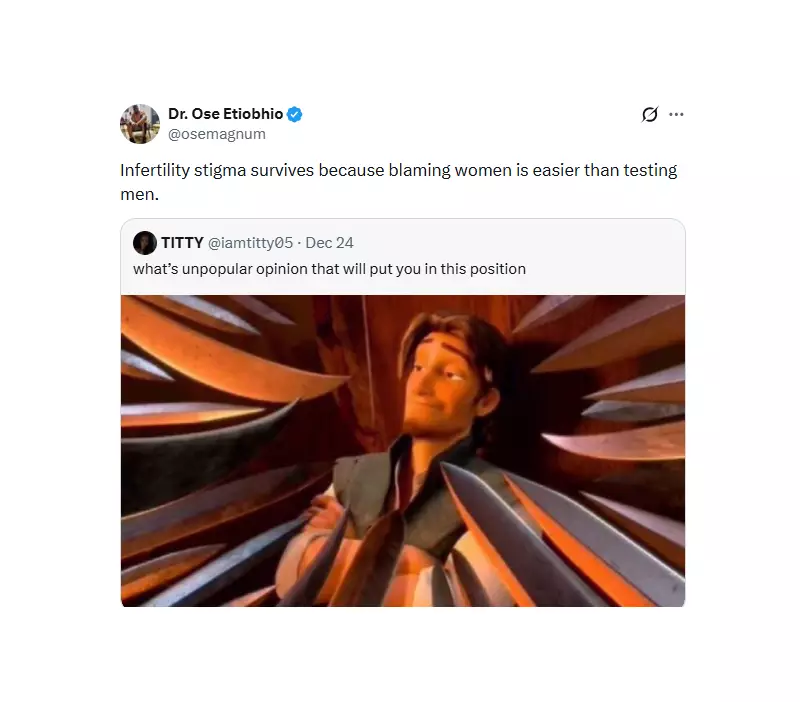
A Nigerian medical professional has called out a persistent social injustice, stating that the stigma surrounding infertility continues largely because it is simpler to place blame on women than to encourage men to undergo necessary medical examinations.
The Root of the Stigma: A Culture of Blame
Dr. Ose Etiobhio brought this issue to public attention in a statement made on Saturday, the 28th of December, 2025. He emphasized a critical fact often overlooked in Nigerian society: infertility is a condition that can affect both men and women equally. However, the burden of stigma and social shame disproportionately falls on women.
Dr. Etiobhio pointed out that this imbalance survives because there is a widespread reluctance to subject men to fertility testing. He argued that culturally, it has become an easier path to fault women for childless marriages rather than to investigate the male partner's reproductive health.

A Direct Call to Action for Men
In his frank message, Dr. Etiobhio used a vivid analogy to drive his point home. He stated that many men are unaware of their own fertility status, highlighting that a lack of visible issue does not equate to fertility. His direct call was for men to take responsibility by getting a simple semen analysis.
"Too many men are shooting loads of rivers into their partners, but no tadpoles or fishes in the rivers," he wrote, underscoring that quantity does not guarantee the presence of viable sperm. His concluding advice was unambiguous: "men get yourself tested. do a semen test."
Shifting the Narrative on Reproductive Health
The implications of Dr. Etiobhio's statement are significant for Nigerian families and the healthcare system. The continued stigma has profound consequences:
- It causes immense psychological distress and social isolation for women wrongly blamed.
- It prevents couples from seeking timely and appropriate joint medical help.
- It perpetuates gender inequality in health discussions and within marriages.
By publicly challenging this norm, Dr. Etiobhio advocates for a more equitable and scientific approach to infertility. His message encourages a shift from blame to shared responsibility, where both partners in a marriage are equally assessed. This is a crucial step towards destigmatizing infertility and ensuring couples receive the correct diagnosis and support they need.