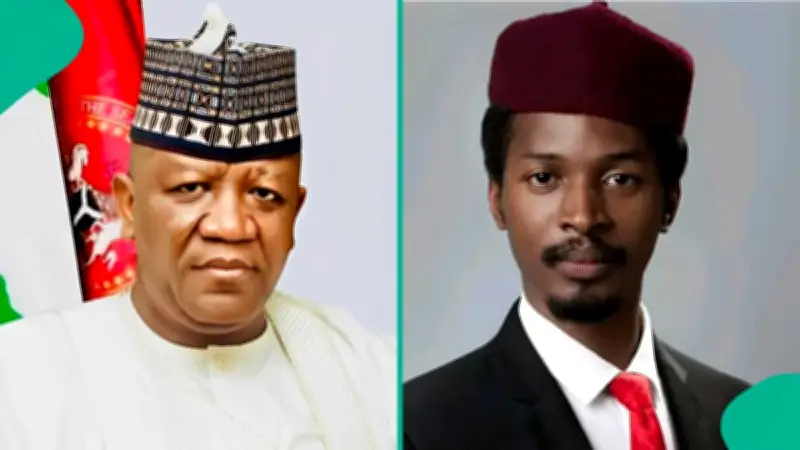
Political analyst Umar Muhammad, PhD, has raised concerns over what he described as a renewed wave of online allegations against Senator Abdulaziz Yari, including claims circulating on social media about a ₦1.7 trillion financial scandal and alleged links to gold-related dealings. Muhammad made the observations in an analysis of recent digital content and viral videos, stressing that while public accountability is essential, the situation highlights risks of misinformation and “trial by social media.”
Allegations Against Abdulaziz Yari Circulate Online
Muhammad wrote that Senator Yari has “found himself at the centre of a renewed wave of online allegations ranging from claims of involvement in a supposed ₦1.7 trillion financial scandal to viral videos circulated by activist Dan Bello linking him to corruption and illegal gold dealings.” He noted that the ₦1.7 trillion allegation is “not new” and has appeared in different forms across blogs and social media platforms, but remains unproven.
No Official Court Findings
Muhammad stated that although some reports and online content link Yari to large financial transactions and corporate acquisitions, “these remain unproven allegations without any final judicial conviction or official court ruling confirming wrongdoing.” He added that political associates have previously described the claims as “politically motivated narratives designed to damage his reputation ahead of future political cycles.”

Gold Seizure Claims Unconfirmed
The analyst also addressed claims linking Yari to gold seizures at Kano airport, stating that “there has been no official confirmation from the EFCC naming him as a suspect or charging him in relation to the seizure.” He emphasised: “This distinction is critical: in law, allegation is not evidence, and viral content is not verdict.”
Rise of Online Investigative Content
Muhammad observed that activist-driven content has reshaped public discourse in Nigeria, noting that social media figures such as Dan Bello have gained followings through viral exposés. However, he warned that problems arise “when unverified claims are presented in a way that mimics formal investigative authority without the legal burden of proof.” He stressed the need for clear separation between “suspicion, investigation, and proven fact.”
Call for Due Process and Caution
The analyst said Nigeria’s political environment often exposes public figures to sustained online scrutiny, noting that Senator Yari, as a former governor and political actor, is no exception. However, he cautioned that scrutiny should not be confused with “coordinated narrative warfare,” adding that the timing and repetition of allegations across platforms suggest a broader pattern. He stated that “one of the foundations of democracy is that guilt is determined in court, not in comment sections,” outlining that due process requires proper charging, presentation of evidence, fair hearing, and judicial determination.
Warning on Digital Misinformation
Muhammad concluded that until judicial processes are completed, public narratives must remain cautious, warning that framing individuals as guilty without conviction risks undermining justice and democratic fairness. He added that his position is not against accountability, but a call for “discipline in public communication and ethical responsibility in digital storytelling.” He said Nigeria’s democracy would be strengthened by prioritising “evidence over emotion, investigation over insinuation, and judgment through courts, not timelines,” warning that unchecked digital narratives risk replacing truth with trending content.