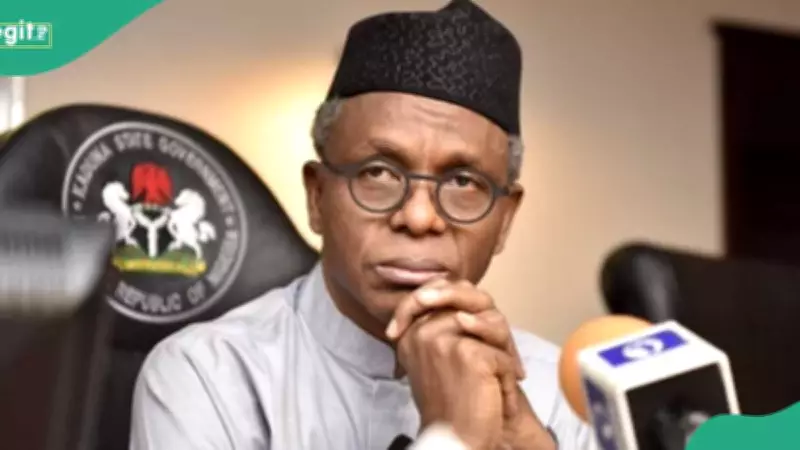
Former Governor El-Rufai Sounds Alarm on Nigeria's Security Direction
Former Kaduna State Governor, Malam Nasir Ahmad El-Rufai, has issued a stark warning about the state of Nigeria's national security, asserting that the country's focus has dangerously shifted from protecting ordinary citizens to defending those currently in power. In a detailed statement released on February 8, 2026, titled "National Security, Justice, and the People's Wellbeing: Reclaiming the Purpose of Power," El-Rufai presented a critical analysis of what he describes as the weaponization of security institutions against political opponents and dissenting voices across the nation.
From National Security to "Regime Security"
El-Rufai emphasized that the fundamental purpose of national security should be to ensure that citizens can live in peace, dignity, and without fear. "National security exists so that citizens can live in peace, dignity and without fear. It should not be about protecting those who temporarily occupy power," he declared. The former governor pointed to Nigeria's National Security Strategy from 2019, which defines security as "the cornerstone of development and progress in a free society." He argued that a state cannot genuinely be considered secure if its citizens live in constant fear or if public institutions become weakened by political partisanship and selective enforcement.
"There is a clear difference between protecting the country and protecting a regime," El-Rufai stated unequivocally. He stressed that while governments are temporary entities that come and go through electoral processes, the state itself and its foundational institutions must endure beyond political cycles. True national security, according to his perspective, involves the comprehensive protection of:

- Lives and property of all citizens
- Constitutional order and democratic principles
- Territorial integrity of the nation
- Public trust in governmental institutions
Security Institutions Deployed Against Critics
The former governor expressed deep concern about what he perceives as the systematic repurposing of Nigeria's security and criminal justice institutions over the country's 26 years of democratic rule. According to El-Rufai, these agencies have increasingly been deployed to preserve political dominance rather than uphold the Constitution and protect citizens' rights. He specifically highlighted the selective deployment of multiple security and anti-corruption bodies against perceived political opponents, including:
- The Nigeria Police Force
- The Department of State Services (DSS)
- The Economic and Financial Crimes Commission (EFCC)
- The Independent Corrupt Practices Commission (ICPC)
- Certain elements within the judiciary
"Treating opposition and criticism as security threats is morally wrong and strategically disastrous," El-Rufai asserted. He further criticized what he described as the targeting of associates and family members of critics without credible evidence, characterizing such practices as collective punishment that erodes professionalism within security agencies and undermines their constitutional mandates.
Consequences of Misusing Security Institutions
El-Rufai warned that the current trajectory has severe consequences for Nigeria's stability and development. According to his analysis, the misuse of security institutions leads to multiple negative outcomes:
- Collapse of public trust in governmental institutions
- Diversion of attention and resources from combating genuine security threats like terrorism and violent crime
- Personalization of state institutions around political figures rather than constitutional principles
- Weakening of the state's capacity to govern effectively
- Radicalization of political competition and discourse
- Discouragement of domestic and international economic investment
"Democracies where security agencies serve incumbents rather than institutions risk collapse, even if elections continue to hold," he cautioned, pointing to the fragility of democratic systems when security forces become politicized.

Call for Constitutional Security Framework
In response to these concerns, El-Rufai called for a fundamental reorientation of Nigeria's security approach. He advocated for a return to what he described as a human-centred and constitutionally grounded security framework, where security agencies owe their primary allegiance to the Constitution rather than to temporary political office holders. The former governor emphasized that justice must remain blind to political affiliation and that opposition should be recognized as a legitimate and necessary pillar of democratic governance.
"National security belongs to the Nigerian people, not to those occupying public office," El-Rufai declared. He added that lasting peace and stability would remain elusive until security agencies fully return to their proper role as guardians of the state and servants of the Constitution. The former governor concluded that Nigeria's security challenges cannot be effectively addressed until the fundamental purpose of security is restored to protecting citizens rather than preserving political power.