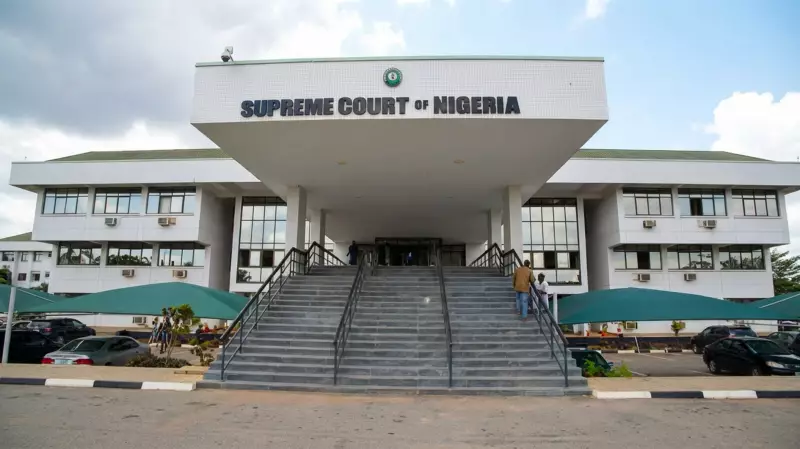
In a decisive ruling, the Supreme Court of Nigeria has delivered a twin verdict affecting the family of former Jigawa State Governor, Sule Lamido. The apex court on Friday, January 16, 2026, dismissed the final appeal by his son, Aminu Sule Lamido, upholding his conviction for currency declaration violations. In a related but separate judgment, the court also ordered the resumption of a high-profile ₦1.35 billion corruption trial against the former governor and two of his sons.
A Decade-Long Legal Battle Ends for Aminu Lamido
The legal ordeal for Aminu Sule Lamido began on December 11, 2012. Operatives of the Economic and Financial Crimes Commission (EFCC) arrested him at the Mallam Aminu Kano International Airport. He was attempting to travel to Egypt and was found in possession of $40,000. The crux of the charge was that he declared only the statutory $10,000 on the Nigeria Customs Service Currency Declaration Form, failing to declare the full amount in his possession.
After his arraignment, the Federal High Court in Kano convicted him on July 12, 2015. The court ordered the forfeiture of 25 percent of the undeclared foreign currency to the Federal Government. Dissatisfied, Aminu, who was 34 at the time of filing his final appeal, took his case to the Court of Appeal, Kaduna Division.

His hopes were dashed when the appellate court, in a judgment delivered by Justice Habeeb Abiru on December 7, 2015, dismissed his appeal and affirmed the lower court's decision. His last resort was the Supreme Court, where he urged the justices to set aside his conviction.
Unanimous Supreme Court Decision
The Supreme Court panel, presided over by Justice Adamu Jauro, found no merit in the appeal. The lead judgment, delivered by Justice Abubakar Sadiq Umar, was unanimous. The court affirmed the concurrent findings of the two lower courts, effectively ending Aminu Lamido's legal challenge. The case was prosecuted throughout by the EFCC's lead counsel, Deputy Commander Sa’ad Hanafi Sa’ad, while Aminu was represented by Chief O. E. B. Offiong (SAN).
Lamido Family Faces ₦1.35bn Trial Revival
In a significant development on the same day, the Supreme Court breathed new life into a major corruption case against the Lamido family. The court set aside a July 2023 Court of Appeal judgment that had discharged former Governor Sule Lamido and his sons, Mustapha and Aminu Lamido, from a ₦1.35 billion fraud charge.
The EFCC had alleged that Lamido, during his tenure as governor from 2007 to 2015, laundered kickbacks from contractors handling state projects. He, his two sons, and their companies—Bamaina Holdings Limited and Speeds International Limited—were arraigned on a 37-count amended charge before Justice Ijeoma Ojukwu of the Federal High Court in Abuja.
After the EFCC presented its case, the defendants filed a no-case submission. The Federal High Court dismissed this, stating that sufficient evidence existed for them to enter a defense. However, the Court of Appeal disagreed in July 2023 and dismissed the charges.
Supreme Court Sides with EFCC, Orders Retrial
The EFCC appealed to the Supreme Court, arguing that the Court of Appeal erred in law by discharging the defendants despite overwhelming prima facie evidence. A five-man panel of the Supreme Court, in another unanimous decision also delivered by Justice Abubakar Sadiq Umar, agreed with the anti-graft agency.
The court held that the EFCC's appeal was meritorious. Consequently, it voided the Court of Appeal's judgment and ordered that the charges against the Lamidos be resuscitated. Sule Lamido and his sons must now return to the Federal High Court to defend themselves against the allegations.
Implications of the Twin Judgments
These rulings underscore the judiciary's role in upholding accountability, particularly in cases of financial misconduct and abuse of office. The affirmation of Aminu Lamido's conviction sends a clear message on the importance of strict adherence to financial regulations, especially regarding cross-border movement of funds.

More notably, the order for the Lamido family's corruption trial to continue reaffirms the principle that no one is above the law. It represents a significant victory for the EFCC in its pursuit of high-profile corruption cases, demonstrating that legal hurdles can be overcome to ensure that suspects have their day in court.
The dual judgments mark a pivotal moment, closing one chapter of legal battle for the family while forcefully reopening another, with the potential for major political and legal repercussions in the future.