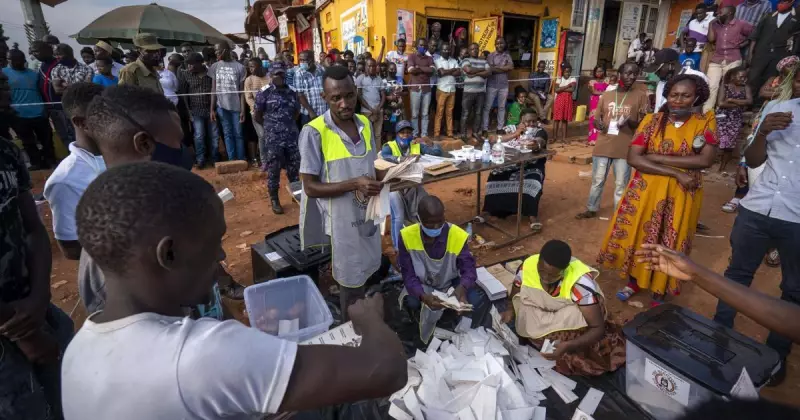
Tensions in Uganda reached a critical point on Saturday as opposition leader Bobi Wine was reportedly cut off from all communications following a police raid on his residence. This development occurred as the nation awaited the final results of Thursday's presidential election, with incumbent President Yoweri Museveni poised to extend his four-decade rule.
Security Forces Raid Opposition Leader's Home
According to his party, the National Unity Platform (NUP), security personnel raided Bobi Wine's home on Friday night. Nkunyingi Muwada, a senior party official, stated that individuals in black attire scaled the compound's wall and confiscated phones, effectively isolating the politician. Conflicting reports emerged about Wine's whereabouts, with his son, Solomon Kampala, claiming on social media platform X that his father had managed to escape during the incident. However, this claim remained unverified.
Early on Saturday, journalists from AFP were blocked from accessing the residence and could not establish contact with Wine or his team by phone. Police spokesperson Kituuma Rusoke defended the actions, stating they were controlling access to areas deemed "security hotspots" to prevent gatherings that could incite violence.

Museveni's Commanding Lead Amidst Election Controversy
The Electoral Commission announced that with over 90% of votes counted, 81-year-old President Yoweri Museveni held a commanding lead of 71.9%. His main challenger, 43-year-old Bobi Wine—whose real name is Robert Kyagulanyi—trailed with 24.5% of the vote. Final results were expected around 1100 GMT on Saturday.
The election process has been marred by significant controversy. An internet blackout, imposed before polling day, remained in effect on Saturday, severely limiting the flow of information. Bobi Wine has accused the government of "massive ballot stuffing" and attacking his party officials under the cover of this digital shutdown. These allegations, while not independently verified, were echoed by the United Nations rights office, which noted the polls occurred in an atmosphere of "widespread repression and intimidation."
Reports of Violence and a Climate of Fear
The election period was not without violence. Muwanga Kivumbi, an MP for Wine's party, reported that security forces killed 10 of his campaign agents after storming his home in the Butambala area. Police offered a different narrative, claiming an "unspecified number" of people were "put out of action" when opposition members allegedly planned to attack a local tally centre and police station.
Near Bobi Wine's residence, 29-year-old stall-owner Prince Jerard described a climate of intense fear, noting the sound of drones and helicopters the previous night and a heavy security presence. "Many people have left the area. We have a lot of fear," he told AFP. Analysts have long viewed the election as a formality, given Museveni's total control over the state and security apparatus since seizing power in 1986.
Election day itself faced logistical hurdles, with malfunctioning biometric voter verification machines and delayed delivery of ballot papers in many areas. As Uganda braces for the official declaration, the actions against the opposition signal a challenging path ahead for political dissent in the country.