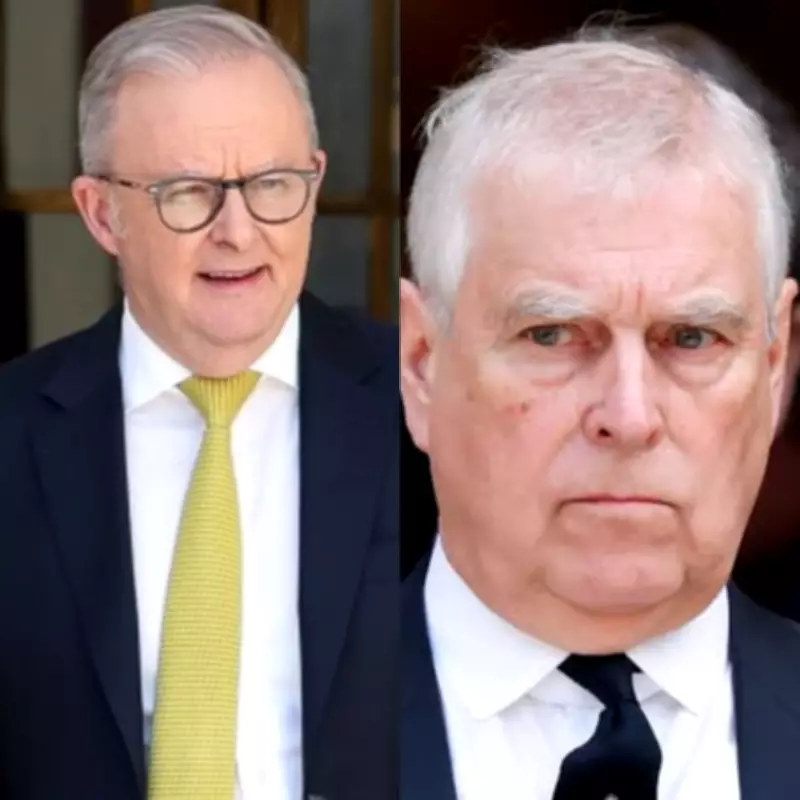
Australia Formally Backs Removal of Prince Andrew from Royal Succession Line
In a significant development concerning the British monarchy, Australian Prime Minister Anthony Albanese has written to UK Prime Minister Sir Keir Starmer, confirming that his government would support any proposal to remove Prince Andrew from the royal line of succession. This move comes in response to the ongoing police investigation into Andrew Mountbatten-Windsor, the former Duke of York, who was arrested on suspicion of misconduct in public office related to his role as a UK trade envoy from 2001 to 2011.
Allegations and Investigation Details
Prince Andrew was questioned by police for approximately 11 hours last Thursday, February 19, which coincided with his 66th birthday, before being released pending further investigation. He has consistently denied any wrongdoing in connection with his duties as a trade envoy and his association with the convicted paedophile Jeffrey Epstein. The allegations include claims that Andrew misused taxpayer funds for personal luxuries such as massages and extravagant travel expenses during his envoy service, as reported by the BBC.
A former civil servant turned whistleblower alleged that attempts to challenge these expenses were overruled by senior staff, adding to the gravity of the accusations. In his letter to Prime Minister Starmer, Albanese, a known Republican, emphasized the seriousness of these allegations, stating, "These are grave allegations and Australians take them seriously." He further expressed agreement with King Charles III that the legal process must proceed with a full, fair, and proper investigation.

Legal and Political Implications
Despite being stripped of his royal titles last year, Prince Andrew remains eighth in line to the British throne. Removing him from the line of succession would require an Act of Parliament in the United Kingdom, as well as the support of all 14 Commonwealth realms where King Charles III serves as head of state. These countries include Australia, Canada, and New Zealand. To date, Australia is the only one of these realms to have publicly indicated its backing for such a measure.
The UK government, under Sir Keir Starmer, has acknowledged receipt of Albanese's letter and is considering whether further steps are necessary regarding Prince Andrew. A spokesman for Starmer stated, "We are considering whether further steps are required in relation to Andrew Mountbatten-Windsor and we are not ruling anything out. But given the ongoing police investigation, it would not be appropriate for the Government to comment further at this stage." The government plans to wait until the police investigation concludes before potentially introducing legislation to alter the succession line.
Broader Context and Reactions
This development highlights the intersection of royal affairs, international diplomacy, and legal accountability. The support from Australia, a key Commonwealth nation, underscores the global scrutiny facing Prince Andrew and the potential for broader repercussions within the monarchy. The case has sparked discussions about transparency and ethics in public office, with many observers closely watching how the UK and other Commonwealth countries will respond as the investigation unfolds.
As the situation evolves, the focus remains on ensuring a thorough investigation while respecting legal protocols. The outcome could set a precedent for how similar cases involving royal figures are handled in the future, balancing tradition with modern expectations of accountability.