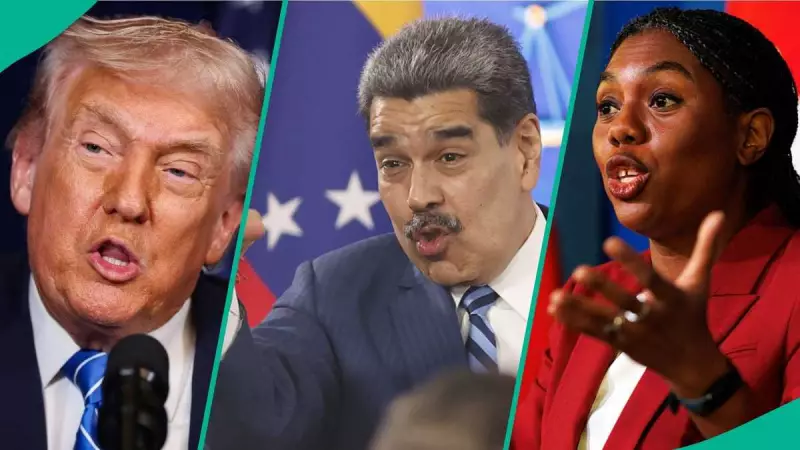
Kemi Badenoch, the leader of the UK's Conservative Party, has publicly stated that the United States' military intervention in Venezuela was morally justified. She made these remarks in a recent interview with the BBC, acknowledging the complex legal questions surrounding the action while firmly supporting its ethical grounds.
Drawing from Nigerian Roots to Condemn Maduro
Badenoch, who spent her formative years in Nigeria, directly linked her personal history to her stance on Venezuela. She revealed that her views were shaped by experiencing life under a military dictatorship before moving to the United Kingdom at age 16. "I grew up under a military dictatorship, so I know what it's like to have someone like Maduro in charge," she told the BBC.
She described the government of Venezuelan leader Nicolás Maduro as brutal and authoritarian. While admitting that the legal certainty of the US operation led by President Donald Trump was not entirely clear, she asserted, "Where the legal certainty is not yet clear, morally, I do think it was the right thing to do." Badenoch added that she was "glad he's gone."

A Clear Distinction: Venezuela vs. Greenland
However, Badenoch was careful to delineate the situation in Venezuela from other geopolitical issues. She emphasized that the UK and its allies were right to push back against President Trump's recent remarks concerning Greenland, a semi-autonomous territory of Denmark.
"There is a big difference between democratic states and the gangster state in Venezuela," she stated. "What happens in Greenland is up to Denmark and the people of Greenland." This distinction underscores the UK government's position that intervention is not a blanket policy but is context-dependent, particularly when dealing with allied democracies.
UK Government's Cautious Diplomatic Stance
The official UK government response has been notably measured. Ministers have refrained from directly condemning the US operation or explicitly stating whether it breached international law. Instead, they have reiterated the position that Maduro was an "illegitimate president."
Health Secretary Wes Streeting defended this cautious approach, explaining that the UK's response to Venezuela differed from its stance on Greenland because Denmark is both a NATO ally and a democratic state. He said Prime Minister Keir Starmer's handling of the issue reflected a balance of Britain's national interest and concern for the Venezuelan people.
This government stance has faced criticism from opposition parties, including Labour MPs and representatives from the Liberal Democrats, the Green Party, and the Scottish National Party, who have urged a stronger denunciation of the US action as unlawful.
The backdrop to these statements includes the US announcement that Nicolás Maduro and his wife, Cilia Flores, would face charges including drug importation conspiracy and narco-terrorism following their capture. The events continue to stir significant debate on the international stage about the limits of sovereignty and the principles of intervention.