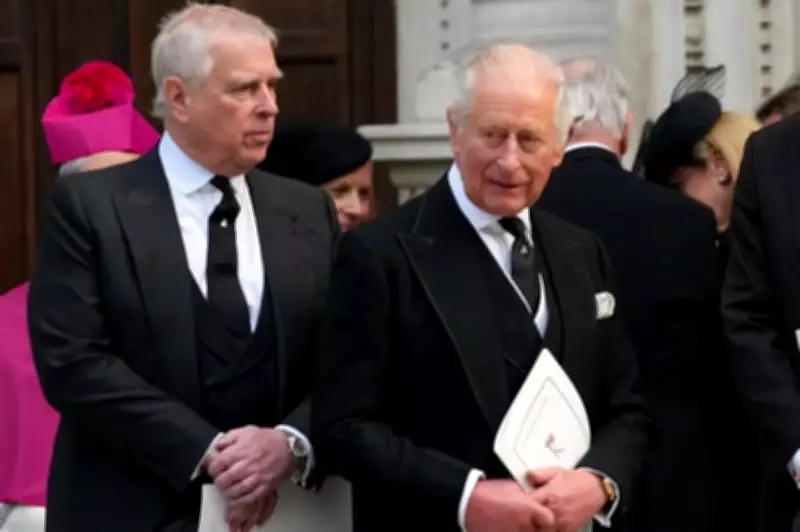
King Charles has declared his readiness to assist British law enforcement authorities as they examine serious allegations concerning his brother, Prince Andrew. The claims suggest that Prince Andrew, also known as Andrew Mountbatten-Windsor, may have shared confidential material with the late convicted sex offender Jeffrey Epstein during his tenure as a United Kingdom trade envoy.
New Epstein Files Spark Police Assessment
The controversy has reignited following the recent disclosure of documents by the United States Department of Justice, which are connected to the Epstein case. These newly released files appear to indicate that in 2010, Prince Andrew transmitted sensitive information to Epstein. This development has prompted immediate action from anti-monarchist organizations and law enforcement agencies.
Graham Smith, who serves as the chief executive of Republic, a prominent British group advocating for the abolition of the monarchy, has formally reported Prince Andrew to the police. The report cites suspicions of "misconduct in public office" and potential breaches of the Official Secrets Act, highlighting the gravity of the accusations.

Official Responses and Palace Position
Thames Valley Police has acknowledged receiving the report and confirmed that they are currently evaluating the information in accordance with their standard operational procedures. Meanwhile, Buckingham Palace has issued a statement expressing the monarch's "profound concern" regarding these allegations.
A palace spokesperson emphasized that while Prince Andrew must address the specific claims himself, the royal household stands prepared to cooperate fully if contacted by investigators. "If we are approached by Thames Valley Police we stand ready to support them as you would expect," the spokesperson stated, underscoring the commitment to transparency and legal compliance.
Historical Context and Previous Denials
Prince Andrew served as a UK trade envoy from 2001 until 2011, when he resigned amid sustained criticism over his association with Jeffrey Epstein. The latest documents include emails showing that Epstein requested details about Prince Andrew's Asia trip in 2010, which reportedly included visits to Vietnam, Singapore, and Hong Kong.
According to the files, Prince Andrew allegedly responded by sharing his itinerary and later forwarded visit reports that had been prepared by his special adviser at the time. Although trade envoys are not classified as civil servants, official parliamentary records stipulate that the role carries a duty of confidentiality, extending even after leaving office, and may involve handling sensitive commercial or political information.
In a 2019 interview, Prince Andrew maintained that his meeting with Epstein in New York in 2010 was solely intended to sever their relationship, citing Epstein's criminal conviction as making further association inappropriate. However, additional emails referenced in the documents suggest that Prince Andrew later sent Epstein what he described as a "confidential brief" concerning investment opportunities in Afghanistan's Helmand province.
Broader Implications and Recent Developments
This renewed scrutiny forms part of a wider fallout from the release of Epstein-related documents. Notably, former UK ambassador to the United States, Peter Mandelson, recently resigned from the House of Lords after documents appeared to indicate he shared sensitive government information with Epstein following the 2008 financial crisis. British police have subsequently conducted raids on properties linked to Mandelson as part of an investigation into alleged misconduct in public office.
The latest developments coincide with Prince Andrew's recent relocation from his long-term Windsor residence, a move occurring against the backdrop of the ongoing Epstein controversy. A spokesperson for the Prince and Princess of Wales has expressed that they are "deeply concerned" by the newly released documents and emphasized that their thoughts remain with the victims of Epstein's crimes.
As the police assessment progresses, the case continues to attract significant public and media attention, raising important questions about accountability and the handling of confidential information within public roles.