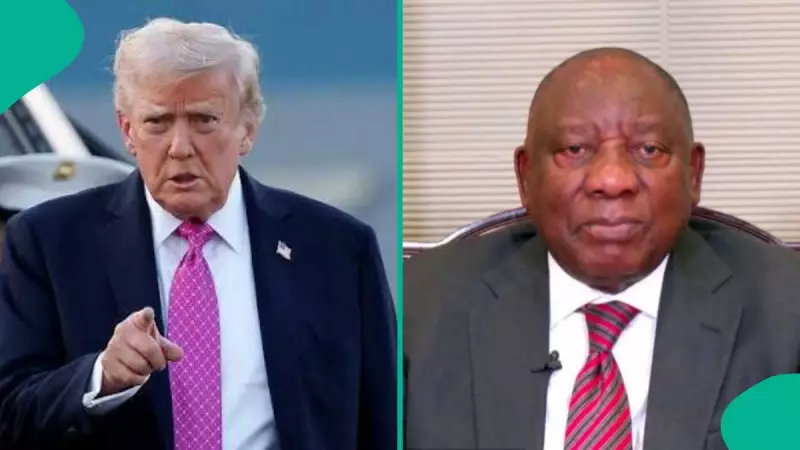
United States President Donald Trump has declared he will not attend the upcoming G20 summit in Johannesburg, while simultaneously questioning South Africa's right to membership in the prestigious international forum. The announcement, made during a conference in Miami, has escalated existing diplomatic tensions between the two nations.
South African officials have responded with confidence, dismissing the criticism and affirming their readiness to host what they describe as a "very successful" gathering of world leaders later this month.
Trump's Controversial Statements and South Africa's Response
Speaking at a Miami conference, President Trump made his position clear: "South Africa shouldn't even be in the Gs any more, because what's happened there is bad. I'm not going to represent our country there. It shouldn't be there."

The remarks reference Trump's repeated accusations that South Africa discriminates against its white minority population. Instead of attending the summit himself, the US President will send Vice-President JD Vance to represent American interests.
South African presidential spokesperson Vincent Magwenya addressed the situation in comments to the BBC, maintaining that the country remains confident it will host a successful G20 summit despite the American leader's absence and criticism.
Underlying Tensions in US-South Africa Relations
The diplomatic friction extends beyond Trump's recent comments. Earlier this year, the United States decided to prioritize refugee applications from white South African Afrikaners - descendants of Dutch and French settlers.
South Africa's government has strongly criticized this policy, stating that claims of "white genocide" lack credible evidence and have been widely discredited. Official crime statistics in South Africa do not indicate that white citizens face higher rates of violent crime than other racial groups.
The relationship further deteriorated when the US imposed 30% tariffs on South African exports in August, representing the highest rate applied to any country in sub-Saharan Africa.
Can a Country Be Removed from the G20?
Experts have clarified that the G20 operates as an informal forum without a legal charter or formal constitution. Dr Andrew Gawthorpe from the Foreign Policy Centre explained that removing a country would require consensus among member states.
"If a country was going to be kicked out, it would basically mean that it was excluded from the meetings - it wasn't invited to the meetings by whoever was hosting the G20 that year," Gawthorpe stated.
Chris Vandome, senior research fellow at Chatham House, noted that achieving such consensus appears unlikely. He revealed that other countries, including the European Union and China, have actually strengthened their support for South Africa in response to US actions.
Vandome also pointed out that the US has previously disrupted G20 proceedings, with several working groups and ministerial meetings failing to produce declarations due to American interference.
The precedent of Russia's continued G20 membership supports South Africa's position. While Russia was expelled from the G8 in 2014 after annexing Crimea, it remains part of the G20 despite calls for its removal following the 2022 invasion of Ukraine.
South Africa's G20 Vision and Historical Context
South Africa has chosen "solidarity, equality and sustainability" as the central theme for this year's summit. Foreign ministry spokesperson Chrispin Phiri emphasized that the country's unique history positions it to champion these values globally.
"Drawing on our own journey from racial and ethnic division to democracy, South Africa is uniquely positioned to champion within the G20 a future of genuine solidarity, where shared prosperity bridges deep inequalities," Phiri stated.
The spokesperson added that the country would emphasize collective action for sustainability that addresses the developmental impact of colonialism on the African continent.

Earlier attempts to ease tensions included President Cyril Ramaphosa's visit to the White House in May with a diverse delegation that included white coalition members and prominent golfers. However, Trump used the meeting to repeat widely discredited claims about white farmer persecution.
The land reform policy allowing expropriation without compensation in rare cases, signed by Ramaphosa earlier this year, prompted Trump to offer refugee status to Afrikaners. White citizens currently own most private farmland in South Africa while comprising just over 7% of the population.
As the G20 summit approaches, South Africa remains determined to focus on global cooperation and inclusive development, navigating diplomatic challenges with the resilience born from its complex history.