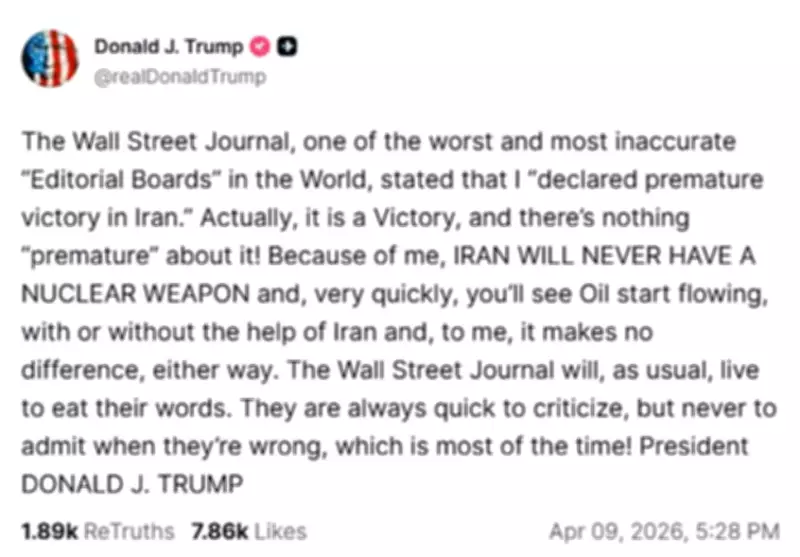
Trump Denies Premature Victory Claim, Blasts WSJ Over Iran Commentary
Former United States President Donald Trump has launched a scathing attack on The Wall Street Journal after the publication claimed he "declared premature victory in Iran." This controversy stems from an opinion piece by the WSJ's editorial board, which suggested that Tehran remains a persistent threat to the Strait of Hormuz and may continue to hold enriched uranium.
Trump's Forceful Rebuttal on Truth Social
In a series of posts on his Truth Social platform, Trump categorically rejected the newspaper's characterization. "The Wall Street Journal, one of the worst and most inaccurate 'Editorial Boards' in the World, stated that I 'declared premature victory in Iran.' Actually, it is a Victory, and there's nothing 'premature' about it!" he wrote emphatically.
He further elaborated on his administration's achievements, stating, "Because of me, IRAN WILL NEVER HAVE A NUCLEAR WEAPON and, very quickly, you'll see Oil start flowing, with or without the help of Iran and, to me, it makes no difference, either way." Trump concluded his criticism by predicting, "The Wall Street Journal will, as usual, live to eat their words. They are always quick to criticize, but never to admit when they're wrong, which is most of the time!"

Addressing Concerns Over the Strait of Hormuz
In a separate Truth Social post, Trump directly addressed one of the key concerns raised by the WSJ regarding Iran potentially imposing tolls on vessels navigating the Strait of Hormuz. "There are reports that Iran is charging fees to tankers going through the Hormuz Strait — They better not be and, if they are, they better stop now!" he warned.
He added a pointed critique of Iran's conduct, "Iran is doing a very poor job, dishonorable some would say, of allowing Oil to go through the Strait of Hormuz. That is not the agreement we have!"
The Wall Street Journal's Editorial Stance
The WSJ editorial board had articulated a firm position on the geopolitical implications. "Freedom of navigation has been a bedrock U.S. principle for centuries. China would be pleased if that principle were abandoned in case it has designs on the straits of Taiwan or Malacca. If Iran retains a veto over traffic in the Strait, that would count as a US defeat," they argued.
They also noted significant discrepancies between Trump's demands and Iran's proposed ten-point plan, which Trump has disputed. "The unfortunate truth is that Mr. Trump put himself in this position. His inconsistent rhetoric on the war—claims of victory amid threats of unleashing 'Hell' and an end to Iran's 'civilization'—raised global fears and undermined support at home and abroad," the editorial added.
The board highlighted an upcoming critical test, stating, "The next test for Mr. Trump will be whether he takes his two-week cease-fire deadline seriously. If he does, and Iran plays its usual games, then he really will have to 'finish the job.'"
Background on the Ceasefire Announcement
This exchange follows Trump's recent declaration on Tuesday that he had successfully negotiated a two-week ceasefire with Tehran, facilitated through discussions with Pakistan. The United States is scheduled to dispatch JD Vance and Special Envoy Steve Witkoff to Islamabad on Saturday to commence formal negotiations with Iranian leaders.