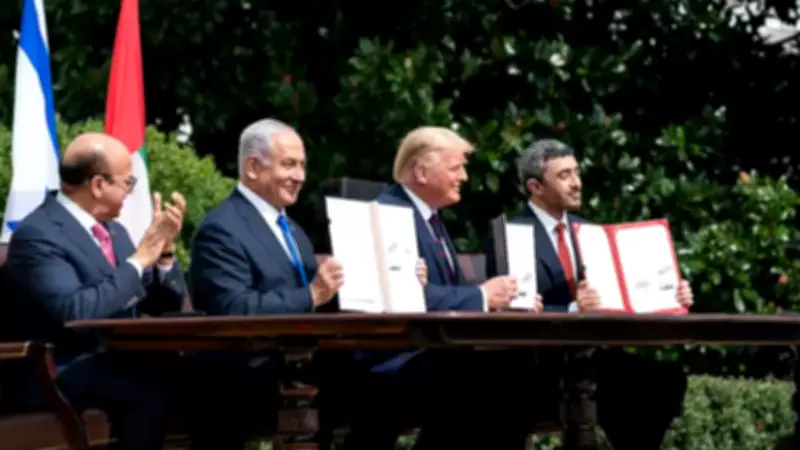
United States President Donald Trump stated on Monday, May 25, that he has requested Saudi Arabia, Qatar, Pakistan, Turkey, Egypt, and Jordan to collectively join the Abraham Accords, normalizing relations with Israel, as he seeks to finalize an agreement to end hostilities with Iran. Pakistan has already rejected the proposal. The other nations have not publicly responded to Trump's demand, and a positive reaction appears unlikely given the widespread public distrust of Israel in these Muslim-majority countries, exacerbated by the scale of Israel's military operations in Gaza.
Trump revealed that he spoke on Saturday with leaders of those countries, as well as with the United Arab Emirates and Bahrain, which have already signed the accords—a series of agreements normalizing ties with Israel. In a post on Truth Social, Trump wrote, "I am mandatorily requesting that all Countries immediately sign the Abraham Accords, and that, if Iran signs its Agreement with me, as President of the United States of America, it would be an Honor to have them also be part of this unparalleled World Coalition." He cited "all the work done by the United States to try and pull this very complex puzzle together."
According to a Pakistani source familiar with the matter, Trump's statement reflects an attempt to leverage Iran ceasefire diplomacy for a broader push on the Abraham Accords. However, the source emphasized that the two issues are "not interlinked and cannot be made so." The source added, "Pakistan is under no compulsion to adhere to any such demand." Israeli Prime Minister Benjamin Netanyahu's office did not immediately respond to a request for comment on Trump's post.

Trump noted that one or two of the countries he spoke with may have reasons for not joining, but most should be "ready, willing, and able to make this Settlement with Iran a far more Historic Event than it would, otherwise, be." For Saudi Arabia, the birthplace of Islam and custodian of the holy cities of Mecca and Medina, recognizing Israel would be more than a diplomatic milestone; it is a deeply sensitive national security issue tied to resolving one of the region's oldest and most intractable conflicts. The kingdom's longstanding position is that it will not sign the accords unless there is an agreement on a roadmap to Palestinian statehood. Egypt, Jordan, and Turkey already have diplomatic relations with Israel, though those ties have been strained since the start of the Gaza war.
Trump also said negotiations with Iran were "proceeding nicely," but gave no indication that a deal was imminent. Longtime Trump ally Senator Lindsey Graham embraced the idea of linking Iran to the Abraham Accords, suggesting it would lead to regional integration and create "a powerhouse for economic opportunity." Others view the strategy as a way to make an Iran deal more palatable to skeptics. Ali Vaez, Iran project director at the International Crisis Group, commented, "Trump is trying to sell an Iran deal as an Abraham Accords sequel: good for Israel, good for the region, tough enough for Washington. But he is trading one fantasy for another—from forcing Iran to surrender to pretending a fragile deal can anchor a new Middle East order."
Trump has repeatedly expressed his desire to expand the accords, which he brokered during his first term. The United Arab Emirates and Bahrain signed the accords in 2020, breaking a longstanding taboo to become the first Arab states to recognize Israel in a quarter century. Morocco and Sudan followed suit.