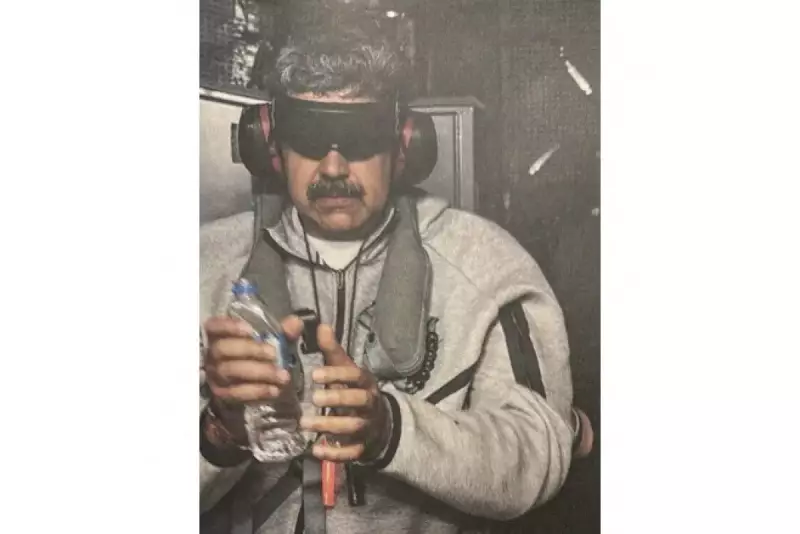
In a move that has sent shockwaves across the globe, United States President Donald Trump has publicly shared a photograph showing Venezuelan leader Nicolas Maduro in US custody. The image was posted on Saturday, 3rd January 2026, just hours after Washington confirmed his capture during a military operation inside Venezuela.
The Provocative Image and Trump's Announcement
President Trump took to his Truth Social platform to release the controversial picture. The accompanying caption simply read: “Nicolas Maduro on board the USS Iwo Jima.” The photograph depicted a dramatic scene: Maduro was shown blindfolded and handcuffed, wearing noise-cancelling earmuffs and a grey Nike tracksuit. This visual followed Trump's earlier announcement that US forces had successfully captured Maduro after conducting strikes on Caracas and other locations.
The US President stated clearly that the Venezuelan leader and his wife would be transported to New York to face federal charges. He described the entire military operation as unfolding “like a television show,” and firmly reiterated his intention to have Maduro prosecuted in an American court.

A Wave of International Condemnation
The release of the image amplified already mounting international concern, drawing strong reactions from both Washington's allies and adversaries. The Venezuelan government itself condemned the act as an “extremely serious military aggression” and declared a state of emergency in response.
Global powers were quick to voice their positions. Russia, a key ally of Caracas, demanded Washington “reconsider its position and release the legally elected president of the sovereign country and his wife.” China expressed being “deeply shocked” and strongly condemned the “US’s blatant use of force against a sovereign state.” Iran labelled the operation a “flagrant violation of national sovereignty and territorial integrity.”
In Latin America, the reaction was one of unified alarm. Mexican authorities warned the action “seriously jeopardises regional stability,” while Colombian President Gustavo Petro called it an “assault on the sovereignty of Latin America” that risked a humanitarian crisis. Brazilian President Luiz Inacio Lula da Silva termed the strikes a “serious affront” to Venezuela's sovereignty, and Cuba denounced what it called “state terrorism.”
European Division and UN Alarm
European nations largely expressed deep concern. Spain called for de-escalation and offered to mediate. France stated the operation undermined international law, arguing Venezuela's crisis couldn't be solved by external force. The EU urged restraint while repeating its stance that Maduro “lacks legitimacy.” UK Prime Minister Keir Starmer stressed his country was not involved and urged patience to “establish the facts.”
A notable exception was Italy, where Prime Minister Giorgia Meloni, a Trump ally, defended the US action as “legitimate and defensive.” At the United Nations, Secretary-General António Guterres said he was “deeply alarmed,” with his spokesman warning the operation could “constitute a dangerous precedent.”
The situation remains fluid and fast-moving, with governments worldwide closely monitoring developments following Maduro's reported transfer into US custody. The global community now watches to see how this unprecedented escalation in international relations will unfold.