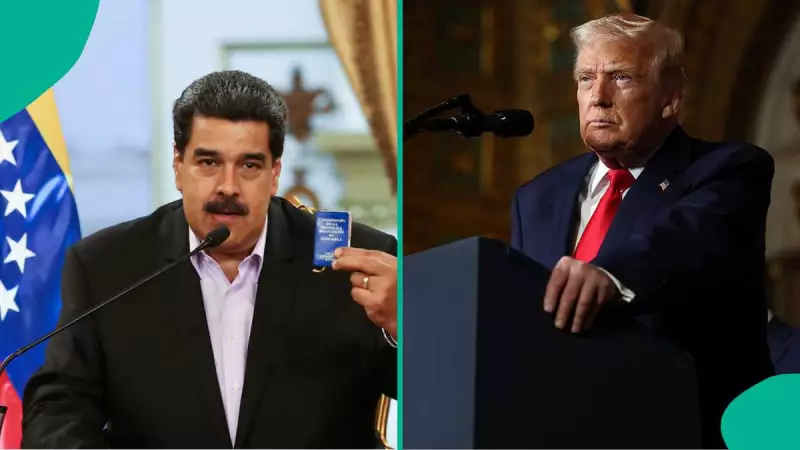
In a dramatic escalation of tensions in Latin America, United States President Donald Trump has issued a direct military threat to Colombia's leader, Gustavo Petro. This follows a stunning US military operation that resulted in the capture of Venezuelan President Nicolás Maduro.
US Forces Seize Maduro in Dawn Raid
The crisis began in the early hours of Saturday, January 3, 2026. American forces launched a large-scale military raid into Venezuela, involving what President Trump described as at least 150 aircraft. The operation, which he called "one of the most stunning displays of American military might since World War II," targeted locations across the country.
The raid culminated in the capture of Venezuelan President Nicolás Maduro and his wife. They were subsequently flown out of Venezuela and are now in the United States, where they face serious charges in a New York court. The charges include narco-terrorism conspiracy, cocaine importation conspiracy, and weapons offences.

Trump's Stark Warning to Colombia
Hours after the operation, President Trump turned his attention to neighboring Colombia. In a press conference held at his Mar-a-Lago resort, Trump issued a blunt warning to Colombian President Gustavo Petro.
"Well, he has cocaine mills, he has factories where he makes cocaine, and yeah, I think I stick by my first statement," Trump stated. He accused Petro's government of producing and sending cocaine into the United States, concluding with the threat: "so he does have to watch his a-ss." The US leader explicitly mentioned the possibility of a military invasion if Colombia did not comply.
Colombia's Defiant Response and Border Reinforcement
Colombian President Gustavo Petro responded swiftly and defiantly to both the invasion of Venezuela and the personal threat from Trump. In a statement posted on his X (formerly Twitter) page, Petro expressed "deep concern" over the reports of explosions and unusual aerial activity in Venezuela and the consequent escalation of regional tension.
Dismissing Trump's cocaine allegations, Petro stated he "is not worried about anything." He provocatively invited the American president to visit Colombia to see firsthand how his government destroys cocaine laboratories "one every 40 minutes, without missiles."
As a concrete security measure, the Colombian government announced plans to strengthen its 2,219-kilometre eastern border with Venezuela, signaling preparation for further instability.
Context of Trump's Previous Threats
This incident is not the first time President Trump has issued stark warnings to foreign nations. The news report recalls that on Christmas Day, he ordered airstrikes in Nigeria's Sokoto State following an agreement with the Nigerian Federal Government to target ISIS militants.
Furthermore, in October, Trump had designated Nigeria "a country of particular concern" over religious freedom issues. He had warned that if Nigeria failed to stop what he described as the killing of Christians, the U.S. would cut all aid and might intervene militarily, "'guns-a-blazing,' to completely wipe out the Islamic terrorists."
The capture of President Maduro and the subsequent threat to Colombia mark a significant and dangerous pivot in US foreign policy under Trump, raising profound questions about sovereignty, international law, and regional security in Latin America and beyond.