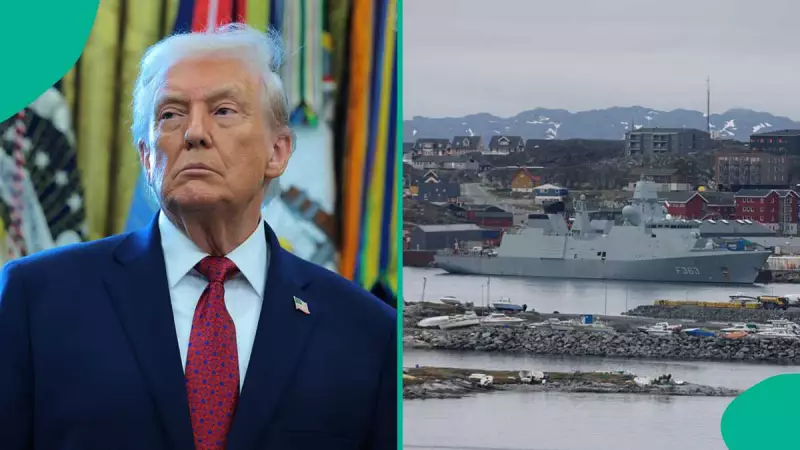
Former US President Donald Trump has once again stirred international controversy by publicly reviving his proposal for the United States to annex Greenland, the vast semi-autonomous territory of Denmark. The suggestion, framed around national security and untapped mineral wealth, has been met with swift and firm rejection from both Danish and Greenlandic leaders.
Denmark and Greenland Issue Swift Rejection
In response to Trump's remarks, Greenland's Prime Minister, Jens Frederik Nielsen, dismissed the idea outright, labelling it a "fantasy." He issued a clear statement demanding an end to the pressure. "That's enough now. No more pressure. No more insinuations. No more fantasies of annexation," Nielsen stated. He emphasised that while dialogue is welcome, it must occur through proper channels and with absolute respect for international law.
Echoing this stance, Denmark's Prime Minister, Mette Frederiksen, firmly asserted that the US has no right to claim any part of the Danish kingdom. She highlighted that Denmark, and by extension Greenland, is a protected member of the NATO alliance. Frederiksen also pointed out that an existing defence agreement already grants the US military strategic access to the island, making annexation unnecessary.

The diplomatic tension was further amplified by a social media post from Katie Miller, wife of Trump aide Stephen Miller, which featured an image of Greenland coloured in the American flag with the caption "SOON." The Danish ambassador to the US responded with a pointed "friendly reminder" about the allied relationship and the importance of territorial integrity.
Strategic Motives Behind the Proposal
Trump's renewed interest in Greenland is not new. He has consistently argued that control of the island is crucial for US national security due to its strategic location in the Arctic. Furthermore, he cites the territory's abundant reserves of rare earth minerals and other resources vital for modern technology and industry as a key incentive for acquisition.
This geopolitical move is seen by analysts as part of a broader pattern. The controversy erupted shortly after a major US military operation in Venezuela on Saturday, January 3, 2026, which resulted in the capture of President Nicolás Maduro. Trump's subsequent declaration that the US would "run" Venezuela and manage its oil resources has raised global concerns about Washington's willingness to use force to achieve its strategic goals.
These events have reignited fears that the Trump administration might consider similar aggressive tactics for Greenland, an option the former president has previously refused to rule out.
Greenland's Status and Public Opinion
Greenland, with a population of approximately 57,000 people, has enjoyed extensive self-rule since 1979, though Denmark retains control over foreign and defence policy. While there is significant local support for eventual full independence from Copenhagen, opinion polls consistently show strong opposition among Greenlanders to the idea of becoming part of the United States.
The Trump administration's decision to appoint a special envoy to Greenland, a move interpreted as bypassing the Danish government, had previously angered Copenhagen. The latest annexation comments have deepened the diplomatic rift, testing the resilience of the long-standing alliance between the US and Denmark at a time of heightened global uncertainty.