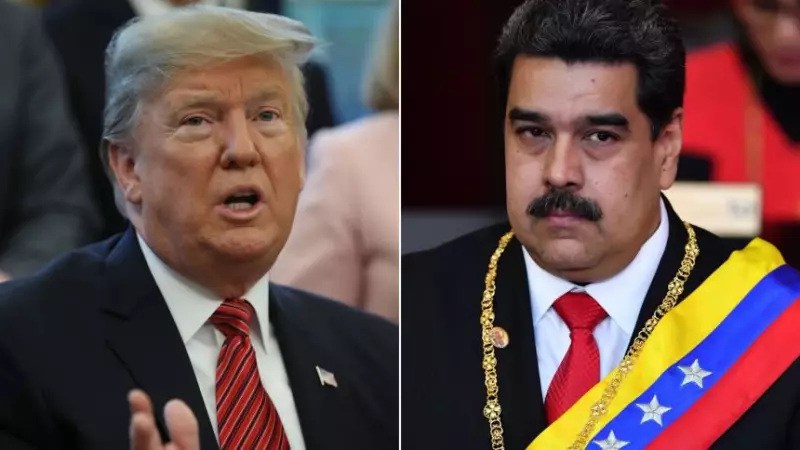
The recent military operation by the United States in Caracas, leading to the arrest of Venezuelan President Nicolás Maduro and his wife, Cilia Flores, has sent shockwaves through the international community. Nigerian legal and diplomatic experts are now raising urgent alarms, arguing that this event exposes the deep fragility of the rules-based world order and poses a direct threat to weaker nations, particularly in Africa.
Legal Experts Decry Blatant Violations of International Law
Leading the critique from a legal standpoint is Dr. Chinyere Rita Agu, Head of the International Law Unit at the Nigerian Institute of International Affairs (NIIA). She asserts that the U.S. actions constitute multiple breaches of established international law. The economic sanctions against Venezuela lack explicit authorisation from the UN Security Council, as mandated by Article 41 of the UN Charter, rendering them unlawful.
Dr. Agu emphasised that the arrest of a sitting head of state on foreign soil is a severe violation. President Maduro, under customary international law, enjoys absolute personal immunity (immunity ratione personae) from arrest by another state. His detention without Venezuela's consent breaches the principle of sovereign equality and contradicts rulings from the International Court of Justice.

Furthermore, she clarified that while the First Lady does not have absolute immunity, her arrest based on her official role is still an unlawful intervention. Dr. Agu also pointed to U.S. officials' statements about controlling Venezuela's political transition as clear evidence of interference, contravening Article 2(7) of the UN Charter. She warned that such military actions trigger obligations under international humanitarian law and could be classified as aggression under UN General Assembly Resolution 3314.
A Dangerous Precedent for Africa and the Global South
The Director-General of the NIIA, Professor Eghosa Osaghae, described the developments as deeply unsettling. He warned that events seemingly far from Africa have direct and troubling implications for the continent. Many are now questioning if this marks a return to a new phase of imperialism driven by raw power rather than international norms.
"From the perspective of the African Union and the Global South, this episode exposes serious lapses in the global order," Osaghae stated. "No state can now confidently assume immunity from similar actions." The gravity of the situation prompted the NIIA to convene a special roundtable, deeming silence an unacceptable option.
Writer and lawyer Mr. Femi Ojumu echoed this, arguing that U.S. actions reflect a pattern of exceptionalism that erodes sovereignty. He questioned the credibility of invoking self-defence and noted the absence of UN Security Council authorisation for any "Responsibility to Protect" claim. "If nuclear-armed states can violate sovereignty with impunity, what restrains others from doing the same?" Ojumu asked, warning of a cascade of instability, especially in vulnerable regions.
Historical Roots and Strategic Implications
Professor Femi Otubanjo, an International Relations scholar, traced the crisis to a long history of oil, ideology, and power asymmetry. He recalled that Venezuela's relationship with the U.S., once cordial but unequal, changed fundamentally with the election of Hugo Chávez in 1998. Chávez's socialist agenda, oil nationalisation, and alliances with China and Russia altered the dynamic.
Otubanjo identified Venezuela's oil trade with China and Iran outside the dollar system as a strategic threat to U.S. economic dominance. The operation on January 3, 2026, he argued, is the culmination of decades of this confrontation, with oil remaining central to the conflict.
On the economic front, Kayode Komolafe of ThisDay/Arise Media Group noted that while the immediate impact on global oil prices may be limited due to Venezuela's weakened production, medium-term effects could emerge if U.S. companies reinvest in the sector.

Former diplomat Ambassador Joe Keshi attributed Washington's boldness to the over-dependence of other nations on the U.S. He warned that unchecked, similar interventions could happen elsewhere. For Nigeria, he stressed that internal governance, resilience, and reduced dependency are critical safeguards.
The incident has drawn sharply divided reactions globally. While opposition figures hailed Maduro's arrest, his son warned that normalising the seizure of a head of state places all nations at risk. Cuba reported that 32 of its nationals were killed during the operation, a fact acknowledged by U.S. President Donald Trump.
As policy analyst Magnus Onyibe observed, this episode reflects the weakness of the United Nations and suggests a urgent need to rethink global governance. The standoff has intensified fundamental questions about whether international law can survive in a world increasingly defined by power politics over collective restraint.