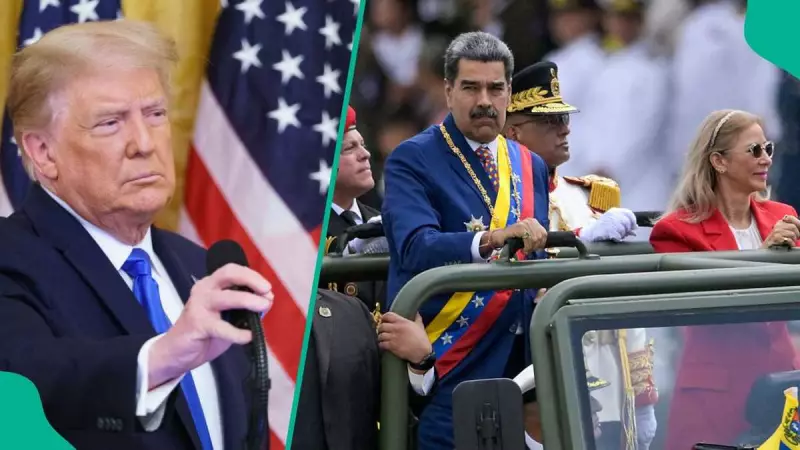
In a stunning and dramatic escalation of tensions, the United States has captured Venezuelan President Nicolás Maduro and his wife, removing them from the South American nation in a major military operation. The event, which unfolded in the early hours of Saturday, January 3, 2026, was confirmed by US President Donald Trump, marking a severe downturn in relations between the two countries.
Operation Details and Trump's Announcement
President Donald Trump announced the successful large-scale strike against Venezuela via a post on his Truth Social platform. He stated that Venezuelan President Nicolás Maduro and his wife had been captured and flown out of the country. While he noted that U.S. law enforcement was involved, specific agencies were not named in his initial statement.
A press conference was scheduled for 11 a.m. at Trump’s Mar-a-Lago resort in Florida, where further operational details were expected. Reports from CBS News indicated that the elite US Army Delta Force unit was responsible for the high-stakes mission. This same unit was famously involved in the 2019 raid that killed Islamic State leader Abu Bakr al-Baghdadi.

Venezuela's Response and National Emergency
The Venezuelan government's initial response was one of defiance and mobilization. While not formally confirming the capture of President Maduro, his official Facebook page released a video detailing attacks in the states of Miranda, Aragua, and La Guaira.
The statement from Caracas accused the United States of seeking to seize Venezuela’s vast oil and mineral resources and vowed resistance. It was announced that Maduro had declared a national emergency and mobilized all defence forces prior to his reported capture.
Social media was flooded with unverified images showing explosions in the capital, Caracas, around 2 a.m. local time (0600 GMT). Venezuelan Defence Minister, Vladimir Padrino López, called for national unity in a video address early Saturday.
He described the US action as "the worst aggression" ever faced by Venezuela and urged citizens to remain calm and cohesive. "They've attacked us but they will not subdue us. Let’s not succumb to the panic the enemy seeks to instil," Padrino López stated. He confirmed the deployment of all armed forces under Maduro's orders but did not address the president's reported capture directly.
Geopolitical Backdrop and Lasting Implications
This operation did not occur in a vacuum. Nicolás Maduro has long been a target of the US government, facing a 2020 indictment on charges of alleged narcoterrorism. President Trump had repeatedly threatened action, stating as recently as December 23, 2025, that it would be "smart" for Maduro to leave power.
The capture of a sitting head of state by US military forces on foreign soil represents an unprecedented and potentially explosive development in international relations. It is likely to trigger severe diplomatic repercussions, reshape geopolitical alliances in Latin America, and lead to significant instability within Venezuela itself.
The situation remains fluid, with the world awaiting further official details from the US administration and observing how the Venezuelan state apparatus responds in the absence of its captured leader.