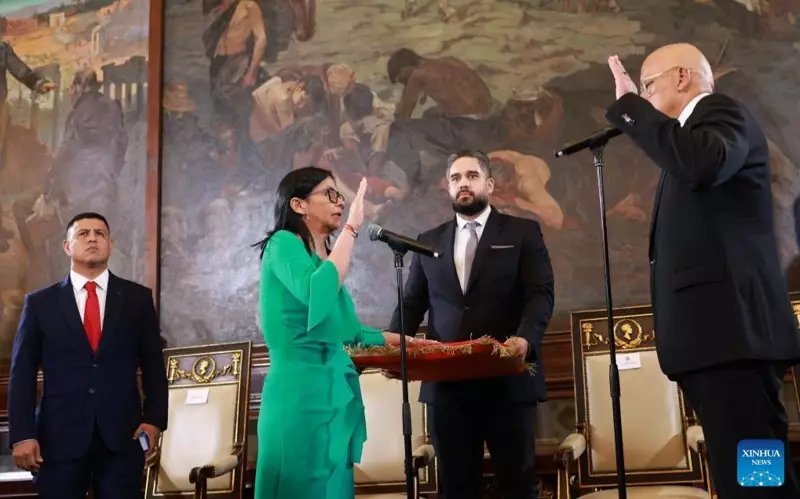
Venezuela has entered a new phase of political uncertainty following the dramatic capture of its former leader. Delcy Rodriguez was formally sworn in as the nation's interim president on Monday, January 5, 2026, just two days after a US military operation seized her predecessor, Nicolas Maduro.
A Swift Transition of Power
The ceremony took place in the National Assembly in Caracas, where Rodriguez, who served as Maduro's vice president, took the oath of office. The session was presided over by her brother, Jorge Rodriguez, who was re-elected as the head of parliament during the same gathering. Also present was Maduro's son, Nicolas Maduro Guerra, who offered his family's support to the new administration.
In her address to lawmakers, Rodriguez framed Maduro's capture as an illegal act. "I take this oath in the name of all Venezuelans. I am in pain over the kidnapping of our heroes, the hostages in the United States," she stated, referring to Maduro and his wife, Cilia Flores. Her brother, Jorge Rodriguez, vowed to use every available means to secure Maduro's return, calling him "my brother, my president."

Domestic Reaction and International Tensions
The parliamentary endorsement, however, was met with mixed reactions domestically. While the assembly, dominated by the ruling United Socialist Party of Venezuela (PSUV) and its allies, offered full backing, significant protests erupted outside. Thousands of demonstrators marched through the streets of Caracas, chanting in support of the captured former president.
One protester, Flur Alberto, 32, captured a common sentiment, telling AFP: "Regardless of whether Nicolas Maduro has something to answer for in court, this was not the way to do it." The political transition was further marred by security incidents, with witnesses reporting gunshots near the Miraflores presidential palace and drones spotted overhead, though officials later declared the situation under control.
International Fallout and Demands
The US operation, ordered by former President Donald Trump and involving airstrikes and naval support on Saturday, January 3, has sharply escalated tensions. Venezuelan lawmaker Fernando Soto Rojas condemned the raid, accusing Trump of acting as "the prosecutor, the judge, and the policeman of the world."
Despite the circumstances, the new leadership has signaled a conditional openness to dialogue. Maduro Guerra emphasized that Venezuela demands "respect" and international relations based on "equality" and "without interference." Interim President Rodriguez has indicated a willingness to cooperate with Washington, which has stated it will engage if Venezuelan leaders comply with US policy demands, particularly regarding oil access. Trump, however, has warned Rodriguez of consequences for non-compliance.
This swift change in leadership occurs in a Venezuela where the PSUV holds a strong parliamentary majority, controlling 256 out of 286 seats following elections in May of the previous year that were largely boycotted by the opposition. The Supreme Court had already authorized Rodriguez to assume the presidency in an acting capacity on Saturday, with the military pledging its support the following day, cementing her position for the immediate future.