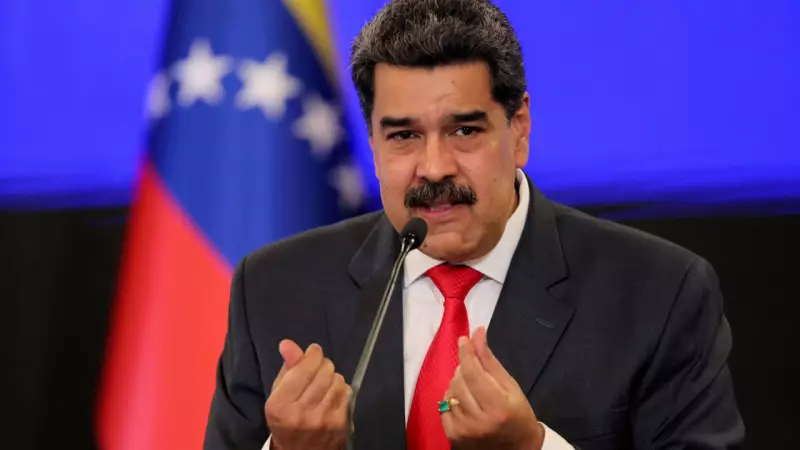
World leaders and international bodies are raising strong objections against the United States' recent military intervention in Venezuela, labeling it a blatant violation of international law and national sovereignty. The condemnation follows last Saturday's airstrike by the U.S. and the subsequent arrest of President Nicolas Maduro and his wife.
International Condemnation and Legal Breaches
Influential figures across the globe have taken to various platforms to denounce the action initiated under former U.S. President Donald Trump. Critics argue the move is undemocratic and contravenes established international laws protecting territorial integrity. The operation, conducted without Venezuela's consent or authorization from the United Nations Security Council (UNSC), is seen as unlawful.
Legal experts point to a specific breach of Article 2(4) of the UN Charter, which prohibits the use of force against a state's political independence. This principle of state sovereignty and non-intervention is a cornerstone of customary international law.

Global Reactions and Stances
The response has been swift and widespread. The European Union (EU), through European Commission Chief Ursula von der Leyen and European Council President Antonio Costa, called for respect for international law and a peaceful, democratic transition shaped by Venezuelans.
Russia demanded the U.S. reconsider its position and release the lawfully elected president and his wife. China firmly opposed both the military strikes and the capture, citing international law violations.
Regionally, Brazilian President Luiz Inacio Lula da Silva called the action a "serious affront" to sovereignty, a sentiment echoed by Mexico. He warned it threatened the region's status as a zone of peace and urged a vigorous UN response.
In a significant statement, the Economic Community of West African States (ECOWAS) expressed deep concern. While acknowledging states' rights to combat international crimes, it reminded the global community of the obligation to respect sovereignty and territorial integrity as per the UN Charter. ECOWAS aligned itself with an African Union call for restraint and inclusive dialogue in Venezuela.
Divergent Views and Underlying Motives
Not all reactions were uniform. Italian Prime Minister Giorgia Meloni defended the U.S. action as legitimate 'defence,' though she cautioned against using force for regime change. France's Foreign Affairs Minister, Jean-Noel Barrot, acknowledged Maduro's violations but stated the military operation contravened the non-use of force principle.
Many observers link Trump's actions to his statement on December 18, 2025, where he accused Venezuela of taking U.S. oil rights and vowed to reclaim them. This has led to perceptions of a "crude oil war."
Domestically, Venezuela's Supreme Court appointed Vice President Delcy Rodriguez as interim president, countering Trump's threat to oversee a transition. Rodriguez, sworn in on state television, insists Maduro remains the country's only legitimate president.
Nigerian Perspectives and Analysis
Within Nigeria, civil society and diplomatic voices have weighed in. Auwal Musa Rafsanjani of the Civil Society Legislative Advocacy Centre (CISLAC) questioned the legality of ousting a sitting president, even amid human rights concerns.
Former Nigerian ambassador to Mexico, Ogbole Amedu-Ode, provided a stark analysis, describing the U.S. action as classic "gunboat diplomacy"—foreign policy backed by military threat. "They went into a sovereign country, compromised its security and then grabbed the President and his wife... That is gunboat diplomacy," he stated. He clarified this was distinct from Nigeria's recent intervention in Benin Republic, which was at the sitting president's invitation.
As the situation develops, the international community, including Turkey and the United Kingdom, continues to call for restraint, dialogue, and unwavering adherence to the rules-based international order to prevent further regional and global instability.