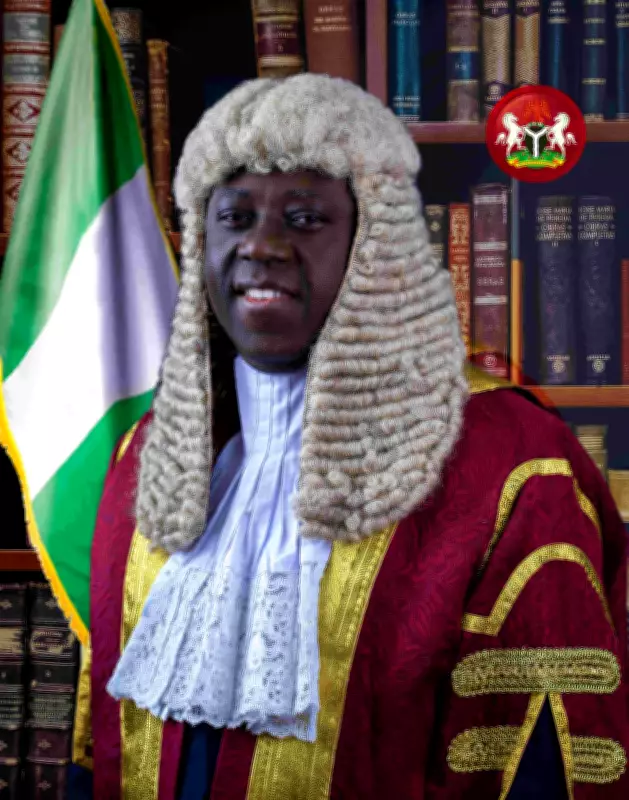
Supreme Court Restored to Full Strength as CJN Administers Oath to Justice Oyewole
The Chief Justice of Nigeria, Justice Kudirat Kekere-Ekun, officially swore in Justice Joseph Oyewole as a justice of the Supreme Court on Wednesday, February 25. This pivotal appointment restores the apex court to its full constitutional complement of 21 justices, as mandated under Section 230(2)(b) of the 1999 Constitution (as amended).
Ceremony Marks Institutional Milestone for Judicial Efficiency
The oath-taking ceremony, conducted at the Supreme Court in Abuja, saw the CJN administer both the Oath of Allegiance and the Judicial Oath to the newly appointed jurist. Justice Kekere-Ekun emphasized the significant institutional importance of this event, highlighting that a full court will now be better equipped to tackle the substantial backlog of cases awaiting judicial determination.
"This is no small milestone. A full court enhances our capacity to sit in robust panels, to manage our docket more efficiently, and to ensure that the business of the nation’s apex court proceeds with renewed vigour and dispatch," she stated. "It enriches intellectual diversity and reinforces the stability of our jurisprudence. For a court whose pronouncements shape the legal destiny of the nation, numerical completeness is structurally significant to the effective discharge of our constitutional mandate."

Supreme Court Role and Responsibilities Emphasized
Justice Kekere-Ekun further elaborated that appointment to the Supreme Court represents not merely the culmination of a distinguished legal career but "the acceptance of a sacred national responsibility." She underscored the court's critical position at the apex of Nigeria's judicial architecture, where its rulings settle controversies, shape jurisprudence development, and define constitutional governance contours.
"Its judgements do not speak only to the parties before it; they speak to generations yet unborn. The authority of this court rests not on force, but on the moral weight of its reasoning, the discipline of its processes, and the integrity of men and women privileged to serve on its bench," the CJN affirmed.
Justice Oyewole's Qualifications and CJN's Counsel
The Chief Justice described Justice Oyewole's elevation as a testament to his "disciplined scholarship, fidelity to the law, and distinguished service on the bench," noting that his record reflects intellectual depth, independence of thought, clarity of expression, and a clear appreciation of the relationship between enduring legal principles and evolving social realities.
She urged the new justice to remain courageous and principled in discharging his duties, including the willingness to dissent where necessary. "Where your Lordship’s considered conviction differs from that of your brother justices; Your Lordship must have the courage to dissent with courtesy and precision. A principled dissent, expressed with intellectual honesty, is not a fracture of unity; it is often the seed of future doctrinal growth," she advised.
Justice Kekere-Ekun also reminded him that the oath of office constitutes "a covenant, binding in conscience and in law," requiring moral courage, restraint, and steadfastness, particularly under intense public scrutiny. Prior to his Supreme Court elevation, Justice Oyewole served as the presiding justice of the Court of Appeal, Enugu Division, bringing extensive appellate experience to the nation's highest judicial body.