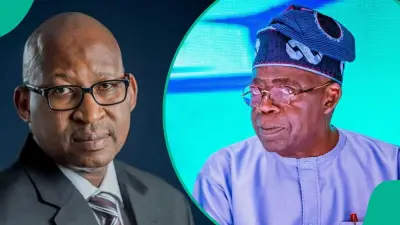
The African Democratic Congress (ADC) has issued a stark warning that Nigeria will face its most distrusted elections since the return of democracy if the Independent National Electoral Commission (INEC) Chairman, Professor Joash Amupitan, is allowed to conduct the 2027 general elections. The party stressed that the consequences would be dire.
ADC National Chairman, Senator David Mark, delivered the warning during the ongoing National Opposition Leaders Summit in Ibadan on Saturday. He emphasized that Nigerians have lost confidence in the electoral body, describing it as partial.
Mark cautioned: "Let me use this opportunity to emphasize once again that the credibility of our democracy rests on the neutrality and integrity of its electoral institutions. When the referee clearly and proudly wears the jersey of one of the teams in a match he should be officiating, then the legitimacy of the entire process is undermined. In this instance, Nigerians have lost confidence in the electoral body, INEC. INEC is no longer an impartial umpire."

He added: "And if nothing changes, Professor Joash Ojo Amupitan is about to preside over the most distrusted election in Nigerian history. The consequences are better left to imagination."
The former Senate President reminded opposition leaders that the gathering was an urgent response to the nation's call for patriotic duty. He stressed that history would remember each of them for answering when the nation cried out to be rescued, when mothers buried children killed by bandits, when fathers watched their daughters and wives raped by terrorists, when struggling workers could not afford transport, when children went to bed hungry, and when proud citizens were turned into beggars.
"History will ask, what did we do? What role did we play? All of us here and millions who are with us but for one reason or another are not here physically will answer positively," he said.
He asserted that the call to rescue Nigeria is not a mere opposition slogan, pointing to widespread insecurity. "Across the length and breadth of our country, insecurity has become a defining feature of daily life. From the avoidable protracted insurgency and terrorism, to the relentless banditry and mass kidnappings, to the steady rise of violent crimes in our urban centres, Nigeria faces a historic challenge."
Mark highlighted alarming statistics: "In 2025 alone, Nigeria recorded more than 12,000 conflict-related deaths. This figure exceeds those of countries who are actively at war, like Syria, Iraq, and Yemen, combined. Nigeria is now ranked 4th in the global terrorism index. Despite all the claims and posturing by government, the situation continues to get worse. While global terrorism deaths fell by 28% in 2025, Nigeria's increased by 46%. At least 15 Nigerians are killed daily, while about 19 people are abducted. In the first three months of this year alone, about 1,400 Nigerians have been killed or abducted in different parts of the country."
He lamented that entire communities are uprooted, families shattered, and livelihoods destroyed, with fear replacing freedom and uncertainty replacing hope. He accused the government of shocking indifference, prioritizing election matters and politics of self-succession over citizen protection.
Mark argued that the essence of democracy is to provide the people with a choice, but the ruling party has done everything to deny Nigerians that right. "In the last three years, this government has launched major attacks on the opposition parties, all in a bid to deny the people the right to choose. They want to foist a one-party state on Nigeria. Institutions that should safeguard our freedom and protect the will of the people are increasingly under assault. The right of citizens to freely choose their leaders is being undermined. The independence of democratic institutions is being compromised."
He reminded the gathering that their responsibility transcends partisan sentiment, personal interest, or ambition. "What is at stake—the very survival and restoration of our country—is greater than every single one of us. It involves sacrifice by every member in the opposition. I have no doubt in my mind that no single opposition political party, no matter how strong, can confront a system so entrenched and so determined to retain power at all costs."

Mark warned against a move towards a one-party state, which he described as real and unprecedented. He called for unity among opposition parties, emphasizing honesty, integrity, and trust. "We must put all our cards faced up on the table and speak truthfully to one another. There must be no hidden agendas, no last-minute surprises, and no room for distrust."
He concluded by stressing the urgency of the situation: "We are racing against time and operating within a limited window. The urgency of our situation does not permit repeated mistakes. We must be willing to rise above narrow sentiments and reject petty parochialism that has historically divided the oppositions in this country. This is the time to rewrite the story of coalition building in Nigeria."