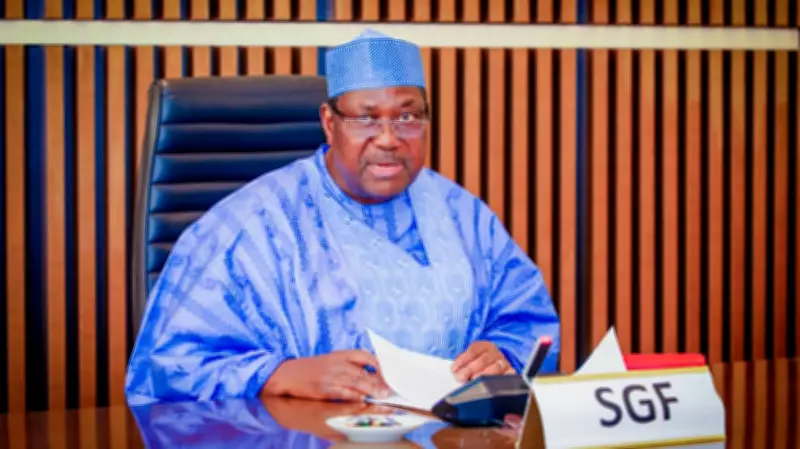
Days to the governorship primaries of the ruling All Progressives Congress (APC), the widening rift between Governor Hyacinth Alia and the Secretary to the Government of the Federation (SGF), George Akume, has heightened fears that the crisis could weaken the party’s hold on Benue State and open the door for the opposition in 2027.
The Battle for 2027 Governorship
The battle for the 2027 governorship election in Benue State is gradually evolving into a high-stakes political contest defined by defections, shifting alliances and an intense supremacy battle within the ruling APC. At the centre of the unfolding drama is the fractured relationship between Governor Hyacinth Alia and SGF Senator George Akume, an alliance that delivered a landslide victory for the ruling party in 2023 but later degenerated into one of the fiercest political feuds in Benue’s recent history.
The crisis has already triggered a wave of defections by key Akume loyalists to opposition parties, significantly reshaping the political landscape ahead of the 2027 polls. Although Akume recently moved to reconcile with Alia and publicly endorsed him as the APC’s preferred governorship candidate, many politicians within his camp appear reluctant to support the governor. Instead, several influential figures formerly associated with the Akume political structure have either rebelled within the APC or defected entirely to opposition parties such as the African Democratic Congress (ADC), Peoples Democratic Party (PDP), Labour Party (LP), Social Democratic Party (SDP) and Nigerian Democratic Congress (NDC).

The decision by Dr. Jeffrey Kuraun, a known political ally of Akume, to seek the APC governorship ticket has further fuelled indications that the political rapprochement between Akume and Alia remains unsettled. Kuraun’s emergence is being viewed in political circles as more than a routine governorship ambition. Analysts believe it reflects the continuing struggle for control of the APC structure in Benue State and suggests that influential blocs within the party are unwilling to concede the 2027 ticket to the incumbent governor without a contest. By stepping into the race on the APC platform, Kuraun has effectively reopened conversations about unresolved grievances between loyalists of Akume and supporters of Alia, despite repeated public assurances of reconciliation between both camps.
Kuraun recently unveiled an economic recovery and infrastructure development blueprint, promising fiscal discipline, efficient spending and greater accountability in governance. Observers interpret the position as an indirect critique of the current administration. The timing of Kuraun’s procurement of the APC’s N50 million expression of interest and nomination forms is significant, as it signals that Akume’s political network still retains ambitions to influence the succession debate within the ruling party. For Alia’s camp, Kuraun’s ambition represents an early test of its grip on the party structure and the governor’s ability to secure the loyalty of key stakeholders ahead of the APC primaries. For Akume’s camp, however, the emergence of a loyalist in the contest may serve as strategic leverage in ongoing negotiations over political control, appointments and the future direction of the party in Benue State.
Weakening of Akume Camp
Nevertheless, the defections of political heavyweights to opposition parties are steadily weakening the Akume camp, once regarded as the most formidable political structure in Benue State. Before the 2023 elections, Akume was widely seen as the undisputed leader of the APC in Benue. Having served as governor, senator, minister and now SGF, he built a powerful grassroots political network across the state. Akume’s political machinery played a decisive role in mobilising support for the Catholic priest-turned-politician, Alia, under the popular “Yes Father!” campaign slogan. The alliance proved effective as the APC swept the 2023 elections, winning the governorship, two senatorial seats, 10 House of Representatives seats and 26 of the 32 seats in the Benue State House of Assembly, effectively dismantling the then-ruling PDP.

However, tensions began shortly after Alia assumed office over appointments and control of party structures. Many Akume loyalists, who expected to dominate the new administration after investing heavily in the APC’s electoral victory, felt sidelined. The disagreement soon escalated into open confrontation over appointments, local party leadership, influence over the state legislature and the general direction of government. Governor Alia, however, appeared determined to establish an independent political structure rather than operate under entrenched APC power brokers. Eventually, the APC in Benue became sharply polarised into two rival camps, one loyal to Alia and the other aligned with Akume. Several political appointees, lawmakers and party officials openly took sides, while the crisis generated bitter public exchanges and legal battles that, at different times, threatened the cohesion of the ruling party.
While the internal crisis deepened, opposition parties quietly began capitalising on the divisions within the APC. The African Democratic Congress (ADC) appears to have emerged as the biggest beneficiary of the realignment. Led nationally by former Senate President David Mark, the party has attracted several influential politicians and grassroots mobilisers dissatisfied with developments within the APC. Former House of Representatives member, Herman Iorwase Hembe, and former Director-General of the Standards Organisation of Nigeria (SON), Dr. Paul Angya, are among the notable figures now associated with the ADC. Political observers believe the party is rapidly becoming a safe political destination for displaced APC and PDP stakeholders, as well as aggrieved Akume loyalists.
The PDP has also gained momentum from the APC crisis. The emergence of former Attorney-General of the Federation and Minister of Justice, Chief Mike Aondoakaa (SAN), as the party’s consensus governorship candidate has provided a rallying point for politicians seeking an alternative platform to challenge Governor Alia. Likewise, the Labour Party (LP) received a boost following the defection of Dr. Mathias Byuan, once considered part of the APC power bloc. Professor Terhemba Shija of the Nigerian Democratic Congress (NDC) is equally attracting attention among younger politicians and members of the Obidient Movement searching for alternative political platforms outside the APC and PDP.
The growing movement of Akume loyalists into opposition parties underscores the reality that the reconciliation between the governor and the SGF may not have fully healed the cracks within the APC. Before the recent truce, many governorship aspirants and party stakeholders aligned with Akume had hoped the SGF would support one of them against Alia. His eventual endorsement of the governor therefore came as a surprise to many within his political camp.
Alia’s Strategic Advantages
Yet, despite the defections and internal tensions within the APC, Alia appears to be entering the 2027 race with several strategic advantages. Perhaps his greatest strength remains his grassroots popularity. Unlike many traditional politicians, Alia entered politics with an already established public image as a Catholic priest and healing minister. Long before contesting for office, he enjoyed widespread admiration among ordinary people, particularly in rural communities. That goodwill has largely remained intact despite the elite political battles surrounding his administration.
Incumbency also gives him enormous leverage. As governor, Alia controls state structures, appointments, development projects and grassroots mobilisation networks that naturally strengthen his influence ahead of any election. The governor also appears to have consolidated control of the APC structure in the state, especially following Akume’s public endorsement of his second-term ambition. The endorsement significantly weakened anti-Alia forces within the party and forced many aggrieved politicians to either defect or quietly accept political reality.
Another factor working in Alia’s favour is the fragmentation of the opposition. While the ADC, PDP, SDP, LP and NDC all parade credible personalities, the opposition vote may ultimately be divided among several strong contenders. Besides, many of Alia’s supporters see him not as part of the traditional Benue political elite but as an outsider challenging entrenched political interests. That perception has helped him retain sympathy among ordinary voters even during his prolonged clashes with influential politicians within his party.
Still, the race remains fluid. Political alignments and realignments are ongoing, and more defections are expected as parties consolidate ahead of the primaries. The ADC continues to gain visibility as a rising opposition force under David Mark, while the PDP is banking on the political experience and grassroots reach of former governor Samuel Ortom. Unless the opposition succeeds in building a broad coalition against the APC, defeating an incumbent governor with an established political structure may prove difficult.
For now, however, Alia, who is also backed by one of his predecessors, Senator Gabriel Suswam, appears to hold the advantage. If the fragile reconciliation between him and Akume survives the coming months, and if the opposition remains divided, the task of unseating the priest-governor in 2027 may prove far more difficult than many of his opponents currently imagine.
Opposition Perspectives
Leading voices across the opposition spectrum, including the ADC, PDP, SDP and LP, argued that the APC’s stewardship at both the state and federal levels has weakened public confidence in the ruling party. The Chairman of the Benue State ADC Caucus and member of the party’s Transformation Committee, Senator Emmanuel Orker Jev, said the APC had inadvertently strengthened the opposition through what he described as poor governance and deep internal crisis. According to the immediate past senator representing Benue North-West Senatorial District, the ADC was conceived as a mass movement driven by a reform agenda aimed at addressing the economic hardship and social distress confronting Nigerians. He argued that the APC in Benue State was “its own worst enemy,” citing growing polarisation within the party and questioning its ability to effectively mobilise voters ahead of the elections.
Jev maintained that elections in Benue could not be won through intimidation or social media attacks, stressing that the ADC would instead focus on selling its manifesto directly to the electorate. “The governing APC both in Benue and at the federal level have made the work less difficult for us as we inch towards the general election. The ADC was modelled as a mass movement with a clear and unambiguous manifesto on reforming the lives of Nigerians traumatised by the collapsed economy and unbearable suffering under APC governments at different levels,” he said. He added that the ADC remained confident that the people of Benue would embrace the party as the alternative platform capable of addressing their aspirations.
On its part, the PDP insisted that despite setbacks suffered in recent elections, it remained the most established political platform in the country and retained deep roots across Benue State. A former PDP governorship aspirant, Bemgba Iortyom Esq, said the party’s longevity and contributions to Nigeria’s democratic development distinguished it from other political parties. Iortyom, who stepped down for Aondoakaa (SAN) following a consensus arrangement within the party, said the PDP was banking on voters’ memories of its years in government, particularly in the areas of security and governance. He argued that the economic hardship currently being experienced under the APC administration would ultimately influence voters’ choices in 2027. “The strength of the PDP is that it is the only organic political party in the Nigerian political space. The party has remained in existence since the return of democracy in 1999. It has survived for three decades and is responsible for much of the achievements of the present democratic setting,” he stated.
He further explained that the PDP had adopted a consensus-based approach in selecting candidates to minimise internal disputes and foster unity ahead of the polls. According to him, the strategy was already helping the party project a united front as preparations intensified for the elections.
The SDP is also seeking to expand its influence in the state following the recent defection of notable PDP figures into its fold. Justice Tsehemba, a former member of the PDP media team who recently defected to the SDP alongside the party’s governorship candidate, Sebastine Hon (SAN), said the party was already consulting extensively across the state despite still rebuilding its structures. He argued that strong grassroots engagement and credible candidates could outweigh the advantage of established party structures. Tsehemba expressed confidence that the SDP’s candidate possessed the credibility and public appeal necessary to challenge the dominant parties in the state. “We are consulting widely in the nooks and crannies of the state, meeting directly with the people and taking stock of their yearnings,” he said. “The fact that our party is only now rebuilding structures is immaterial. The people’s voice will ultimately matter most irrespective of party alphabets or godfatherism, and we will triumph.”
Similarly, the Benue State Chairman of the Labour Party, William Okefie, said the LP remained a strong political force in the state following its performance in the 2023 general election. Okefie claimed that the party emerged second in several contests during the last elections and currently boasts one of the largest bases of registered supporters in the state. He disclosed that the LP intended to field candidates for all elective positions in the state, insisting that the party’s grassroots mobilisation would translate into electoral victory. “The masses are with us. LP is on the ground in Benue State. Check the statistics, Labour Party came second in most elections in 2023 and even first in others. Currently, in terms of registration, no single political party has more registered voters than the Labour Party in Benue State. We are going to field candidates for all positions across the state and mobilise the people at the same time. Certainly, we are going to win,” he said.