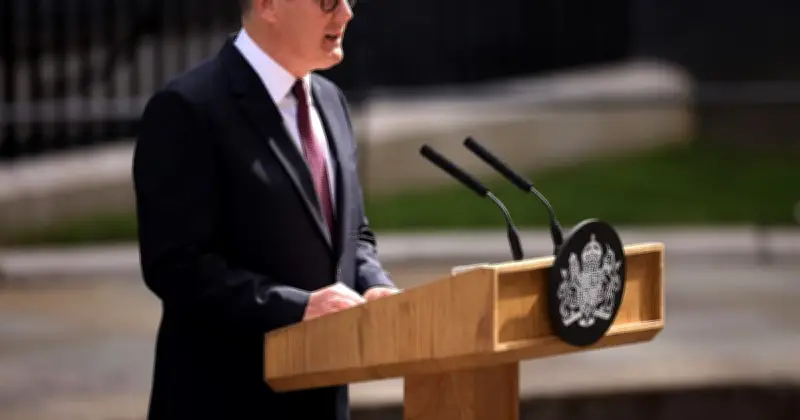
Keir Starmer has announced his resignation as UK prime minister and Labour Party leader after mounting pressure from within his party, triggering a leadership race to determine Britain's next leader. He will remain in office temporarily as caretaker prime minister until Labour chooses a successor.
Emotional farewell outside Downing Street
Speaking outside 10 Downing Street on June 22, 2026, an emotional Starmer acknowledged that many within his party no longer believed he was the right person to lead Labour into another election. "The question my party is asking now is whether I am best placed to lead us into the next general election," Starmer said. "I have heard the answer of my parliamentary party to that question, and I accept that answer with good grace."
Starmer's resignation follows growing dissatisfaction within Labour and the rise of Andy Burnham, who had planned to challenge him for the party leadership. Burnham, the former mayor of Greater Manchester and one of Labour's most popular figures, secured victory in a special parliamentary election last week, catalyzing the final push for a leadership change. He is expected to be sworn in as a Member of Parliament on Monday, further strengthening speculation that he could become Labour's next leader.

Landslide victory to rapid decline
The outgoing prime minister led Labour to a commanding victory in the July 2024 general election, ending years of Conservative rule. However, his government struggled to maintain momentum after entering office. Labour's popularity has steadily declined amid concerns over the economy, rising living costs, and the pace of improvements to public services. Critics within the party have argued that Starmer failed to deliver the economic growth and reforms voters expected after Labour's election win. His leadership also faced controversy over several political decisions, including the appointment of Peter Mandelson as the United Kingdom's ambassador to the United States.
Recent polling has shown Labour losing support on multiple fronts. The party has seen some progressive voters move towards the Green Party, while Reform UK, led by Nigel Farage, has continued to gain ground and frequently tops national opinion polls. Starmer becomes the sixth British prime minister in the past decade to leave office before completing a full term, highlighting the political instability that has characterised British politics since the Brexit referendum in 2016.
International reactions and domestic fallout
US President Donald Trump weighed in on the situation before Starmer formally announced his resignation, linking the British leader's departure to disagreements over immigration and energy policy. "Keir Starmer will resign as Prime Minister of The United Kingdom. He failed badly on two very important subjects- IMMIGRATION AND ENERGY (OPEN NORTH SEA OIL!). I wish him well! President DJT," Trump wrote on his social media platform. Relations between Starmer and Trump had initially been cordial but reportedly became strained in recent months over foreign policy issues, including the conflict involving Iran. Despite his domestic difficulties, Starmer received praise internationally for his support of Ukraine and efforts to strengthen European cooperation during major geopolitical crises.
While many Labour lawmakers have rallied behind Burnham, others believe Starmer has been treated unfairly. Labour MP Neil Coyle criticised the pressure campaign against the outgoing prime minister, warning that similar expectations could quickly turn against whoever succeeds him. "The prospect of an utter stitch-up & the media circus being rewarded," Coyle wrote on X. "When the next leader cannot change Trump, Iran, Ukraine, Putin, Musk, broadcast editorial & algorithm bias overnight they'll bay for his blood too. Better keep that guillotine sharp."
Leadership race ahead
Labour is expected to begin the process of selecting a new leader immediately, with Burnham and former Health Secretary Wes Streeting among the names being discussed as potential contenders. The leadership contest will determine not only the future direction of the Labour Party but also who becomes Britain's next prime minister. Starmer's resignation marks an abrupt end to a turbulent period in government less than two years after his landslide election victory.