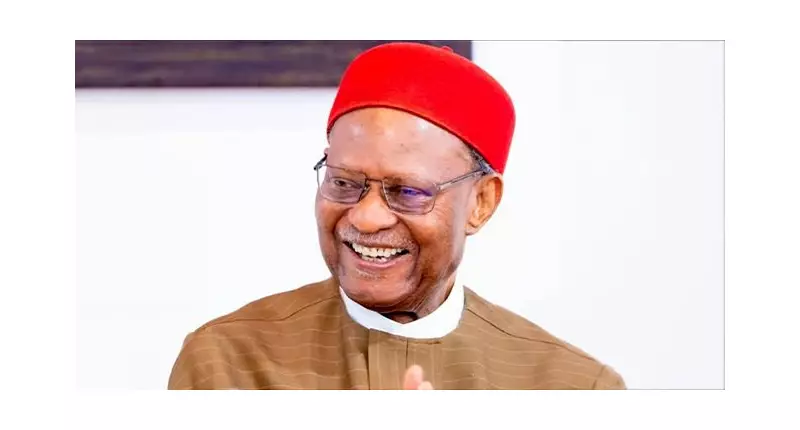
Former Commonwealth Secretary-General, Chief Emeka Anyaoku, has declared that the only viable path for Nigeria's stability and progress is the adoption of a new constitution that genuinely reflects the country's diverse nature.
A Call for Constitutional Overhaul
Anyaoku expressed this firm conviction while delivering a goodwill message at the official launch of a book titled 'The Gun Hegemony', authored by Ayo Opadokun. He stated that he has long been a strong advocate for a new, truly federal constitution for Nigeria.
He argued that Nigeria is a pluralistic nation, a characteristic it shares with several other countries worldwide. According to his analysis, pluralistic countries that have endured as unified political entities are those that practice authentic federalism. Conversely, those that have disintegrated failed because they refused to adopt a true federal republican constitution.

Learning from Global Examples
To support his argument, Anyaoku pointed to nations like India, Canada, and Switzerland. He noted that India's remarkable survival for approximately 5,000 years is largely attributed to its constitutional framework. Similarly, Canada's sustained unity over the years is fundamentally hinged on its constitution.
Reflecting on Nigeria's own history, Anyaoku recalled the progressive era before military rule. He described a time when the premiers of the four regions were actively developing their territories with locally generated revenue.
The Golden Era of Regional Development
He provided specific examples of this pre-military economic success:
- In the North: The Sardauna of Sokoto developed northern Nigeria using revenue from high-quality groundnuts, hides, and skins—products so esteemed they were marketed abroad as 'Moroccan leather'—along with tea from the Plateau.
- In the West: Chief Obafemi Awolowo funded an education revolution and pioneered television broadcasting in Africa, all with revenue from cocoa. At that time, Nigeria was the world's leading cocoa producer.
- In the East: Dr. Michael Okpara developed the eastern region with proceeds from palm produce, when Nigeria held the title of the world's largest producer.
- In the Midwest: Dennis Osadebe developed his region with rubber revenue. The quality was so superior it attracted major global tyre manufacturers like Dunlop and Michelin to establish operations in Nigeria.
Anyaoku lamented that this narrative of regional prosperity and development drastically changed following military intervention in the country's governance.
Reflections on 'The Gun Hegemony'
Earlier at the event, the Publisher of Vanguard Newspaper, Sam Amuka-Pemu, in his welcome address, described the launched book, 'The Gun Hegemony', as a documentation of a political journey witnessed by every Nigerian over 60 years of age.
"The Gun Hegemony is not just affecting our lives, but it is directing it. The Gun hegemony actually rules the world," Amuka-Pemu stated.
The book's author, Mr. Ayo Opadokun, in his remarks, posed critical questions about Nigeria's trajectory. He asked where and how the nation began to falter. He prompted reflection on what Nigeria's status might be today without the January 15, 1966 coup and the profound impact of prolonged military rule on the country's socio-economic landscape, social services, infrastructure, and public institutions like the police and the army itself.
The event underscored a growing consensus among elder statesmen and intellectuals that addressing Nigeria's foundational legal framework is imperative for its future unity and development.