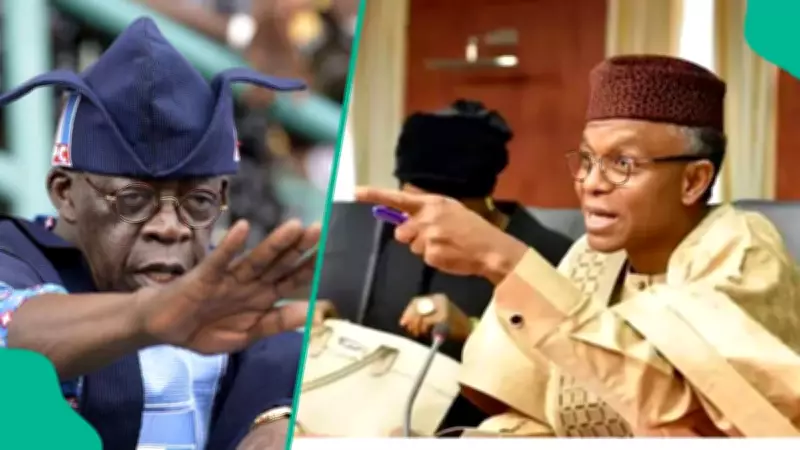
El-Rufai Exposes Core Reasons for Tinubu Fallout: Governance Principles at Heart of Dispute
In a revealing interview that has sent shockwaves through Nigeria's political landscape, former Kaduna State Governor Malam Nasir El-Rufai has finally detailed the actual reasons behind his much-discussed rift with President Bola Ahmed Tinubu. The former governor categorically stated that their disagreement stems from fundamentally different governance philosophies rather than any personal animosity.
"We Were Never Friends": El-Rufai Clarifies Relationship with Tinubu
Speaking candidly during an interview with Trust TV on Monday, February 9, El-Rufai made it clear that he and President Tinubu never shared a close personal bond. "I was never Tinubu's friend. We never had a personal relationship like the one I had with General Buhari of blessed memory," he declared emphatically.
The former governor explained that his initial support for Tinubu's presidential bid was purely political and strategic. "I was approached by certain Islamic stakeholders from the South-West to support the emergence of a South-West Muslim presidential candidate," El-Rufai revealed. "As governor of Kaduna and one of the founders of APC, I knew there was an understanding that after eight years of Buhari, power would return to the South. It wasn't about Tinubu; he was merely an accidental beneficiary."

Party Loyalty Over Personal Connection
El-Rufai emphasized that his support for Tinubu was based on party loyalty rather than any personal friendship. "It is a principle of mine to fight for the candidate of my party in every election, whether I like the candidate or not," he stated. "The fact that he emerged as the party's candidate meant I would give everything to ensure he won."
This clarification sheds new light on the political dynamics within the All Progressives Congress (APC) and highlights how party discipline often supersedes personal relationships in Nigerian politics.
Clash of Governance Philosophies
The crux of the disagreement, according to El-Rufai, lies in fundamentally different approaches to governance and public service. "We didn't fall out; we just didn't find areas of agreement," he explained. "I am in government to serve the public and deliver results, not to enrich myself or appoint cronies."
In a particularly pointed statement, El-Rufai contrasted his governance philosophy with what he perceives as the current administration's approach: "The philosophy of this government is contrary to everything I've been taught as a Muslim, a northerner, and a Nigerian. They came to govern the cake, to enrich themselves. We are different people, parallel lines that will never meet."
Ministerial Rejection on Principle
Perhaps the most significant revelation from the interview was El-Rufai's disclosure that he rejected a ministerial position offered by President Tinubu. "If I had accepted the ministerial position that was publicly offered to me, I would have resigned shortly after," he declared. "Our fundamental philosophies of governance are worlds apart."
This rejection underscores the depth of their philosophical differences and suggests that El-Rufai values principle over political position, even when it means turning down a potentially influential role in the federal government.
Political Implications and Future Ramifications
The interview provides crucial insights into the internal dynamics of Nigerian politics, particularly within the ruling APC. Key points that emerge include:

- Political alliances in Nigeria are often based on strategic calculations rather than personal friendships
- Governance philosophy represents a significant dividing line among political actors
- Party loyalty can coexist with fundamental disagreements on approach and methodology
- The rejection of high-level appointments can signal deeper ideological divides
El-Rufai's revelations come at a critical juncture in Nigerian politics, with the 2027 general elections already generating speculation and positioning. As a leading figure in the African Democratic Congress (ADC), El-Rufai's statements about his relationship with President Tinubu may have significant implications for future political alignments and opposition strategies.
The former governor's insistence on principle over personal connection, and his willingness to publicly articulate these differences, represents a notable development in Nigeria's political discourse, where such candid assessments of relationships between prominent figures are relatively rare.