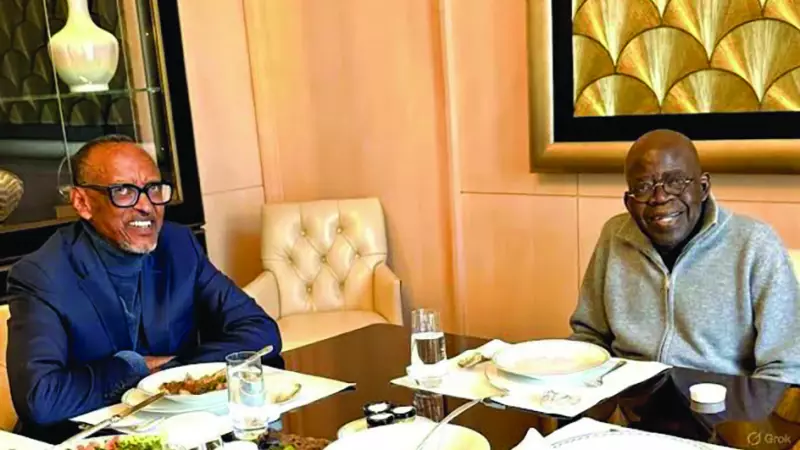
The Nigerian Presidency has issued a firm rebuttal against widespread claims that a photograph of President Bola Tinubu and his Rwandan counterpart, Paul Kagame, was artificially created. The image, taken during a private lunch in Paris, France, on January 4, 2026, became the subject of intense online debate, leading to official clarification.
Controversy Over a Watermark and Image Quality
The controversy erupted after an enhanced version of the photograph, originally shared on President Tinubu's verified X (formerly Twitter) account, circulated with a visible Grok watermark. This detail prompted a flurry of reactions on social media, with some users alleging the picture was entirely fake or generated by artificial intelligence (AI). The speculation persisted despite initial explanations, forcing the Presidency to address the matter directly.
Presidency's Detailed Clarification
In a statement released on Monday, January 5, 2026, the Presidency, through Temitope Ajayi, the Senior Special Assistant to the President on Media and Publicity, categorically denied the AI claims. The statement outlined the following key facts:

- The meeting between President Bola Tinubu and President Paul Kagame was a real, private diplomatic engagement in Paris.
- The leaders shared lunch as part of high-level consultations and later joined French President Emmanuel Macron for dinner the same evening.
- The original photograph was captured using a mobile phone, which resulted in suboptimal quality.
- To improve clarity for public viewing, the image was enhanced using a standard digital image-improvement tool.
The Presidency stressed that this post-capture enhancement is a common practice and does not equate to creating a fabricated or AI-generated image. "The picture is real. It was not generated by AI, as has been wrongly suggested," the statement affirmed.
Calls for Responsible Journalism and Public Communication
The Presidency expressed concern over what it termed "hasty conclusions and inaccurate reporting" surrounding the incident. Officials lamented that some commentators drew sweeping conclusions without making basic inquiries. The statement urged journalists and editors to prioritize verification and seek clarification before publishing claims that could mislead the public.
While reaffirming its commitment to transparency, the Presidency also acknowledged the calls from some Nigerians for clearer disclosure and greater caution in handling official photographs. The incident has highlighted the challenges of public communication in an era where digital tools are commonplace and misinformation spreads rapidly.
The statement concluded by emphasizing that enhancing an image's quality does not invalidate the authenticity of the diplomatic moment it captures, underscoring the substantive nature of the leaders' discussions in Paris.